GCSE Results 2026: What If My Child Didn't Get the Grades They Expected?
If your child's GCSE results are lower than expected, it can be hard to know what to do first. This guide walks through exactly what a disappointing result means for Maths, English, sixth form places, resits and reviews of marking, plus a 10-minute checklist to work through before you make any decisions.
Want to know exactly what to work on next? Book a free diagnostic assessment to find out →
This guide walks through what a disappointing GCSE result actually means and what to do about it: Maths and English below Grade 4, sixth form and college flexibility, reviews of marking, resits, and the alternative routes worth knowing about. Most situations lead to a small, manageable next step rather than a crisis. Short on time? Jump straight to the 10-minute checklist below.
If your child's GCSE results are lower than expected, it can be hard to know what to do first, especially with a sixth form offer, a college place or a resit decision all resting on the same slip of paper. This guide has been reviewed by Sterling Study's academic team, Dr Igors Pupko, who holds a PhD in Genetics from the University of Surrey, and Dr Parth Patel, who holds a PhD in Neuroscience from UCL, and is built to walk you through what to check today, what typically happens next for Maths, English and sixth form places, and which decisions can wait a day or two.
What Actually Counts as a Disappointing GCSE Result?
Before anything else, it helps to separate the grades that are genuinely a problem from the ones that only feel like one. A single grade that landed one below prediction in a subject your child is not continuing with is disappointing, but it is rarely a crisis. A Grade 3 in GCSE Maths or English, or several grades clustered well below target across the board, is a different situation, and one that does need a plan fairly quickly.
A useful first question is simply this: does this grade block anything your child actually needs? A weak result in an optional subject they are dropping anyway carries very little weight. A missed grade in Maths, English, or a subject that gates entry to a specific A-level or course is the one worth focusing your energy on first.
See Exactly Where Today's Results Actually Stand
Rather than relying on a gut read of the slip, it is worth running the real numbers before deciding what needs attention. Enter each of your child's grades below, along with targets if you have them, for an instant breakdown: how many subjects cleared Grade 4 and Grade 5, which ones fell short of target, and exactly where the profile needs a plan versus where a result looks worse than it actually is.
Important: This calculator is an educational interpretation tool. It does not issue or verify GCSE results and cannot tell you whether a sixth form or college offer has actually been met, only your child's exact written offer conditions can confirm that. There is no official "overall GCSE grade": sixth forms and colleges look at individual subject grades against their own entry conditions, which they set independently. If your child sat Combined Science, add each half of the double grade as its own row (for example "Combined Science 1" and "Combined Science 2") so the tool counts it correctly.
What Should We Do First?
Resist the urge to make any big decisions in the first hour. The single most useful thing you can do on results morning is work out which of three categories your situation falls into, because each one points to a different next step: a sixth form or college offer that has genuinely been missed, a Maths or English grade below the standard pass, or a result that is disappointing but does not actually block anything your child needs right now.
Once you know which category applies, the rest of this guide is organised so you can go straight to the relevant section rather than reading everything in order. If you would rather work through a simple list first, the checklist below covers the same ground in ten minutes.
A 10-Minute GCSE Results Day Checklist
Work through this list before deciding anything else. It takes about ten minutes and turns a stressful morning into a manageable set of facts.
- 1Write down every GCSE grade.
- 2Compare each result with the prediction or target grade.
- 3Highlight Maths and English specifically.
- 4Check the sixth form or college offer conditions in writing.
- 5Identify any grade sitting close to the next boundary.
- 6Contact the sixth form or college directly if an offer condition has been missed.
- 7Ask the school about review-of-marking options where relevant.
- 8Check resit eligibility for any subject below target.
- 9Look at alternative pathways if the original plan is no longer realistic.
- 10Avoid making any big decisions from panic. Sleep on anything irreversible.
Entry requirements vary between sixth forms, colleges, apprenticeships and individual courses, so always check the specific offer or course requirements rather than relying on a general rule.
Should We Be Worried About One Low Grade?
Generally, no, not on its own. Sixth forms and colleges look at a GCSE profile as a whole, and a single subject sitting below target rarely changes the overall picture, particularly if it is not one of the subjects the next course depends on. It is worth resisting the temptation to fixate on the one grade that stands out rather than looking at the full spread.
Where it is worth paying closer attention is when a low grade sits in a subject your child needs for progression, such as GCSE Maths for A-level Maths or Sciences, or when several grades together fall noticeably below the offer conditions. That is the pattern that genuinely warrants a conversation with the school or sixth form.
What Happens If Maths or English Falls Below Grade 4?
Grade 4 is generally regarded as the standard pass, and many post-16 providers, including sixth forms, colleges, apprenticeships and employers, use Grade 4 or above in Maths and English as an entry requirement. Requirements do vary by institution and course, so it is worth checking the specific offer rather than assuming the worst, but a Grade 3 or below in either subject is the outcome most likely to need a plan.
GCSE Maths and English have November resit opportunities for eligible candidates, with results normally issued in January, which means your child could be working towards a Grade 4 well before spring. Many sixth forms and colleges will allow a student to start their main course in September while resitting Maths or English alongside it, so a missed grade in either subject does not automatically mean a delayed start, though it is worth confirming this with the specific school or college.
If GCSE Maths or GCSE English is the subject in question, focused, exam-board-specific preparation over the autumn term tends to make the biggest difference, since a student sitting the paper for a second time already knows the format and usually just needs the specific gaps closing.
What Should We Do If My Child Has Missed Their Sixth Form Offer?
Contact the sixth form or college directly, ideally that same day, and bring your child's exact grades and the offer's written conditions with you rather than a vague sense of how close they came. Admissions teams deal with this constantly on results day, and specifics make the conversation faster and more productive than a general enquiry.
Ask directly whether there is any flexibility, whether a different course within the same school or college is a better fit, or whether the offer cannot be honoured this year. Getting a clear answer today, rather than assuming the worst, is usually the most useful thing you can do.
Can a Sixth Form Still Accept My Child If They Miss the Grades?
Sometimes. A one-grade miss may still leave room for discussion, particularly where the rest of the profile is strong, but the decision ultimately depends on the sixth form, college and course, so it is genuinely worth asking rather than assuming the answer either way.
If the original course is not available, ask specifically what alternatives exist within the same institution. A different subject combination, a Level 3 vocational route instead of A-levels, or a conditional place attached to a resit are all outcomes that come up regularly, and none of them close the door on a strong set of A-levels two years later.
Should We Request a GCSE Review of Marking?
A review of marking, sometimes called a remark, is worth considering when a grade sits unusually close to the next boundary, or looks out of step with a student's other results and mock performance. It is not a guarantee that the grade will increase: the outcome can be an increase, no change, or in rare cases a decrease, so it is not a decision to make automatically for every borderline result.
Three things are worth weighing before requesting one: how close the mark is to the next boundary, how much the subject actually matters for your child's next step, and the relevant exam board's deadline, which varies from board to board. Reviews are requested through the school or exam centre rather than directly by families, so the best first move is a conversation with the subject teacher, who will usually have a good sense of whether it is likely to be worthwhile.
Should My Child Resit a GCSE?
For Maths and English, see above, since those two subjects follow a distinct route. For every other GCSE, a resit is more of a judgement call: worthwhile if the subject is genuinely needed for a specific course or career path, less essential if it was an option your child is not continuing with anyway.
These other subjects are generally resat in the following summer examination series rather than in November, so the school or college can confirm eligibility and how the entry process works for the specific subject. Where a resit does make sense, most students find the second attempt considerably less daunting than the first, simply because the exam format and question style are already familiar; a focused plan for the specific topics that cost marks originally tends to matter more than repeating the entire course.
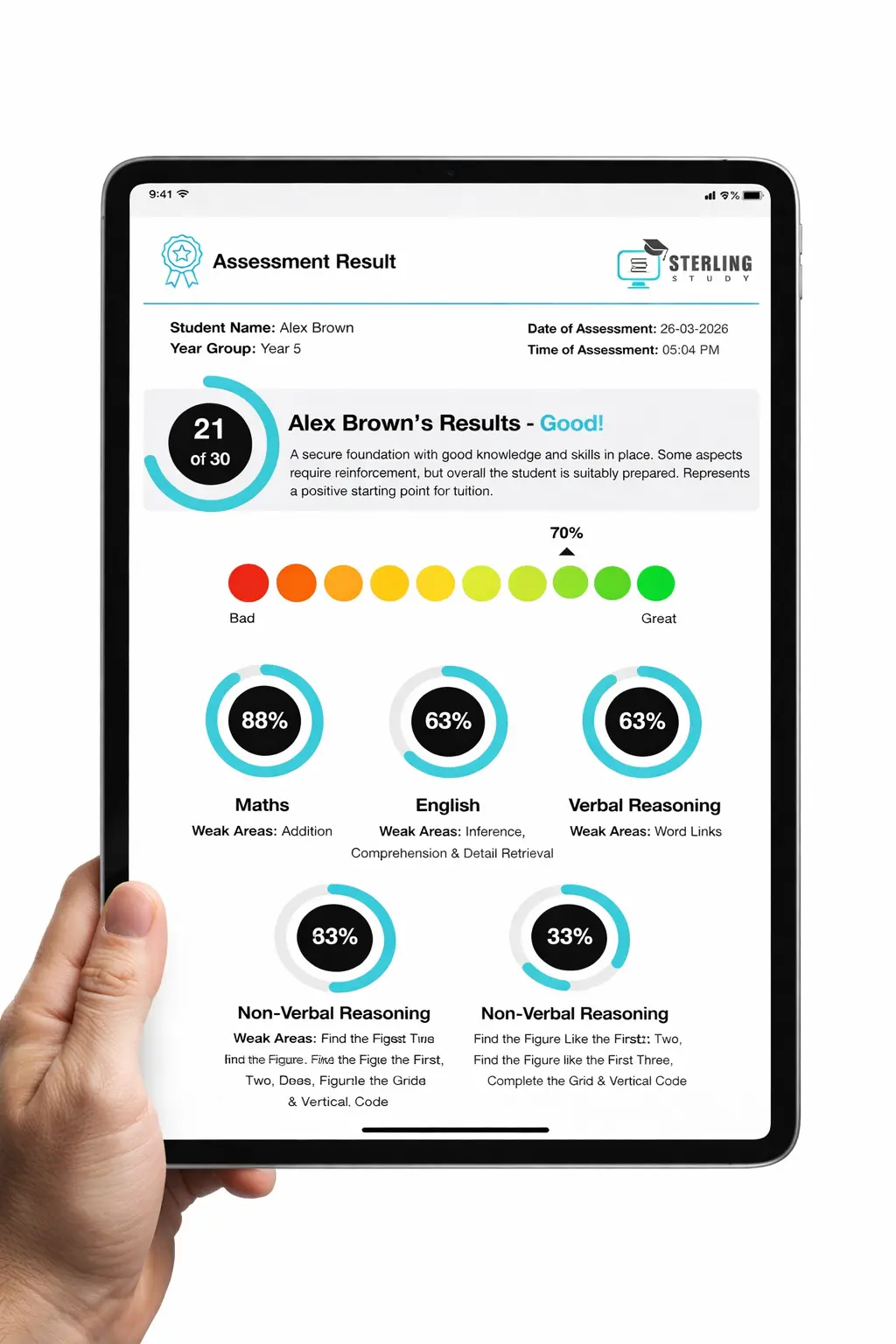
your child can
improve.
- ✓ Subject-by-subject breakdown, including Maths and English
- ✓ Clear read on how close they were to the next grade boundary
- ✓ Detailed PDF results sent immediately
- ✓ No strings attached
What If My Child Has Failed Several GCSEs?
A cluster of low grades understandably feels heavier than one, but the same principle applies: work out what is actually needed for the next step, and build the plan around that rather than trying to fix everything at once. Maths and English come first if either is below a 4, since so much else depends on them. After that, prioritise any subject that gates a specific course, and treat the rest as optional depending on your child's direction.
It is also worth having an honest conversation about whether the intended next step is still the right one, or whether a route such as a Level 2 vocational course, a different Level 3 pathway, college, an apprenticeship or another post-16 option might suit your child better than pushing through with the original plan regardless. Several low grades do not mean the options are closed, but the plan may need to look different from the one you started the summer with.
What Are the Alternatives to Sixth Form?
Sixth form and A-levels are not the only route forward, and for a good number of students they are not even the best one. Colleges, apprenticeships, T Levels and BTECs are all well-established alternatives, each suited to different strengths and goals rather than being a fallback for students who missed grades.
- ✓Colleges typically offer more flexible entry requirements than school sixth forms and a wider course range.
- ✓Apprenticeships combine paid work with study and are increasingly seen as a genuinely strong route, not a consolation prize.
- ✓T Levels give a more vocational, industry-linked alternative to A-levels in subjects like engineering, health and digital.
- ✓BTECs and other Level 3 vocational courses remain open to students whose GCSE profile does not fit A-levels exactly, without limiting future options.
Do Disappointing GCSE Results Affect University Later On?
Not automatically. Requirements vary by course and institution: A-levels or equivalent qualifications are usually the primary factor in admissions decisions, though some competitive courses may also consider GCSE results, particularly in Maths, English and subjects directly relevant to the course. Strong results at the next stage can still open a wide range of university options, so one disappointing GCSE result does not follow a student through their entire education in the way it can feel like it might right now.
How Should We Talk to Our Child About Disappointing Results?
However the morning has gone, the conversation that follows matters more than the grades themselves. It helps to let your child react first, without immediately jumping to fixes or comparisons with siblings, friends, or your own memories of results day. A results slip is not a verdict on ability or effort.
A set of exams sat over a few weeks in May and June is one data point, not a final judgement. Plenty of students who have a rocky GCSE results day go on to thrive at A-level, at university, and well beyond, once the immediate plan is in place. The plan matters far more than the disappointment.
What If the Results Are Better Than Expected?
If your child's grades came in above prediction, it is worth checking quickly whether that opens up a stronger sixth form, a different A-level combination, or a more competitive course than originally planned. Strong, unexpected results are worth acting on just as quickly as disappointing ones, since offer deadlines and course spaces move fast on results day.
What Should You Do Today?
Check the grades against the exact written requirements for the next step, contact the sixth form or college if an offer has been missed, flag any borderline grades, ask the school about review-of-marking options, and confirm resit arrangements where relevant. Once that is done, it is worth deciding separately whether your child needs additional academic support, rather than folding that decision into the panic of results morning.
Whoever you consider, it is worth asking directly about safeguarding rather than assuming it is covered. Every tutor at Sterling Study is DBS-checked, and our Safeguarding Officer, Company Director Ms Yesha Mukhtiar, holds overall responsibility for our safeguarding policy.