GCSE Results Day 2026: Date, Time, Grades, Resits & What to Do Next
GCSE Results Day 2026 is Thursday 20 August. Everything students and parents need: the exact timeline, what your grades mean, grade boundaries, reviews, resits and what to do next, sourced from JCQ and Ofqual, from Sterling Study's PhD-led tutors.
Not sure where things stand for September? Book a free diagnostic - our PhD-led team will find exactly what's holding your child back →
GCSE Results Day 2026 is Thursday 20 August 2026. Results may be released to candidates from 08:00, but your school decides exactly how and when you receive them, in person, by email or through a portal. Schools and colleges receive results under restricted release from 00:01 the day before, Wednesday 19 August, but students cannot access their own grades before the Thursday. If a grade is lower than expected, speak to your school the same day: options include a review of marking, a November resit for Maths or English, or an alternative sixth-form or college route, all covered in detail below.
Results Day has a way of making one envelope feel like it decides everything. It does not. What it does decide is which of several well-defined paths you take next, and every one of those paths has a clear process behind it. This guide has been checked against official JCQ, Ofqual, DfE and awarding-body guidance, and is updated as 2026 results-day information is confirmed. It was written by Dr Parth Patel (PhD Neuroscience, UCL), founder of Sterling Study, alongside co-founder Dr Igors Pupko (PhD Genetics, University of Surrey).
The short version: know your child's sixth-form offer in exact wording, plan to listen before problem-solving if grades disappoint, and know the 24 September review deadline. A fuller Parent's Guide to GCSE Results Day is further down this page.
When Is GCSE Results Day 2026?
GCSE Results Day 2026 is Thursday 20 August 2026. The date is set by the Joint Council for Qualifications (JCQ), which coordinates results across AQA, Pearson Edexcel, OCR, WJEC and CCEA, and it applies to every school and exam centre in England, Wales and Northern Ireland. There is no regional variation in the date, only in how grades are reported, covered later in this guide.
Can You Get GCSE Results Before 8am?
No. JCQ's official Notice to Centres for the release of June 2026 results states that GCSE grade boundaries and results must not be released to candidates until after 08:00 on results day, and centres must not despatch results to students by email, post or any other means before that time.
This is a genuinely useful distinction to hold onto: schools and colleges receive results under restricted release from 00:01 on the Wednesday, a full day earlier, purely so exams officers can prepare. That early access is for staff only and does not mean results leak out to students ahead of time, however connected a family might feel to someone in the school office. 08:00 on the Thursday is the earliest point any candidate can legally see their own grade.
What Time Do GCSE Results Come Out?
GCSE results may be released to candidates from 08:00 on Thursday 20 August 2026; awarding bodies cannot release results to candidates before that time. However, your school decides exactly how and when you receive your results within that, so the honest, useful answer is a combination of the official floor and your own school's process:
- ✓ Most schools open for in-person collection from 8am itself, though some open at 8:30 or 9am.
- ✓ Larger schools sometimes stagger collection by year group, tutor group or surname.
- ✓ Some schools email results or publish them to a portal from 8am, alongside in-person collection.
- ✓ Where a school has signed up to the government's Education Record app, a digital copy appears separately, from 11am, three hours after the 8am floor.
If you haven't been told a time, check the letter or email your school sent in July, or its website. Treat any specific hour quoted online, beyond the official 8am floor, as an estimate rather than a guarantee.
How Do You Get Your GCSE Results?
There is no single universal GCSE results website where any student can enter their details and retrieve their grades. Access depends entirely on your own school's arrangements, roughly in this order of how common each route is:
- Your school's own collection process, in person. The most common route by far: a printed statement of results, with staff on hand to talk through next steps.
- Email or a school-specific portal. Some schools send results electronically or publish them to a parent/student login on the morning itself.
- An authorised representative. A parent, guardian or named person can usually collect on your behalf, typically with a signed authorisation letter and photo ID.
- The government's Education Record app, where applicable. If your school has opted in, a digital copy appears from 11am as a lasting record, useful later for sixth form, college or job applications, but this supplements rather than replaces your school's own process.
Can you get GCSE results online?
Only through whichever of the routes above your specific school offers; there's no separate online-only option beyond what's listed. If you'll be away on results day, contact your school before the summer holidays begin. Postal delivery is sometimes offered but can arrive later in the day or the day after, so build that into your plans if it applies to you.
What if my result in the Education Record app doesn't match my school's slip?
The DfE's own guidance is direct on this: the app is not intended to replace your school's results slip, results can take time to appear or may show as incomplete, and if there's ever a difference between the two, you should treat your school's results slip as the correct evidence, not the app. If a qualification appears in your app that shouldn't be there, contact your school rather than the app itself.
What if you're abroad, on holiday, or your school is closed?
Contact your school well before the summer holidays begin, not on the morning itself. Most schools can arrange for someone to collect on your behalf, or to send results by post or email, but you need to have agreed this in advance; exams offices are not always staffed every day over the summer, so don't assume a same-day email will reach anyone on results day itself if you haven't set the arrangement up beforehand.
| Missing grade | Speak to your exams officer |
| Grade looks wrong | Exams officer or subject teacher |
| Missed a sixth-form requirement | Contact the provider immediately, same day |
| Below Grade 4 in Maths or English | Ask about the November resit |
| Considering a review | Check access to scripts, get teacher advice, note the 24 September deadline |
| Can't attend in person | Contact your school before results day, not on the day |
| Sixth form not answering the phone | Try email in parallel, then try again later the same day |
What to Do Before GCSE Results Day 2026
A little preparation in the days beforehand removes most of the avoidable stress on the morning itself.
Know your child's offer requirements and have the provider's admissions number ready. Don't compare siblings or friends' results. Let your child process the result first before jumping to a fix, and don't push for a remark before checking the script or a teacher's view. A fuller parent's guide, covering the whole day and what comes after, is further down this page.
What Happens on GCSE Results Day?
- ✓ Photo ID, if your school requires it
- ✓ Your sixth-form or college offer, with the exact grades required
- ✓ Contact details for that provider
- ✓ A charged phone
- ✓ A parent or guardian's contact number
- ✓ A pen and notebook for anything you need to write down
- ✓ Your exams officer's contact details
Don't worry if you're unsure what to do once you arrive; schools normally have staff on hand to help.
What happens at 8am?
Before opening your results, find the arrangement that suits you: some students want to open the envelope surrounded by friends, others prefer a quiet corner first. There's no right way to do it. Once you have your slip, check every subject, not just the ones you're most focused on.
Immediately afterwards, check your grades against your sixth-form or college's exact requirements. If something looks wrong or unexpectedly low, speak to a teacher or exams officer before you leave the building; it's far easier to query while staff and grade boundary information are still on hand. If a place is genuinely affected, contact the provider directly the same day.
The day before: restricted release
From 00:01 on Wednesday 19 August, exam boards release results electronically to schools, colleges and exam centres. This is for exams officers and senior staff only, so they can prepare grade boundary information and support before students arrive the next morning.
The following days and weeks
Access to scripts and review of marking requests can be submitted from results day itself through to 24 September 2026. If a November resit is needed, registration typically opens in early September with an entry deadline in early October, so this is not a decision to leave until the last minute.
How to Read Your GCSE Results Slip
Your results slip shows a grade for each subject sat, alongside the exam board and specification code for that subject, and sometimes component-level detail depending on the school. This is a provisional statement of results, not your formal certificate.
Is a results slip the same as a certificate?
No. The slip you collect on results day is provisional. Your formal certificate, the permanent record of the qualification, is issued separately and usually arrives at school several months later. If a certificate is later lost, your exam board can issue a replacement, typically for a small administrative fee.
Your First 60 Minutes: A Results-Day Decision Guide
Whatever the slip says, the first hour matters more than it might feel like at the time.
- Read the whole slip before reacting to any single grade. One low result next to several strong ones tells a different story than a slip that's uniformly below expectations.
- Check what your sixth form, college or apprenticeship actually needs, in the exact wording used in your offer, not from memory.
- If everything is on track, confirm your place the same day where possible, and note any enrolment dates.
- If a result is short of what you need, speak to a teacher on-site before leaving. They have grade boundary context that becomes harder to access once the building empties.
- If a place is genuinely at risk, contact the provider directly the same day. A short, plain message stating your grades and asking what they need from you tends to achieve more than waiting until you have a fully worked-out plan.
| If this is your situation... | ...do this |
|---|---|
| Met your offer | Confirm your place |
| Missed by one grade | Contact the provider immediately, same day |
| A result is missing or unusual | Speak to your exams officer before leaving |
| You think a mark is wrong | Consider access to scripts, then a review of marking |
| Below Grade 4 in Maths or English | Ask about the November resit |
| Don't want your original sixth form anymore | Contact alternative providers directly |
GCSE Grades 9 to 1 Explained
GCSEs in England are graded on a 9 to 1 scale, with 9 the highest and 1 the lowest, phased in between 2017 and 2020 to replace the old A* to G letters. Ofqual only officially confirms three exact anchor points between the two scales: Grade 7 aligns with the old grade A, Grade 4 with the old grade C, and Grade 1 with the old grade G. Every other number sits between these anchors and is a broad approximation.
| Grade | Broadly equivalent to | What it signals |
|---|---|---|
| 9 | Above old A* | The highest grade available. Among 16-year-olds' entries in England in summer 2025, 5.2% were graded 9. |
| 8 | High A / low A* | Excellent performance, comfortably strong for competitive sixth form entry to most subjects, including Science. |
| 7 | A (Ofqual's official anchor point) | A strong, reliable result. In summer 2025, around 23% of GCSE entries from 16-year-olds in England reached grade 7 or above. |
| 6 | High B | A solid grade, generally sufficient for most A-level entry requirements in that subject. |
| 5 | Low B / high C | Known as a "strong pass". Many sixth forms and colleges set this as their effective minimum in English and Maths. |
| 4 | C (Ofqual's official anchor point) | The official "standard pass". In summer 2025, roughly 70% of GCSE entries from 16-year-olds in England reached a 4 or above. |
| 3, 2, 1 | D, E/F, G | Below a standard pass. For English and Maths specifically, this typically means continued study, most often through a resit. |
| U | Ungraded | The minimum standard required for a numbered grade was not met. |
What is a pass at GCSE?
Grade 4 is the standard pass, the government's official benchmark, broadly equivalent to the old grade C. Grade 5 is the strong pass, sitting above it. Whether a provider asks for a 4 or a 5 depends entirely on the institution and course, and English and Maths carry additional post-16 study rules if a 4 isn't achieved, covered later in this guide.
Is Grade 5 a good GCSE grade? Yes, it's above the standard pass and is what many sixth forms and colleges actually require in English and Maths, even though 4 is the official minimum. Is Grade 6 good? Yes, generally sufficient for most A-level entry requirements. Is Grade 7 good? Yes, it's Ofqual's anchor point for the old grade A and a common minimum for selective sixth forms setting entry requirements for A-level sciences.
GCSE Grade Boundaries 2026: What They Are and How to Check Them
A grade boundary is the minimum number of raw marks needed to achieve a particular grade. These are not fixed figures decided in advance. Each exam board sets its boundaries after every series, once marking is complete, based on the difficulty of that year's papers and how the national cohort performed, a process known as comparable outcomes, designed to keep standards consistent from one year to the next.
When are GCSE grade boundaries released?
Boundaries are confirmed only after marking and awarding, and published alongside results, usually from results day itself.
Are boundaries the same for every exam board?
No. Boundaries differ by exam board, subject and specification, so a Grade 6 in one board's Maths paper can need a different raw mark to a Grade 6 in another board's paper.
Can grade boundaries change, and can I calculate my grade from raw marks myself?
Boundaries are set fresh each series and can move up or down year to year depending on paper difficulty and cohort performance, so treat any predicted or historical boundary figures you see online as context, not a reliable prediction. Once your board's official boundaries are published, you can compare them against a raw mark from access to scripts, but not before.
What if I'm one or two marks away from the next grade?
This is exactly the situation where access to scripts and a review of marking are worth understanding properly, covered in detail in the next section. Being close to a boundary is one of the stronger reasons to consider a review; being comfortably clear of one is a reason to think carefully before requesting it.
| Exam board | Where to check official boundaries |
|---|---|
| AQA | aqa.org.uk, results and statistics section |
| Pearson Edexcel | qualifications.pearson.com, results information |
| OCR | ocr.org.uk, results and grade boundaries |
| WJEC / Eduqas | wjec.co.uk / eduqas.co.uk, results section |
| CCEA | ccea.org.uk, results and grade boundaries |
Your school or exam centre is always the primary route for your actual results; these board websites are useful afterwards, for checking published boundaries or starting a post-results request, not for looking up your own grade directly. Boundaries also aren't necessarily the same for higher and foundation tier papers, or between different subjects on the same board, so compare like for like rather than assuming one figure applies everywhere. A raw mark is the number of marks scored on a paper; where a subject has multiple components, these are combined (sometimes weighted) into a total, which the boundary then converts into a grade. You won't be able to work out your own boundary position without the official published figures.
GCSE Results Day 2026: England, Wales, Northern Ireland and Scotland
The date, Thursday 20 August, is the same across England, Wales and Northern Ireland. What genuinely differs is how the grade itself is reported.
| Nation | GCSE grading | Regulator |
|---|---|---|
| England | 9 to 1 (AQA, Pearson Edexcel, OCR, Eduqas) | Ofqual |
| Wales | A* to G for Welsh-domiciled WJEC/CBAC GCSEs | Qualifications Wales |
| Northern Ireland | A* to G plus an additional C* grade for CCEA GCSEs; some subjects also offer 9 to 1 | CCEA |
In Wales, WJEC's Welsh-domiciled GCSEs are regulated by Qualifications Wales and kept the letter scale. This is distinct from Eduqas, WJEC's brand for GCSEs taken in England, which is regulated by Ofqual and uses the same 9 to 1 scale as AQA, Edexcel and OCR.
In Northern Ireland, CCEA GCSEs use A* to G with an extra grade, C*, sitting between B and C and broadly treated as equivalent to a Grade 5 in the English system. A plain C aligns more closely with a Grade 4. A small number of CCEA subjects also offer a 9 to 1 numerical option.
What about Scotland?
Scotland does not use GCSEs. Scottish pupils take National 5, Higher and Advanced Higher qualifications instead, released by Qualifications Scotland (the body that replaced the SQA), on a completely separate results timetable outside the JCQ system that governs England, Wales and Northern Ireland. Scottish results day 2026 falls earlier, on Tuesday 4 August. If you're searching for "UK GCSE results day" while based in Scotland, check Qualifications Scotland directly rather than this guide.
What If You Don't Get the Grades You Need?
If results haven't gone to plan, there are several established options, and it's more common than it feels on the day. Work through your actual situation below.
| Your situation | What to do |
|---|---|
| You missed by one grade | Contact the provider the same day; many will still consider a place where the rest of the profile is strong. |
| You missed by two or more grades | Ask about an alternative course or subject combination, or a different provider entirely. |
| Your chosen A-level subject needs a higher grade | Ask the sixth form whether a different subject combination is possible with your actual results. |
| Your sixth form says no | Contact another sixth form or college directly; places are most available in the days immediately after results day. |
| The course you wanted is full | Ask about waiting lists or a related course at the same provider. |
| You missed Grade 4 in English or Maths | Ask your school about the November resit window; results release in mid-January 2027. |
| One result looks unexpectedly low | Speak to your subject teacher, then consider access to scripts and a review of marking before 24 September. |
| You are considering an apprenticeship instead | Entry requirements are set by the individual employer and sector, not a national standard; check directly. |
A handful of exams sat across a few weeks in May and June do not capture everything a student is capable of. Many students who resit perform noticeably better the second time, largely because they already understand a paper's format and know precisely which topics need work. Don't make a major decision in the first five minutes; talking a result through with someone you trust before deciding on next steps tends to help more than reacting immediately.
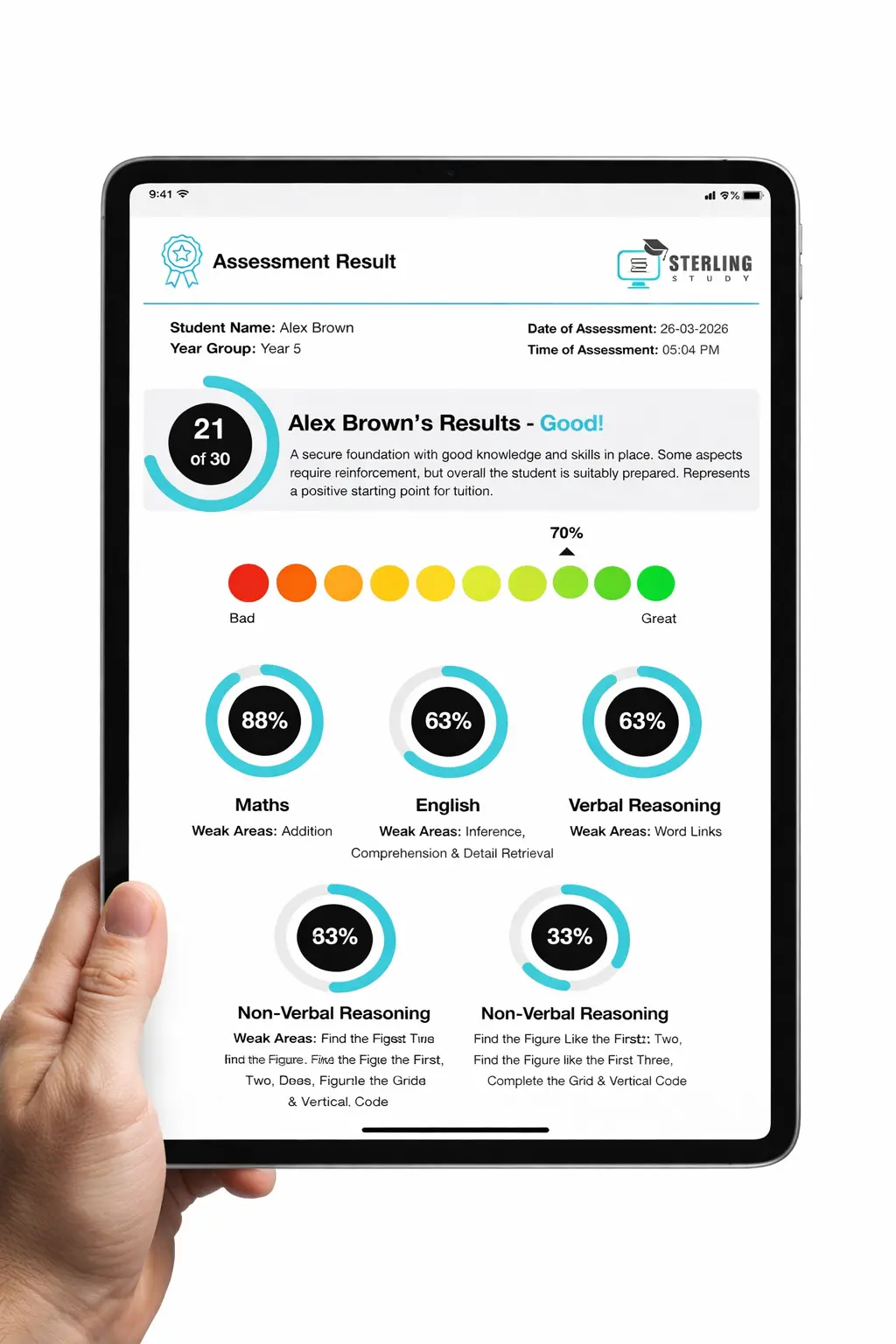
We'll find the gap
behind it.
- ✓ Subject-by-subject breakdown across Maths, English and Science
- ✓ A clear picture of what a resit or A-level jump will actually require
- ✓ Detailed PDF results sent immediately
- ✓ No strings attached
What If Your Results Are Better Than Expected?
This deserves attention too, since results-day advice tends to focus heavily on disappointment. If your grades beat expectations, it's worth pausing before making changes rather than rushing a decision on the day itself.
- ✓ Check whether a more academically demanding subject combination is now realistic, and whether your sixth form or college would support a change.
- ✓ If you're considering a different, more competitive sixth form, contact them directly; strong unexpected results can sometimes open doors that weren't part of the original plan.
- ✓ Re-check the entry requirements for anything you're now considering, rather than assuming stronger grades automatically qualify you.
- ✓ Take a moment to actually celebrate before making any changes; a good result doesn't need to be immediately optimised.
GCSE Remark 2026: Reviews of Marking, Access to Scripts & Appeals Explained
Most people search for this using the word "remark," but the official JCQ service is generally called a review of marking. Students don't appeal directly to an exam board; requests go through your school, and the process is more specific than the word "appeal" suggests. JCQ's post-results services guidance defines several distinct services, escalating in this order if concerns remain unresolved:
Result → Access to Scripts → Review of Marking → Outcome → Appeal (via your centre) → Ofqual's Exam Procedures Review Service, where applicable
| Service | What it checks | Can the grade go down? |
|---|---|---|
| Clerical re-check | That every page was marked and every mark was added up correctly. | No |
| Access to scripts | An electronic copy of the marked paper, useful for deciding whether to pursue a review, or for teaching purposes. | Not applicable; this is a copy request, not a mark review. |
| Review of marking ("remark") | Whether the agreed mark scheme was applied correctly and consistently to the answers given. | Yes, technically; in practice this is rare (see below). |
| Review of moderation | Whether coursework or non-exam assessment was moderated fairly against the criteria, reviewed at cohort level. | Yes, in principle. |
| Appeal | A formal challenge, submitted by your centre, if concerns remain after a review outcome. | Handled case by case under Ofqual's appeals framework. |
Should you get a GCSE remark?
This is worth a level-headed look at the actual numbers rather than a reflex reaction. According to Ofqual's official statistics for the summer 2025 series, 17.0% of GCSE students had at least one grade challenged, and 5.2% had a grade changed as a result. Of grades that were challenged, 24.1% were changed upward, while fewer than 0.1% were changed downward.
A simple three-step process to decide:
- Step 1: check how many marks you were from the next boundary. A near-miss is a stronger case than a result well clear of, or well below, the boundary either way.
- Step 2: ask your subject teacher to look at the script. Access to scripts gives them something concrete to assess, rather than a gut feeling.
- Step 3: weigh the potential benefit against the risk and cost. Given the statistics above, a review is far more likely to raise a grade than lower it, but "far more likely" isn't "certain."
Consider a review if: you're close to a grade boundary, your teacher believes the result is unexpectedly low against your other work, or access to scripts shows something that looks inconsistent with the mark scheme.
Think carefully if: you're already comfortably above the grade you need, there's little concrete evidence of a marking issue, or a lower grade (however unlikely) would meaningfully affect your next step.
Can a GCSE remark lower your grade? How much does it cost? How long does it take?
A review of marking can technically raise, lower or leave a grade unchanged, which is why written candidate consent is required before your school submits one, though a downward change is rare in practice (see the statistics above). Fees are set by each exam board and are often refunded if the review results in a higher grade; ask your exams officer for your specific board's current pricing. Per JCQ's common timescales: a clerical re-check (Service 1) must be completed within 10 calendar days of the request being received, and a review of marking (Service 2) within 20 calendar days.
Key deadlines and rules
- ✓ Requests must be submitted through your school or college; students and parents cannot apply directly to an exam board.
- ✓ Written candidate consent is required for a review of marking and for access to scripts, but not for a review of moderation.
- ✓Requests can be submitted from results day itself, and the deadline for standard reviews of marking and access to scripts is 24 September 2026.
What happens if the review doesn't change my grade, and can I appeal after that?
If a review confirms the original mark, the grade stands. If you still have genuine concerns about how the review itself was conducted, rather than the original marking, your centre can submit a formal appeal on your behalf. In rare cases with unresolved procedural concerns, Ofqual's Exam Procedures Review Service (EPRS) sits above that as a final route, though the large majority of results-day concerns are fully resolved at the review-of-marking stage.
Results Day terminology explained
| Restricted release | Results sent to schools/colleges from 00:01 the day before students see them. |
| Statement of results | The provisional slip you collect on results day; not your formal certificate. |
| Comparable outcomes | The method used to set grade boundaries so standards stay consistent year to year. |
| Candidate consent | Your written agreement, required before a school can request a review of marking or access to scripts. |
GCSE Resits 2026: When Can You Retake Maths, English and Other GCSEs?
Resits are a normal, well-used part of the system, not a last resort, and a resit grade carries exactly the same regulatory standing as a first attempt. There is no limit on how many times a student can retake a GCSE.
Can you resit GCSE Maths and GCSE English Language in November 2026?
Students who are 16 or over by 31 August 2026 and did not achieve a Grade 4 or above in GCSE English Language or GCSE Maths can resit these two subjects specifically in the November window. This sitting is restricted to English Language and Maths only; GCSE English Literature is not part of the November series, and no other GCSE subject is available at that time. Entry is arranged through a school, college or an approved private exam centre, with an entry deadline typically in early October. Results from the November window are expected in mid-January 2027.
Can you resit other GCSE subjects?
Yes, but not in November. Any GCSE subject other than English Language and Maths is resat the following summer alongside the next cohort, with results on the national Results Day in August 2027.
| Situation | When can you resit? | Subject | Results |
|---|---|---|---|
| Below Grade 4 Maths | November 2026 | Maths | January 2027 |
| Below Grade 4 English Language | November 2026 | English Language | January 2027 |
| English Literature | Summer 2027 only | English Literature | August 2027 |
| Any other GCSE subject | Summer 2027 | Relevant GCSE | August 2027 |
Should you resit?
There isn't a single right answer; it depends on how close the grade was to the requirement you need, how much preparation time realistically exists, and what your current sixth form, college or apprenticeship plans allow for. A resit tends to work best when a student already understands the paper's format and knows specifically which topics cost them marks. This is a decision worth making with a teacher rather than alone.
What happens if you fail Maths or English?
Most sixth forms, colleges and apprenticeship providers require continued study toward Grade 4 in English and Maths where it was not achieved at GCSE, most commonly through the November resit, as part of the national requirement to continue in education or training until 18. Many providers build this into a student's first-term timetable alongside their main courses.
What Happens If You Miss Your Sixth-Form or College Offer?
Speed matters more than having a fully worked-out plan. Contact the provider on results day itself, state your grades plainly, and ask what they need from you. A simple message is often enough to open the conversation:
"Hello, I received my GCSE results today and narrowly missed the [subject] requirement by one grade. My other results meet the entry requirements. Could you please let me know whether my place can still be considered, or what alternative options might be available?"
- ✓ Ask whether an alternative subject combination or course level at the same provider is an option.
- ✓ Contact a different sixth form or college directly; places are most likely to still be available in the days immediately following results day.
- ✓ Consider a T Level or another vocational route, which some providers accept with a broader grade profile than traditional A-levels.
- ✓ Ask about apprenticeships, where entry requirements are set by the individual employer and sector rather than a national standard.
- ✓ If English or Maths is the specific issue, ask whether the provider can offer conditional entry alongside a November resit.
What Can You Do After GCSEs?
| Route | Who it may suit |
|---|---|
| Sixth form A-Levels | Students planning on academic, university-focused subjects |
| College (academic or vocational) | Students wanting a wider mix of course types in one place |
| T Levels | Students wanting a technical, industry-linked pathway |
| Apprenticeship | Students who want to earn while training with an employer |
| Resit | Students who need to improve a specific required grade first |
In England, students are generally required to continue in education or training in some form until 18, whether that's full-time study, an apprenticeship, or part-time education alongside employment, with specific rules and exceptions depending on individual circumstances. For students moving into A-Levels, the jump in pace and independent study expected from week one is the single biggest step change in secondary education, and Russell Group universities, including Oxbridge, often look at GCSE results alongside A-level grades when assessing competitive applications later on.
A Parent's Guide to GCSE Results Day
Parents play a genuinely important role on results day, and the most useful one is usually as a calm, steady presence rather than an active problem-solver in the first hour.
- ✓ Before the day: know the sixth-form/college offer details and have the provider's contact number ready, so you're not searching for it under pressure.
- ✓ Confirm in advance whether you're able to collect results on your child's behalf if needed, and what your school requires for that.
- ✓ If grades are disappointing, listen first. Resist the urge to problem-solve in the first five minutes; a calmer conversation an hour later usually leads to better decisions.
- ✓ Ask your child what they need from you rather than assuming; some want to make calls themselves, others want a parent to lead.
- ✓ Know the 24 September review-of-marking deadline, so it doesn't get missed in the noise of the following weeks.
- ✓ If outside support such as tutoring becomes part of the conversation, it's usually most useful once there's a clear picture of what's actually needed, whether that's resit preparation or bridging into A-levels, rather than as an immediate reaction on the day itself.
Feeling Nervous About GCSE Results Day?
This is worth naming plainly: a lot of students feel genuinely anxious in the days before results day, and that's a normal reaction to something that feels high-stakes, not a sign anything is wrong.
- ✓ Don't compare yourself to friends' results, on the day or online. Everyone's starting point and target grades are different.
- ✓ A predicted grade is exactly that, a prediction. It isn't your actual result, and plenty of students end up above or below it.
- ✓ Open your results wherever actually feels comfortable for you, not wherever you think you're supposed to.
- ✓ Talk to someone you trust, before or immediately after, rather than sitting with the anxiety alone.
- ✓ One set of grades doesn't determine your future. It determines which of several genuinely workable paths you take next.
GCSE Results Day 2026: Common Myths
| Myth | Reality |
|---|---|
| Everyone gets results at exactly 8am | 08:00 is the earliest permitted candidate release time; your school's own process determines exactly when and how you receive results within that. |
| A Grade 5 is the only GCSE pass | Grade 4 is the official standard pass; Grade 5 is a strong pass some providers additionally require. |
| A remark always improves your grade | A review can raise, lower or leave a grade unchanged, though downward changes are rare in practice. |
| You can enter your details on one national website for GCSE results | Access arrangements depend entirely on your own school or centre; there's no universal lookup. |
| Missing one GCSE means you can't go to college | Different routes and provider-specific requirements almost always leave a realistic path forward. |
What You Should NOT Do on Results Day
- ✓ Don't panic over one grade before reading the rest of the slip.
- ✓ Don't request a review of marking before checking access to scripts or a teacher's honest view.
- ✓ Don't assume a Grade 5 is required everywhere; check the specific provider's published wording.
- ✓ Don't assume a sixth-form place is automatically lost because one requirement was missed; ask first.
- ✓ Don't rely on unofficial or predicted grade boundaries found online.
- ✓ Don't wait weeks before contacting a provider if a place is genuinely at risk; speed matters more than a perfect plan.
GCSE Results Day 2026 Checklist
Whoever you turn to for tutoring, ask directly about safeguarding rather than assuming it is covered. Every tutor at Sterling Study is DBS-checked, and our safeguarding policy sits under the direct oversight of a named Safeguarding Officer, Company Director Ms Yesha Mukhtiar. It is a fair question to put to any provider.
What to Do Next: A Quick Summary
- ✓ Got the grades you needed? Confirm your place.
- ✓ Narrowly missed? Contact the provider immediately, the same day.
- ✓ A result looks wrong? Speak to your teacher or exams officer, then consider access to scripts.
- ✓ Want a review? Check the 24 September deadline and decide with your teacher first.
- ✓ Missed Grade 4 in Maths or English? Ask your school about the November resit.
Frequently Asked Questions
When is GCSE results day 2026?+
What time do GCSE results come out?+
Do schools get GCSE results early?+
Can I get my GCSE results online?+
Can parents collect GCSE results?+
What if I can't collect my results in person?+
What is a Grade 4 at GCSE, and is it a pass?+
Is Grade 5 a good GCSE grade?+
What does Grade 7 mean, and what about Grade 9?+
Can I get a GCSE remark, and can it lower my grade?+
How much does a GCSE remark cost, and what's the deadline?+
Can I resit GCSE Maths or English in November 2026?+
What happens if I fail GCSE Maths or English, for example with a Grade 3?+
What happens if I miss my sixth-form offer?+
Are GCSE results the same in England, Wales, Northern Ireland and Scotland?+
Read These Next
 GCSE Maths
 GCSE Science
 GCSE English