How to Read GCSE Results 2026: Grades Explained + Free Results Analyser
You've got the results slip in your hand and a column of numbers that don't quite mean what the old letters did. This guide walks through exactly what each grade tells you, includes a free Results Analyser to check your child's full profile against their targets, and covers what to do next whatever the slip says. If you're looking at the slip wondering whether the grades are good, what they mean for sixth form, or whether one unexpected result needs action, this guide takes you through it step by step.
Want to know exactly what's behind a grade? Book a free diagnostic assessment to find out →
A GCSE results slip lists a subject-by-subject grade from 9 (highest) to 1, with U meaning ungraded. Grade 4 is the standard pass and Grade 5 the strong pass, and only three points genuinely line up with the old A*–G system: 7 with A, 4 with C, and 1 with G. There's no official overall GCSE average — what matters is whether each individual grade meets the target or entry requirement for your child's specific next step. Got the slip already? Scroll to the Results Analyser below to see how your child's profile compares with their targets.
GCSEs, General Certificate of Secondary Education, are the qualifications most students in England sit at the end of Year 11. Most Year 11 students take several GCSEs, with 16-year-olds taking an average of 7.78 GCSEs in the 2025 summer exam series; the exact number varies between students and schools, depending on the subjects they study and the qualifications they enter. English and Maths are core GCSE subjects for most students in England, while Science is also a common part of the GCSE programme, and the rest of the timetable is filled with options the student has chosen, anything from History and Geography to Art, Computer Science or a modern language. The exams themselves are set and marked by one of the awarding bodies, AQA, Pearson Edexcel, OCR or WJEC/Eduqas, and the whole system is regulated by Ofqual, the body responsible for making sure standards stay consistent from one year, subject and exam board to the next.
GCSEs matter because they're usually the first set of results that genuinely shapes what a student does next. A sixth form, college, apprenticeship or training provider will almost always ask to see them, and the specific grades achieved, subject by subject, decide which of those doors are open and which need a different plan. That's exactly why the rest of this guide is built the way it is: not just explaining what the grades mean in the abstract, but helping you work out what a specific set of results means for a specific student.
How to Read Your Child's GCSE Results Slip
A GCSE results slip is more than a list of numbers. It gives you a subject-by-subject picture of how your child performed, and it's the starting point for working out what those results actually mean for the next stage of their education. Before you reach for a calculator, it helps to know what you're looking at.
A few things are worth holding in mind as you read down the list:
- ✓GCSEs in England generally use the 9–1 grading scale, with 9 the highest numbered grade and 1 the lowest. U means ungraded.
- ✓Grade 4 is commonly described as the standard pass, while Grade 5 is commonly described as a strong pass; Grade 7 is a strong higher grade.
- ✓Individual sixth forms, colleges and courses set their own entry requirements — there's no single national rule that applies everywhere.
- ✓The old A*–G system isn't a direct one-to-one conversion to the 9–1 system; only a few points genuinely line up.
- ✓Grade boundaries aren't fixed percentages — they can vary between qualifications and exam series.
- ✓Some GCSEs use Foundation and Higher tiers, which cap the grades available.
- ✓Combined Science is a double-award qualification and appears on the slip as a paired grade.
Each of these is covered in full further down this guide, so this is just enough context to make sense of the slip in front of you; there's no need to absorb it all at once.
| What's on the slip | What it means |
|---|---|
| Subject | The GCSE qualification itself, e.g. Mathematics, Biology. |
| Exam board | AQA, Pearson Edexcel, OCR, or WJEC/Eduqas — the organisation that set and marked that specific paper. |
| Specification code | Identifies the exact version of the qualification. Useful if you need to check the syllabus content later. |
| Grade | The final result, 9 to 1. |
| U | Ungraded — see the section below. |
| Other codes or symbols | May appear on individual results statements depending on the exam board or qualification. If you see an unfamiliar code, ask the school's exams officer rather than assuming what it means. |
What the slip is not is your child's official certificate. The results slip or statement you receive on results day is not the same as the formal GCSE certificate, which is issued separately by the school or college later. If anything on the statement doesn't look right, speak to the school's exams officer rather than trying to interpret an unfamiliar code alone.
Don't Judge the Whole Result from One Grade
It's tempting to scan the slip for one headline figure, whether that's the best grade, the worst, or a rough average. It's worth resisting that instinct.
Imagine two students. The first has a run of solid 6s and 7s across the board, nothing outstanding, nothing weak. The second has three 9s, three 6s, and a single Grade 3. On paper, the second student's headline results look more impressive. But if that Grade 3 happens to be in the one subject their chosen college course requires at Grade 5, the first student is actually in the stronger position for that specific pathway. Neither profile is simply "better"; what matters is how each result lines up against what comes next.
When you're reading through the slip, it's worth looking at four things rather than one: the actual grade in every subject, the target grade if your child had one, whether any subject has a specific requirement for the next step already in mind, and the overall pattern across the results. Once you've done that, the next question is what the complete profile actually tells you, which is exactly what the Results Analyser below is built to help with.
Before You Use the GCSE Results Analyser
It helps to have three things ready before you start: your child's actual grades exactly as they appear on the slip, target grades if you have them (from school, mocks, or a course offer), and the sixth form, college or post-16 pathway your child has in mind, if they already know. You don't need all three to get something useful out of the tool, but the more you enter, the more the profile will actually tell you.
The analyser isn't trying to produce one final number. It's built to turn a list of individual results into a subject-by-subject profile you can actually read at a glance, which is far more useful than a single average when it comes to deciding what happens next.
GCSE Results Analyser 2026: See What Your Child's Grades Mean
Enter your child's actual and target grades below for an instant breakdown: Grade 4+, 5+ and 7+ counts, an indicative average, the full grade profile, and exactly which subjects are meeting, exceeding or falling short of target. This is a genuinely interactive calculator, all working entirely in your browser.
Important: This calculator is an educational interpretation tool. It does not issue or verify GCSE results and cannot determine whether a student has secured a place at a particular sixth form, college or course. Always check the institution's current published entry requirements. There is no official "overall GCSE grade" — sixth forms and colleges look at individual subject grades against their own entry conditions, which they set independently. If your child sat Combined Science, add each half of the double grade as its own row (for example "Combined Science 1" and "Combined Science 2") so the tool counts it correctly.
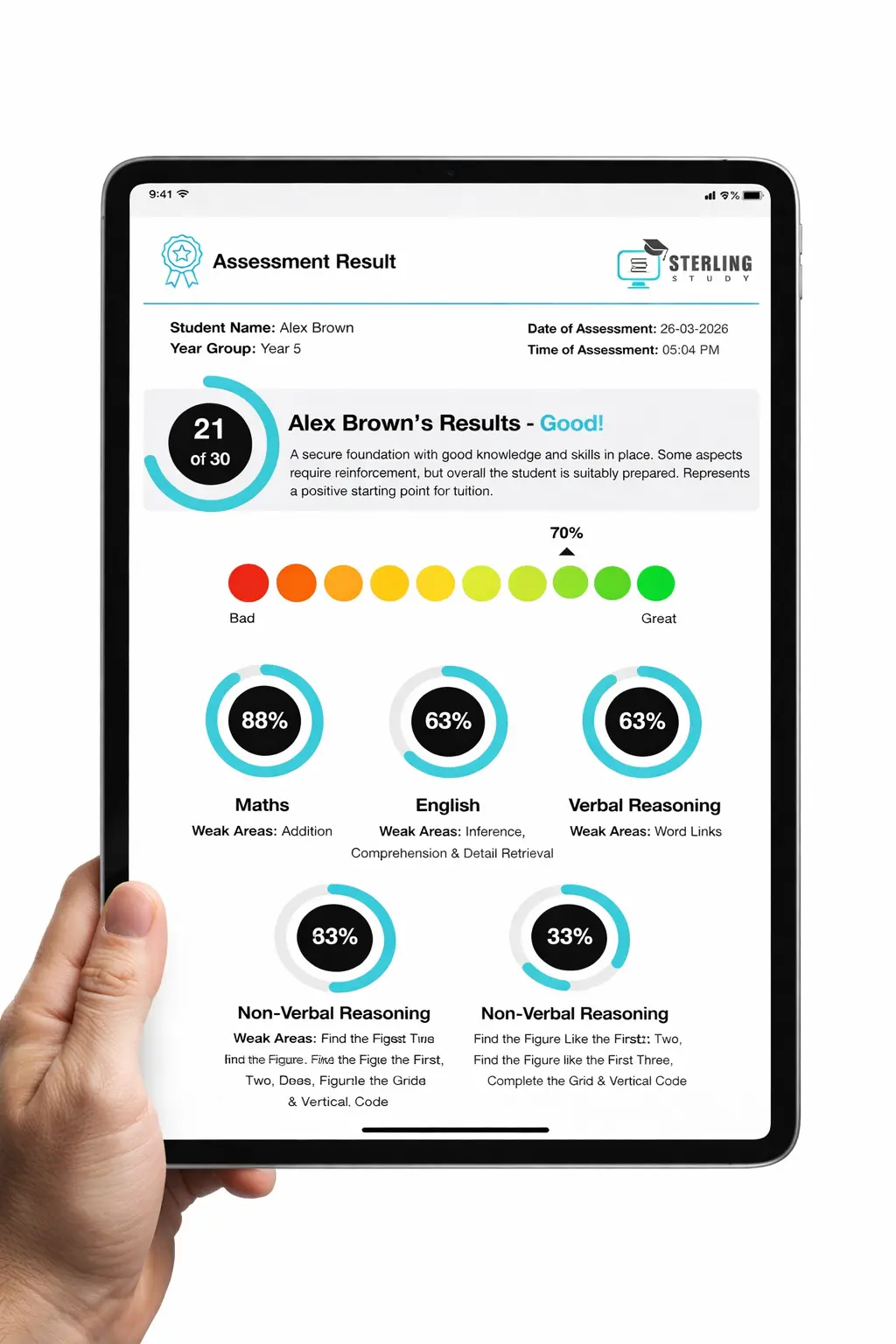
The analyser above tells you what your child achieved. Our free diagnostic assessment tells you why, breaking down exactly which topics and question types cost the most marks, so you know precisely where to focus before the new school year starts.
How to Read Your GCSE Results Analyser
Each figure the analyser produces is telling you something slightly different. Here's what each one actually shows.
- ✓Indicative average — a broad snapshot of the overall grade profile, not an official national GCSE measure. See "What does the average mean?" further down for why it's a starting point rather than a verdict.
- ✓Grade 4+ — how many subjects cleared the standard pass. Useful as a baseline check, particularly for English and Maths.
- ✓Grade 5+ — how many subjects reached the strong pass. Worth knowing since some institutions and courses use this as their practical floor rather than a bare 4.
- ✓Grade 7+ — how many subjects landed at the higher end of the scale. Gives a sense of the strength at the top of the profile, relevant for more selective courses.
- ✓Above target — the achieved grade is higher than the target entered for that subject.
- ✓At target — the achieved grade matches the target entered.
- ✓Below target — the achieved grade is lower than the target entered, and may be worth a closer look.
One point worth being clear about: below target doesn't automatically mean poor performance. Targets are individual, set months in advance, and don't always perfectly reflect where a student ends up wanting to go. A below-target result is a prompt to look closer, not a verdict.
Two Example GCSE Results Profiles: What Do These Grades Actually Mean?
Results envelopes have a habit of landing on a morning that already feels busy, and the slip itself doesn't come with instructions. Here are two fictional examples showing how different GCSE profiles can tell very different stories. Each one covers what the grades mean together, key strengths, areas that need attention, recommended next steps, and how it typically plays out for sixth form or whatever comes next. Both students are entirely fictional, built from a typical eight-subject GCSE spread of English Language, English Literature, Maths, Biology, Chemistry, Physics, History and Geography.
the grades mean
for what's next?
- ✓ Subject-by-subject breakdown across Maths, English and Science
- ✓ Time-per-question analysis
- ✓ Where your child stands vs typical grade boundaries
- ✓ Detailed PDF results sent immediately
- ✓ No strings attached
What If Your Child's GCSE Result Is Lower Than Expected?
If a result comes in below what you were expecting, it helps to work through it in order rather than reacting immediately. Check the grade carefully against the results slip. Compare it with the target, if one was set. Consider whether it actually affects a specific entry requirement for the next step your child has in mind, or whether it's an optional subject with no real bearing on that. Where relevant, it's worth knowing how close the result was to the next grade boundary, since a narrow miss is a different conversation to a wide one. Then speak to the school or subject teacher before deciding on any next move.
From there, the usual options are access to scripts, a review of marking, resits, or an alternative post-16 route. We cover all of these in detail, including current deadlines, further down this page, and our GCSE Results Day 2026 guide has the full results-day timeline and 2026 resit guidance if you need it.
What If Your Child's Results Are Better Than Expected?
Stronger-than-expected grades open up options rather than closing them down, and it's worth treating them that way. Check whether the new grades meet the requirements for more ambitious courses your child might not have originally planned for, and it's worth a call to the relevant sixth form or college to see what flexibility exists, since offers aren't always fixed once results are in.
That said, a stronger set of grades is a reason to widen the conversation, not necessarily to change direction. It's worth weighing any new options against your child's actual interests and longer-term plans rather than switching course purely because the grades allow it. A student who's genuinely excited about their original choice doesn't need to second-guess it just because another door has opened.
What Do GCSE Grades 1–9 Mean for Your Child?
Every grade from 9 down to 1 sits on the same numerical scale, but they don't carry equal weight in practical terms. Ofqual's official 9 to 1 grade scale guidance covers the full detail; here's what each one means in plain English.
| Grade | What it means |
|---|---|
| 9 | The highest GCSE grade, awarded to students demonstrating exceptionally strong performance. It's a genuinely new tier that didn't exist under the old A*–G system. |
| 8 | Sits between the old A and A*. A strong, high-achieving result. |
| 7 | The bottom of Grade 7 broadly aligns with the bottom of the old Grade A. A strong result that may meet or exceed the entry requirements for many academically selective courses, although individual sixth forms and courses set their own requirements. |
| 6 | A solidly good result, sitting within the old B/A range. |
| 5 | Commonly described as a "strong pass," but whether it's sufficient for a particular next step depends on the student's own goals and the specific institution or course. |
| 4 | The "standard pass," officially recognised by the government. It's the level below which students must continue studying English and/or Maths, though the grade individual institutions and employers require beyond that is set by each of them, not by a national rule. |
| 3 | Below the standard pass. In tiered subjects, this is the top grade reachable on some foundation-tier arrangements. |
| 2 | A lower-level grade, still recorded as an award rather than an ungraded result. |
| 1 | The lowest grade actually awarded on the scale. The bottom of Grade 1 broadly aligns with the bottom of the old Grade G. |
| U | Ungraded. The result fell below the standard needed for a Grade 1. |
What Does U Mean on GCSE Results?
U stands for "ungraded." It means the student didn't reach enough marks to be awarded a Grade 1, the lowest number actually given out on the scale. It's worth treating U as a distinct outcome rather than simply "a very low grade": a Grade 1 is still a recorded, awarded result, while a U carries no grade at all.
What a U means practically depends on the subject and the next step. In English or Maths, anyone without a Grade 4 who continues in education is required to keep working towards one, and a U triggers this in the same way a Grade 1, 2 or 3 does. In an optional subject that isn't a prerequisite for anything specific, a single U is usually a smaller issue than it feels like on the day, though it's still worth understanding why it happened, since it sometimes points to a paper that wasn't attempted in full or a tier that didn't suit the student.
GCSE Foundation vs Higher Tier: What Parents Need to Know
This explains a question we hear constantly on results day: "why can my child only get a Grade 5?" One common reason is tiering rather than ability.
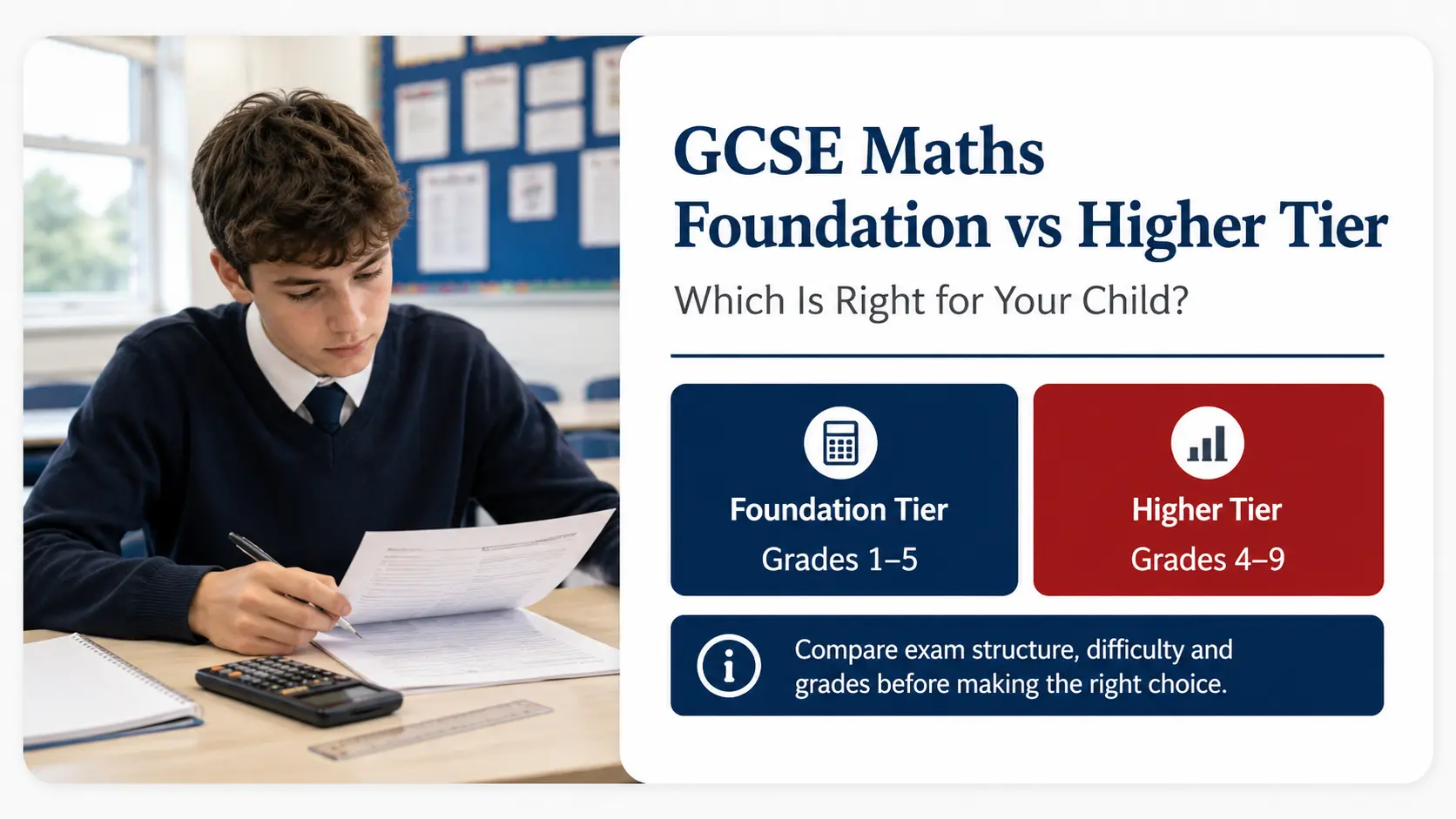
Several GCSE subjects, including Maths, the sciences (Biology, Chemistry, Physics and Combined Science) and Modern Foreign Languages, are split into two tiers of exam paper. English Language and English Literature are not tiered; every student sits the same paper with the full 9–1 range available. If Maths is the subject in question, our GCSE Maths Foundation vs Higher Tier guide goes into which tier suits which student in more depth.
| Tier | Grades available |
|---|---|
| Foundation | Generally 5 down to 1 (top grade achievable is a 5, even with a perfect score) |
| Higher | Generally 9 down to 4, with Grade 3 available as a narrow "safety net" for students who just miss a 4 |
The exact arrangements depend on the subject and qualification, so it's worth checking the specification for the exact subject in question if you want to confirm the precise grade range.
A student entered for Foundation cannot be awarded a 6, 7, 8 or 9 in that subject, however well they perform on the day, because the paper itself doesn't assess to that standard. This is a school decision, usually made in the months before the exam based on mock results and teacher judgement, not something decided on results day itself.
The important thing to hold onto: a Grade 5 achieved on Foundation is not a lesser Grade 5 than one achieved on Higher. The tier determines which grades are available on that paper, but a Grade 4 or 5 achieved on Foundation represents the same standard of achievement as a Grade 4 or 5 achieved on Higher. If you're unsure which tier your child sat, your school's exam officer or subject teacher can confirm it, and it's a reasonable thing to ask about if a result looks capped in a way you didn't expect.
How Your Child's GCSE Grades Compare with the Old A*–G System
It's tempting to want a clean one-to-one conversion chart, and plenty of sites publish one. Treat any chart that maps all nine numbers neatly onto nine letters with a healthy dose of scepticism, because that isn't how the reform actually works.
Ofqual's own guidance is explicit that the numerical scale is not directly equivalent to the old letters. There are exactly three genuine anchor points:
- ✓The bottom of Grade 7 is comparable with the bottom of the old Grade A.
- ✓The bottom of Grade 4 is comparable with the bottom of the old Grade C.
- ✓The bottom of Grade 1 is comparable with the bottom of the old Grade G.
Everything else on the scale exists precisely because the reform wanted more room to distinguish between students who would previously have been lumped into the same letter. A Grade 8 isn't "a bit more than A," and a Grade 5 isn't simply "a B" — it deliberately straddles what used to be a high C and a low B. That's the point of the system, not a gap in it.
Is Grade 4 a Pass? What Counts as a Good Result for Your Child
Yes, Grade 4 is officially recognised as a standard pass. Beyond that, it's worth being precise: there's no single national rule about which grade a sixth form, college or employer will accept. Each institution sets its own entry requirements, and they vary considerably, so "is it a good result" is a slightly different question, and the honest answer is that there is no single GCSE result that counts as "good" for every student. A strong result is one that meets the requirements for the student's own next step and reflects their individual targets, not a fixed national bar.
A Grade 4 that clears a sixth form's baseline entry requirement is a genuinely good outcome for that pathway. The same Grade 4 in a subject a student needs for a competitive A-level, where the sixth form actually asks for a 6 or 7, is a result that needs a conversation rather than a celebration. This is exactly why the analyser above compares each subject against the target you enter, rather than treating every grade as equally weighted — as the two example profiles further up illustrate, a stronger headline average doesn't automatically mean a stronger position once you look subject by subject.
Are These GCSE Grades Good? A Framework, Not a Verdict
Rather than a yes/no answer, it's more useful to work through a short set of questions. Together they give a far more honest picture than any single number.
| Question | Why it matters |
|---|---|
| How many grades are 4 or above? | Shows standard-pass attainment, the baseline most institutions look for first. |
| How many are 5 or above? | Shows stronger-pass attainment, increasingly the more meaningful practical floor. |
| How many are 7 or above? | Shows higher-grade attainment, relevant for more selective courses and subjects. |
| Did your child meet their target grades? | Shows performance against their own expectations, not a national average. |
| Do the grades meet the requirements for their next step? | Shows genuine progression readiness, which is what actually decides what happens in September. |
Run your child's results through the analyser above and you'll have an answer to the first three questions in seconds. The last two need a look at the specific offer or course requirements, which is exactly what the rest of this guide helps with.
What Does My Child's GCSE Average Mean?
There isn't an official "good" GCSE average, and it's worth being cautious about leaning on this figure too heavily. The analyser's average is an indicative calculation to help you get a quick read on the overall profile, not an official qualification measure that any institution actually uses.
Two students can post an identical average of 6.0 and mean two completely different things by it. One might have eight consistent 6s across the board. The other might have four 9s and four 3s. Both average out the same, but they represent entirely different profiles, different strengths, and potentially different next steps. That's why this guide keeps coming back to the subject-by-subject picture rather than settling on the average as the final word.
GCSE Grade Boundaries Explained: What Parents Need to Know
One of the most common questions we hear is some version of "what percentage do you need for a Grade 5?" The honest answer is that there isn't a single figure, and any page that gives you one confidently is oversimplifying.
Grade boundaries, the minimum mark needed for each grade, are set separately for every subject, every exam board and every exam series, after papers have been sat and marked. A given grade can need a different percentage of the available marks from one series or subject to the next, even for what looks like the same qualification.
This isn't an oversight, it's deliberate. Grade boundaries are set after students have taken and been marked for the exams. They can change from one year to another because exam boards consider the difficulty of the paper and evidence from students' work when deciding where the boundaries should fall. Ofqual oversees the system to ensure that the standard required for a particular grade remains comparable between years and exam boards. That's why grade boundaries genuinely do change every year, and why last year's published boundaries are only ever a rough guide, not a target to aim for. This is precisely why we've avoided publishing a fixed percentage table on this page: any chart claiming "70% = Grade 7" across every GCSE subject is, at best, describing one paper in one year, and treating it as universal will give you the wrong impression of what your child actually needs to hit a given grade next time.
Combined Science GCSE Grades Explained for Parents
Combined Science causes more confusion on results day than almost anything else on the slip, because it's the only qualification awarded as a double grade rather than a single number. It's worth pausing on this specifically.
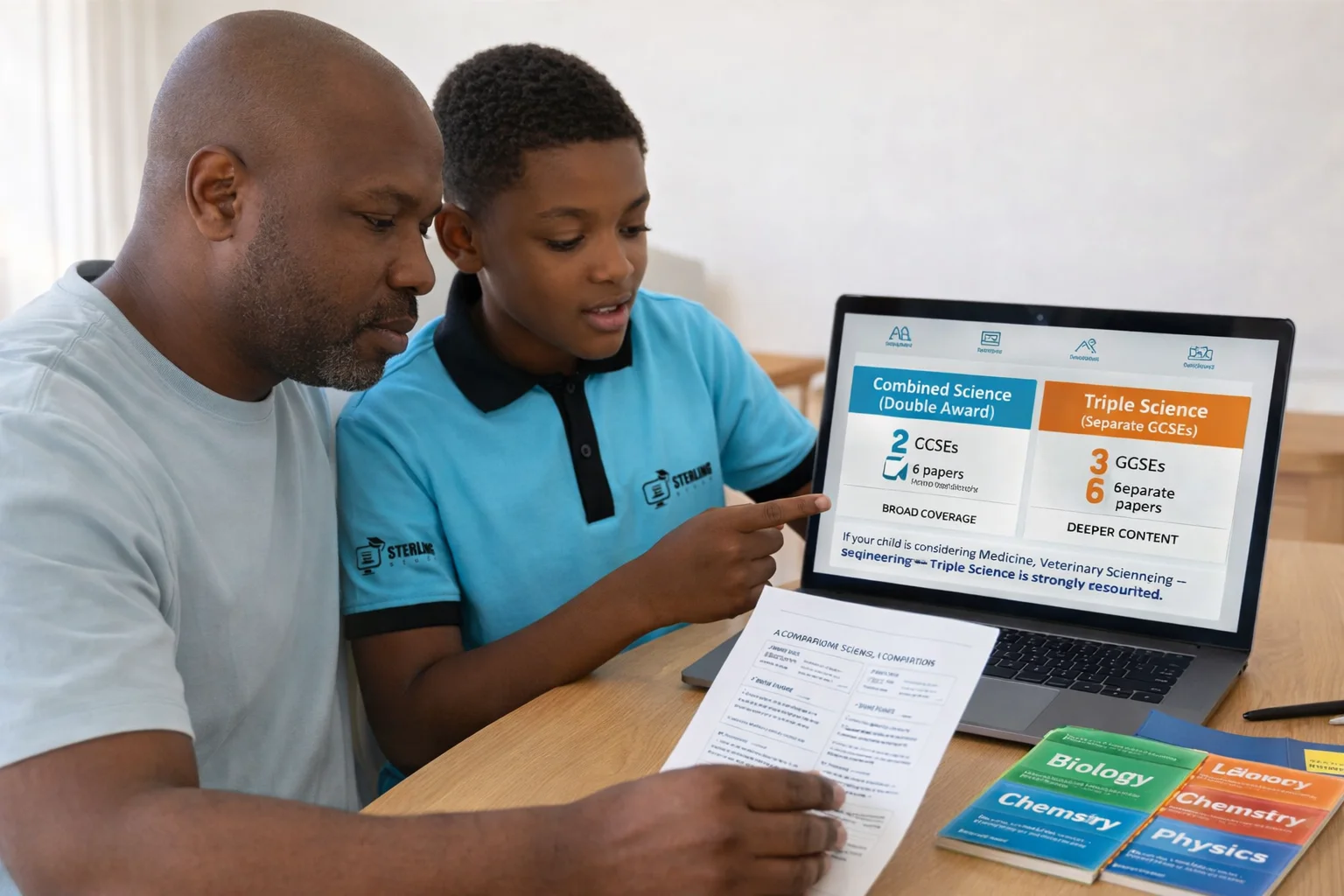
Combined Science, sometimes referred to as Trilogy, is a double-award qualification worth two GCSEs, reported as a single paired grade: 9-9, 9-8, 8-8, 8-7, right down to 1-1. The two numbers can be identical or one grade apart, but never further, which reflects how closely the two halves of the assessment are weighted against each other.
For the purposes of the Sterling Study Results Analyser, the two grade components are entered separately, as "Combined Science 1" and "Combined Science 2," so the tool can correctly calculate Grade 4+, Grade 5+ and Grade 7+ totals. A 6-5 result, for instance, should contribute one Grade 6 and one Grade 5 to the analyser's profile, not a single averaged figure.
How Your Child's GCSE Results Affect Sixth Form and College Places
Most sixth form and college offers come with two layers of conditions, and it's easy to satisfy one while missing the other. There's usually an overall requirement (for example, five subjects at Grade 5 or above) and, separately, subject-specific requirements for the particular courses your child wants to study (for example, a Grade 6 in GCSE Science to take A-level Biology). Both types of requirement are set independently by each institution, so the exact figures vary from one sixth form to the next.
A student can technically meet the overall headline figure and still find a specific A-level pathway blocked because one relevant subject fell a grade short of what that course needs. This is worth checking carefully against the exact wording of the offer letter, not just the general impression of "did we get the grades." If your child's Science results are sitting right on that boundary, it's genuinely worth a conversation with the sixth form before assuming the door is closed; some will still admit a student with a bridging arrangement, particularly where the rest of the profile is strong.
Sterling Study's A-Level teaching in Maths, Further Maths, Biology, Chemistry and Physics is built by the same team behind our GCSE Science curriculum, specifically so a student moving up doesn't feel like they're starting from nothing in September — see how the two GCSE Science routes compare in our Triple Science vs Combined Science guide. GCSE results can also remain relevant beyond sixth form, particularly when a student applies for competitive courses or where a university or course considers GCSE performance as part of its admissions process. The exact approach varies by institution and course, so parents should always check the current admissions information for the university they are considering.
What Do Your Child's GCSE Results Mean for the Next Step?
Sixth form and college A-levels aren't the only route forward. Depending on the results and the student's interests, the realistic options can include sixth form, college, T Levels, an apprenticeship, another Level 3 vocational route, or a resit where that's the sensible move. There's no single GCSE profile that guarantees a particular pathway — individual institutions and courses set their own requirements, so it's worth checking the exact figures for whatever your child is actually considering rather than relying on generic rules of thumb like "you need Grade 5s for sixth form," which isn't true everywhere and for every course.
Reviews of Marking, Resits and Your Options
Take a breath before deciding anything. A result that lands below what you were hoping for is genuinely common, not a rare misfortune, and there are clear, well-understood routes forward from almost every outcome.
If a grade looks unusually low next to the rest of your child's results, or narrowly missed a boundary you were expecting to clear, it's worth speaking to the subject teacher or head of year as soon as you can, ideally on results day itself. They can request a review of marking through the exam board, the correct term for what people often loosely call a "remark." It's worth knowing a review can move a grade up, leave it unchanged, or occasionally move it down, so this is a decision best made with your teacher's honest input rather than as an automatic reflex.
If English or Maths is below Grade 4, students who continue in education are generally expected to keep working towards a Grade 4, often through a resit. Both subjects can be resat in November, with results out the following January, well before the new academic year is properly under way. Other GCSE subjects are generally retaken the following summer alongside the next cohort. If Maths is the subject holding things up, focused GCSE Maths tuition over the autumn tends to close a specific gap faster than broad, unfocused revision.
One set of exams, sat over a handful of mornings in May and June, doesn't define what a student is capable of. Plenty of students who resit do noticeably better the second time round, simply because they already know the format and exactly which topics need attention. There's usually more flexibility in the system than it feels like in the moment.
Outside resits and reviews, a missed grade rarely closes every door outright. Some sixth forms and colleges will admit a student onto an A-level or vocational course with a bridging arrangement where the rest of the profile is strong, and BTECs, apprenticeships and other Level 3 vocational routes remain genuinely open, often turning out to be the better fit anyway.
Plenty of families start looking into tuition for the first time in the days after results day. Whoever you speak to, it's a fair question to ask directly about safeguarding rather than assume it's covered. Every tutor at Sterling Study is DBS-checked, and our safeguarding policy sits under the direct oversight of a named Safeguarding Officer, Company Director Ms Yesha Mukhtiar. A reputable provider should be able to answer that question without hesitation.
5 Common Mistakes Parents Make When Reading GCSE Results
- ✓Judging the whole result from the average alone. It's a starting point, not a conclusion — see "What does the average mean?" above.
- ✓Assuming the same grade requirement applies to every sixth form or college. Requirements are set independently by each institution and course, and they genuinely vary.
- ✓Treating an old grade-boundary percentage as a universal rule. Boundaries are set fresh for every subject, exam board and series; last year's figure is only ever a rough guide.
- ✓Comparing one child's results directly with another child's. Different subjects, tiers and target grades make a like-for-like comparison misleading more often than it's useful.
- ✓Deciding on a review or resit before understanding the individual result and the next-step requirements. It's worth knowing exactly what's riding on a grade before requesting a review of marking or committing to a resit.
What Parents Should Do After Receiving GCSE Results
It helps to have a simple order of operations rather than trying to process everything on the slip at once, standing in a school hall at 9am. Here's a sensible sequence for the first day.
What Should You Do Next? A Quick Decision Tree
Once you've run the analyser, your next move usually falls into one of four situations.
| Situation | What to do |
|---|---|
| Most or all grades meet target | Check the exact sixth-form or college requirements, confirm the place or course, and take a moment to acknowledge the result before moving on. |
| One grade below target | Check whether that specific subject is required for the next step. Speak to the school or provider if it is. If it isn't, this is often a smaller issue than it feels on the day. |
| Several grades below target | Speak to the school or college about the options available, review the realistic pathways, and consider additional support or resits where appropriate. |
| A result is very close to the next grade up | Discuss the specific script with the school and consider whether a review of marking is worth requesting, covered in detail below. |
Where Does Your Child Collect GCSE Results, and Can You Check Online?
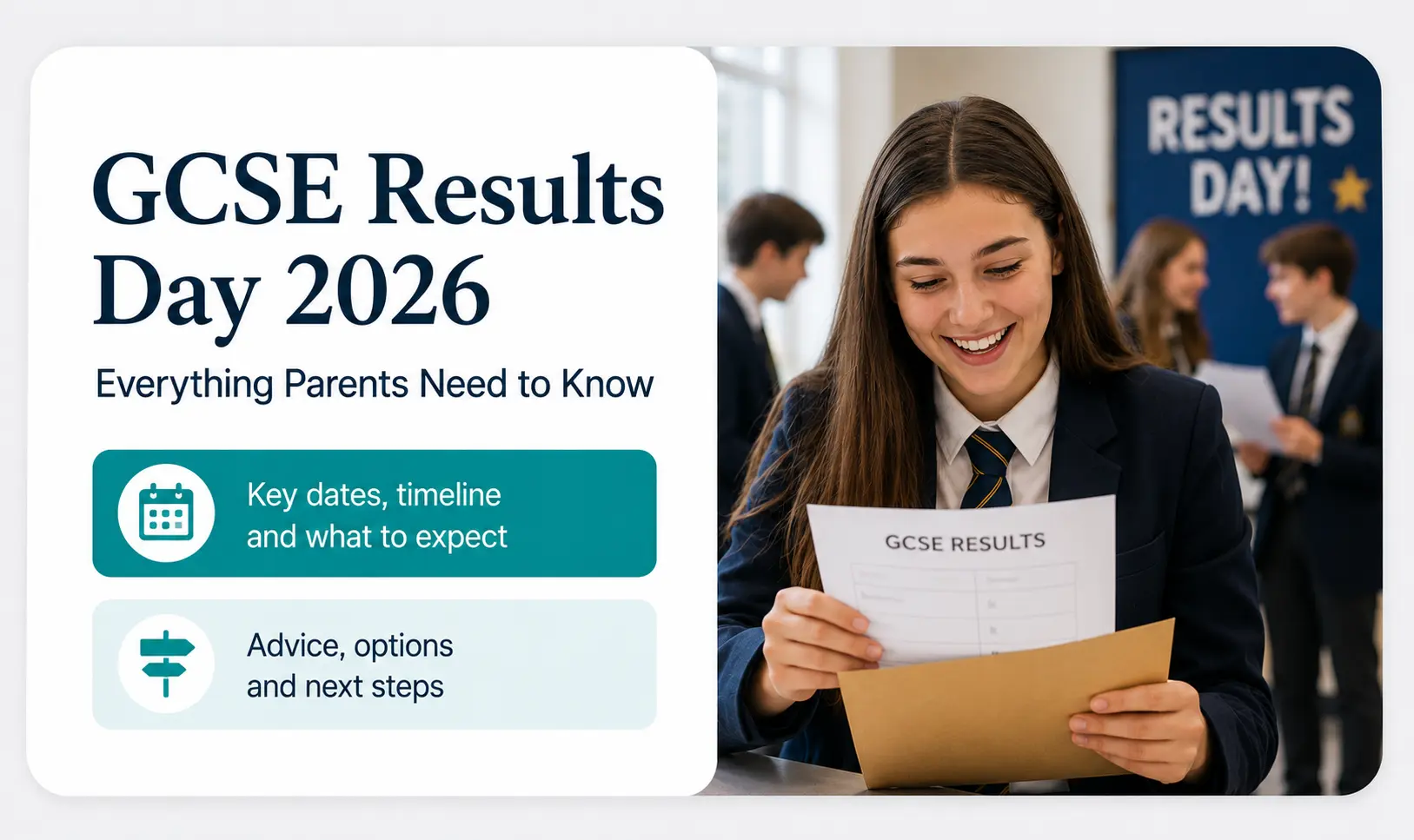
GCSE Results Day 2026 falls on Thursday 20 August, with results released to candidates from 8am under JCQ's official guidance; schools and exam centres receive them electronically the day before, purely so staff can prepare. Schools set their own arrangements for when and how students collect their results, whether that's in person, by email or through a portal, so check your school's own instructions rather than assuming a specific time.
From summer 2026, the Education Record service is being rolled out nationally, although access depends on whether a student's school has chosen to participate, following successful pilots in Greater Manchester and the West Midlands. Where a school has signed up, students can view a verified digital copy of their results through the app on results day, alongside collecting results through their school's usual arrangements. Signing up is a decision each school or college makes individually, not something applied everywhere at once, so availability depends entirely on whether your child's school has chosen to participate. Whatever the case, it's worth following your school's own Results Day arrangements rather than assuming the app applies to you.
Outside of a participating school's own app or portal, there is no single national website where every student can look up their own results, so treat any third-party "results checker" site with real caution and never enter personal exam details into anything that isn't your school's own system. If you're unable to attend in person, most schools will let a parent or named representative collect on your behalf with signed authorisation and photo ID, or will arrange to post the slip; it's worth confirming this with your school well before the summer holidays.