GCSE Maths Foundation vs Higher Tier: Which Is Right for Your Child?
Foundation Tier covers grades 1 to 5 and Higher Tier covers grades 4 to 9. Here is exactly how the two GCSE Maths tiers differ, how schools decide, whether a student can switch, and what to do if the wrong tier gets chosen - with guidance from Sterling Study's PhD-led tutors.
Not sure which tier fits your child? Book a free diagnostic - our PhD-led team will pinpoint exactly where they stand →
Foundation Tier GCSE Maths covers grades 1 to 5 and Higher Tier covers grades 4 to 9, with grades 4 and 5 available on both. Foundation suits students who are consistently working at or below a grade 5 standard, while Higher suits those comfortably reaching a grade 6 or above in mock exams. Schools usually confirm tier entries in the spring term of Year 11, based on ongoing assessment rather than a single test, and in most cases a student can still move between tiers right up until the entry deadline if their performance changes. Neither tier closes doors permanently: what matters most for sixth form, college and university is the final grade achieved, not which paper it came from.
If you are trying to work out whether your child should sit Foundation or Higher Tier GCSE Maths, you are not alone, and you are not late to the conversation either. This is one of the most common questions we hear from parents at Sterling Study, and it tends to arrive with more anxiety attached to it than it really deserves. The good news is that tier decisions are rarely as final or as high-stakes as they can feel in the moment. This guide walks through exactly how Foundation and Higher Tier differ, how schools make the decision, what happens if the wrong tier gets chosen, and how to think about your own child's readiness. It draws on the approach our PhD-led team, including founder Dr Parth Patel (PhD Neuroscience, UCL), uses when advising families on exactly this question.
1. What Is the Difference Between GCSE Maths Foundation and Higher Tier?
The core difference between GCSE Maths Foundation and Higher Tier is the range of grades each one makes available and, as a result, the difficulty of the content and questions on the paper. Foundation Tier GCSE Maths covers grades 1 to 5, while Higher Tier covers grades 4 to 9. Both tiers are assessed across three exam papers, one non-calculator and two calculator-based, and both are offered by every major exam board. The tiers share a significant amount of content, particularly in number, basic algebra and standard statistics, but Higher Tier introduces additional topics and asks questions that require more abstract reasoning, longer multi-step problem solving, and less scaffolding within the question itself.
It helps to think of the two tiers less as "easy" and "hard" versions of the same exam, and more as two exams built around different grade targets. Foundation Tier is designed to let a student working at a grade 3, 4 or 5 standard demonstrate what they know clearly, without being asked questions pitched at a grade 7 or 8 level they were never going to reach anyway. Higher Tier is designed to stretch a student who is capable of grades 6 and above, with enough headroom in the paper to differentiate between a grade 7 and a grade 9.
Foundation Tier caps out at grade 5; Higher Tier starts at grade 4 and goes up to grade 9. The overlap at grades 4 and 5 is deliberate, and it is the safety net that makes tier decisions far less risky than they can feel.
2. What Grades Can You Get in Each Tier?
This is one of the most searched questions on this topic, and it is worth answering precisely rather than approximately, because the overlap between the two tiers is exactly what makes the decision less stressful than it first appears.
| Tier | Grades Available | Highest/Lowest Grade | Typical Student Profile |
|---|---|---|---|
| Foundation | 1 to 5 | Highest possible: Grade 5 | Working consistently at grade 3 to 5 in class and mocks |
| Higher | 4 to 9 | Lowest possible: Grade 4, with an Ofqual-mandated Grade 3 "safety net" if a student narrowly misses the Grade 4 boundary | Working consistently at grade 6 and above, or a confident grade 5 |
A student can get a grade 5 on Foundation Tier, and this is a genuinely good outcome: a strong pass that meets the Grade 4/5 threshold almost every sixth form, college and employer asks for. What a student cannot do is get a grade 9 on Foundation Tier, since the paper simply does not include questions pitched at that level, no matter how well the paper is answered. On the flip side, a student cannot get a grade 5 confirmed as safely on Higher Tier if their overall performance falls below the grade 4 boundary, which is why the tier decision matters and should not be treated casually.
What is a good target grade for Foundation Tier?
Grade 5 is the realistic ceiling and the target worth aiming for, since it is classed as a "strong pass" and meets the Maths threshold most sixth forms and employers ask for. Grade 4, a "standard pass," is the minimum most families are working towards if Foundation is the confirmed tier.
3. Should My Child Take GCSE Maths Foundation or Higher Tier?
There is no single test that answers this question on its own. Schools build the picture from several sources over time: end-of-topic assessments, mock exam results across Year 10 and Year 11, classroom performance, and the subject teacher's professional judgement of how the student handles unfamiliar or multi-step problems under exam conditions. As a parent, you can use broadly the same signals to sanity-check what your child's school is telling you.
Signs Foundation Tier is the right fit
- ✓ Mock results sitting consistently in the grade 3 to 5 range across multiple attempts, not just one paper
- ✓ Confidence with core number, ratio and basic algebra, but regular struggles with multi-step or unfamiliar problem types
- ✓ Anxiety or a tendency to freeze when a Higher-style question does not immediately look like something practised before
- ✓ A realistic target of grade 4 or 5, where the priority is securing that grade cleanly rather than chasing a grade that is currently out of reach
Signs Higher Tier is the right fit
- ✓ Mock results consistently at grade 6 or above, or a confident, well-supported grade 5 with clear room to grow
- ✓ Comfortable applying known methods to new or unfamiliar contexts, not just repeating practised question types
- ✓ A subject teacher actively recommending Higher, ideally backed by more than one data point across the year
- ✓ Ambitions that depend on a grade 6 or above, such as A-level Maths, Further Maths, or Science-heavy sixth form options
If your child sits somewhere in the middle of these two lists, that is common, and it is exactly the scenario where a short, honest conversation with the subject teacher is worth more than any online checklist. Ask specifically what tier they are currently minded to enter your child for, and what evidence that decision is based on. A good teacher will be able to point to real data rather than a general impression.
4. Is My Child Ready for Higher Tier? A Quick Self-Assessment
This is not a substitute for your school's own evidence, but it is a useful gut-check before that conversation. Go through the eight statements below and count how many genuinely apply to your child, based on their last two or three sets of mock or assessment results rather than a single good day.
- ✓ Their last three maths assessments have all landed at grade 6 or above, not just their best one
- ✓ They can usually work out which method to use on an unfamiliar question, not just on ones they have practised before
- ✓ They finish most mock papers with time to check their answers, rather than running out of time
- ✓ They can explain their working out loud, not just arrive at the right answer
- ✓ Their teacher has mentioned Higher Tier as a realistic option in at least one parents' evening or report
- ✓ They want to keep A-level Maths, Further Maths, or a Science-heavy sixth form pathway open
- ✓ A wrong answer on a hard question does not derail their confidence for the rest of the paper
- ✓ They are willing to put in extra practice on the topics that only appear on Higher Tier
6 to 8 statements true: Higher Tier is very likely the right fit; the conversation with school should be about confirming this, not questioning it.
3 to 5 statements true: This is a genuine borderline case. A diagnostic assessment or a detailed conversation with the Maths teacher is worth prioritising before the tier is confirmed.
0 to 2 statements true: Foundation Tier is likely to be the more secure route to a strong, confident grade right now, though this can always be revisited if performance improves over the year.
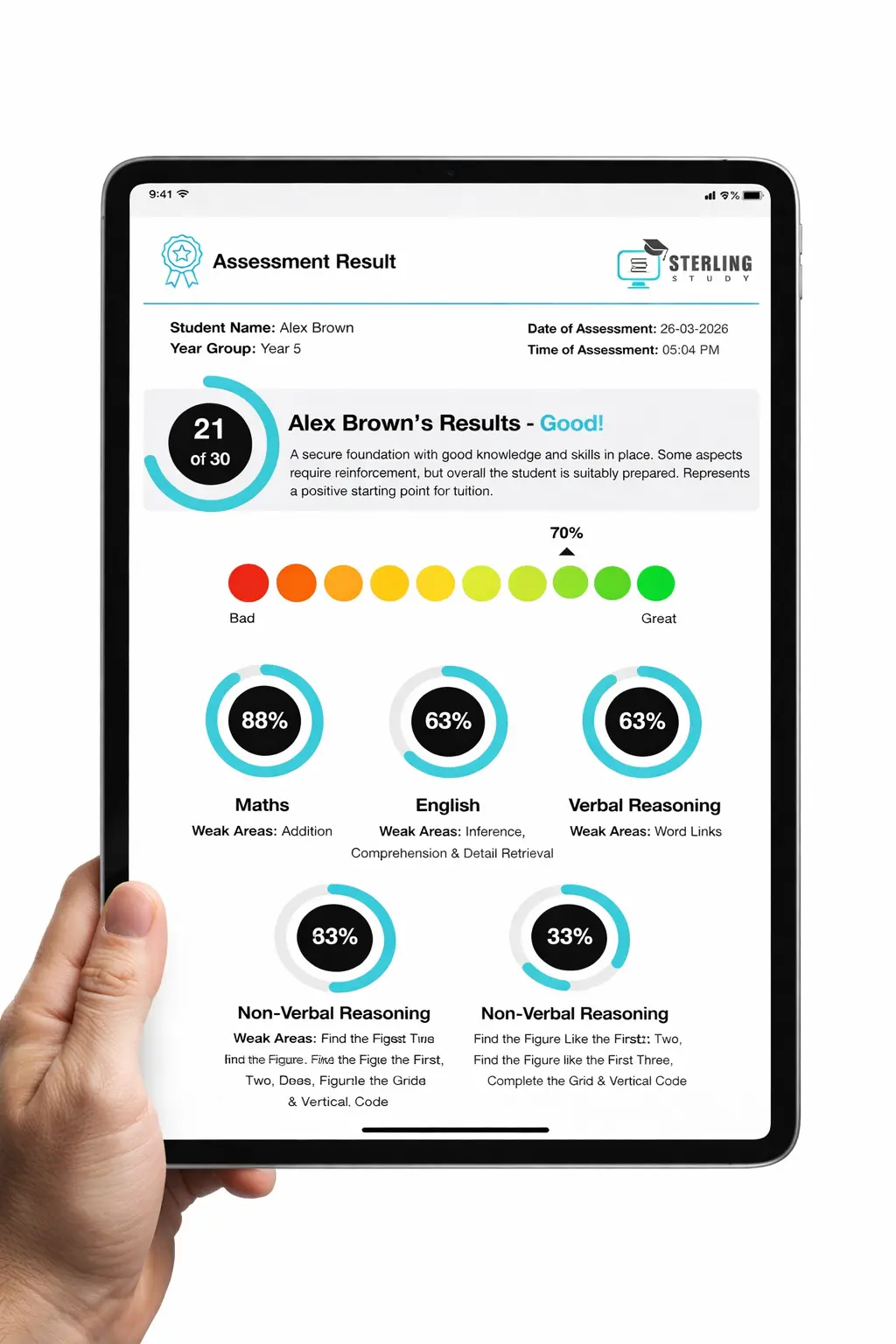
Find out for
free.
- ✓ Topic-by-topic breakdown across number, algebra, geometry and statistics
- ✓ A clear read on whether Foundation or Higher matches current performance
- ✓ Time-per-question analysis to spot exam-technique gaps
- ✓ Detailed PDF results sent immediately
- ✓ No strings attached
5. Who Decides Whether a Student Takes Foundation or Higher Tier?
The decision sits with the school, specifically the Maths department, and it is not something parents or students can simply request or override unilaterally. JCQ guidance to exam centres is explicit that a candidate can only be entered for one tier, not both, so schools must make a single, formal tier entry for every student ahead of the exam series, based on the school's own assessment evidence built up over Year 10 and Year 11, not a single walk-in test on the day.
That said, "the school decides" does not mean parents have no voice in the process. Most schools are genuinely open to a conversation if you have concerns, particularly if you can point to specific evidence, such as a pattern of underperformance in mocks relative to classwork, or the reverse. Raising it early and directly with the Head of Maths or your child's class teacher tends to get a far more useful response than raising it close to the entry deadline.
6. When Do Schools Decide Whether a Student Will Take Foundation or Higher Tier?
There is no single national date, since this depends on each school's own internal timeline and how their assessment calendar is structured, but there is a fairly consistent pattern across most schools in England. A provisional tier is often indicated after Year 10 mock exams, refined further after any Year 11 autumn mocks, and then formally confirmed in the spring term of Year 11, ahead of the final exam board entry deadline, which typically falls several months before the summer exam series itself.
Because the exact dates vary school to school, the most reliable way to know your own child's timeline is to ask their Maths teacher directly, ideally at a parents' evening or via email, rather than assuming a generic timeline applies.
7. Your Step-by-Step GCSE Maths Tier Decision Checklist
If you want a practical sequence to follow rather than a general sense of what matters, this is the order we recommend families work through with Sterling Study.
- Gather the last two to three sets of results, not just the most recent one, so a single unusually good or bad paper does not skew the picture.
- Run the self-assessment above to get an honest, independent read before hearing the school's view, so you can compare notes rather than simply accepting a recommendation at face value.
- Ask the Maths teacher directly which tier they are currently minded to enter your child for, and what specific evidence that is based on.
- If the picture is genuinely borderline, ask about a diagnostic assessment, either through the school or an external tutor, to get a topic-by-topic breakdown rather than a single overall grade estimate.
- Confirm the school's internal entry deadline so you know exactly how much time is left to act if you want to challenge or revisit the tier.
- Put any change of mind in writing (an email to the Head of Maths works well), so there is a clear record of the request and the reasoning behind it.
- Revisit the decision after the next assessment point if your child is on a genuine upward or downward trend, rather than treating the first conversation as final.
8. Can You Move From Foundation to Higher GCSE Maths?
Yes, in most cases a student can move from Foundation to Higher Tier, provided the change happens before the school's internal entry deadline and there is clear evidence to support it, such as an improved run of assessment results. This is a normal and fairly common adjustment, not an exceptional request, and it usually involves a conversation between the parent, the student and the Maths department rather than any formal appeals process.
The practical limiting factor is time. A student moving up to Higher Tier partway through Year 11 needs to cover the additional content that Foundation does not include, on top of consolidating what they already know, so this move tends to work best when it happens with enough runway left before study leave, ideally by the autumn or early spring of Year 11 rather than a few weeks before the exams.
Can You Switch GCSE Maths Tiers Before the Exam?
Switching tiers, in either direction, generally remains possible right up until the exam board's formal entry deadline, which is typically set several months before the exams themselves and is managed by the school's exam officer rather than the subject teacher. Once that deadline passes, changing tier is usually no longer possible for that exam series, since the entry has already been locked in with the exam board.
This is why raising any tier concerns early matters more than almost anything else in this whole decision. A conversation in the early autumn term of Year 11 has room to result in real change. The same conversation held two weeks before the entry deadline may arrive too late to act on.
9. What Happens if My Child Is Entered for the Wrong Tier?
If a student sits Foundation Tier but was genuinely capable of a grade 6 or above, the practical consequence is that their result is capped at grade 5, even if their actual ability was higher. This is one of the reasons schools take tier decisions seriously and generally err on the side of caution when the evidence is close, since capping a strong student's grade is a costly mistake to get wrong.
If a student sits Higher Tier but was genuinely working below a grade 4 standard, the risk runs the other way. Ofqual's own guidance confirms that Higher Tier carries an allowed grade 3 "safety net" for students who score a small number of marks below the grade 4 boundary, but a student who falls further short than that receives an unclassified result (a U), not a lower number grade. This is the single most important reason tier decisions should never be treated as a low-stakes guess, and why schools lean on solid evidence rather than optimism when the decision is genuinely close.
A student who was entered for the wrong tier and did not get the result they needed is not stuck. Maths and English can be resat in November following results day, with results released the following January, well before the next academic year is properly underway. Many students who resit after a tier mismatch actually improve significantly, simply because the correct tier now matches what they can realistically demonstrate.
Risk analysis: weighing up which mistake is more likely, and more costly
It helps to think about the two ways a tier decision can go wrong separately, since they carry different risks and need different safeguards.
| Scenario | How Likely | Consequence | How to Reduce the Risk |
|---|---|---|---|
| Capable student entered for Foundation | Uncommon; schools tend to err upward when in doubt | Grade capped at 5, even if a 7 or 8 was realistic | Raise concerns early with clear evidence from independent assessment |
| Underprepared student entered for Higher | The more common and more serious mismatch | Risk of an unclassified result (U) below the grade 3 safety net | Base the decision on several data points, not one strong mock |
| Borderline student, either tier | Common; this is the case most families are actually in | Either a capped grade or a shaky pass, depending on the call made | Use the self-assessment above and a diagnostic to remove the guesswork |
The practical takeaway is that entering a genuinely borderline student for Higher Tier is not automatically the "brave" choice and Foundation is not automatically the "safe" one. The safest choice is always the one backed by the most complete evidence, whichever tier that happens to point towards.
10. GCSE Maths Foundation vs Higher Tier: Myth vs Fact
Higher Tier is harder in the sense that it includes more demanding content and expects more independent problem solving, but "harder" does not automatically mean "wrong for your child." A well-prepared student working at a genuine grade 6 to 9 standard will generally find Higher Tier a fairer test of their ability than Foundation would be, precisely because Foundation caps out below what they are capable of.
Is GCSE Maths harder now than it used to be?
In the sense that matters here, not particularly. What changed with the move to the 9 to 1 grading system in 2017 was the scale and the addition of a genuine "safety net" grade 3 on Higher Tier, not the underlying tier structure itself, which has worked the same way since tiering was introduced. What has shifted more recently is national attainment: Department for Education figures show the proportion of 19-year-olds achieving grade 4 or above in English and Maths has been trending down slightly year on year as pandemic-era grading leniency has fully unwound, which makes an accurate tier decision more important, not less.
A number of specific misconceptions come up often enough to be worth addressing directly, side by side with the reality.
| Myth | Fact |
|---|---|
| "Foundation Tier is only for weaker students." | Foundation is for students whose realistic target sits at grade 5 or below. A clean, confident grade 5 is worth more than a shaky grade 4 scraped on Higher. |
| "You can get a grade 9 on Foundation Tier if you answer everything perfectly." | Not possible. The paper is capped at grade 5, regardless of how well every question is answered. |
| "Higher Tier always looks better on a CV or application." | Sixth forms, colleges and employers look at the grade achieved, not which tier it came from. A grade 5 is a grade 5. |
| "Once a tier is set, that's final." | Generally not true up until the formal entry deadline, and even after results day, resits remain a normal route forward. |
| "A grade 4 on Foundation is worth less than a grade 4 on Higher." | A grade 4 is a grade 4 regardless of tier. Exam boards deliberately overlap the papers at grades 4 and 5 to make outcomes comparable across tiers. |
| "If in doubt, always choose Higher, since you can't do worse than Foundation." | This is not true. Higher Tier carries a real risk of an unclassified result (U) for students below the grade 3 safety net, which Foundation does not. |
| "Schools always get the tier decision right." | Schools generally get it right, but the decision is a judgement call based on available evidence, not an exact science, which is exactly why it is worth checking in on rather than assuming. |
11. What Topics Are Only Included in Higher Tier GCSE Maths?
Both tiers share a substantial core of content, but Higher Tier adds topics and extends the depth of others. The exact specification varies slightly by exam board, but the general pattern below holds across AQA, Edexcel and OCR.
| Topic Area | Foundation Tier | Higher Tier |
|---|---|---|
| Algebra | Linear equations, basic graphs, simple expansion and factorising | Quadratic equations, simultaneous equations, algebraic proof, function notation |
| Geometry | Area, perimeter, angle rules, basic Pythagoras | Trigonometry (sine and cosine rule), circle theorems, vectors |
| Number | Standard form, fractions, percentages, basic ratio | Surds, upper and lower bounds, more complex compound interest and growth/decay |
| Statistics & Probability | Averages, basic probability, simple charts | Cumulative frequency, histograms, conditional probability, tree diagrams with algebra |
The practical implication for a student considering a move up to Higher Tier is that this is real new content to learn, not just harder versions of familiar questions. This is exactly the kind of gap that targeted GCSE Maths tutoring tends to close efficiently, since a tutor can focus purely on the topics that differ between tiers rather than re-teaching everything from scratch.
12. Does the Foundation vs Higher Tier Decision Differ Between AQA, Edexcel and OCR?
The Foundation and Higher structure itself is consistent across all three major exam boards used in England: AQA, Edexcel (Pearson) and OCR all use the same 1 to 5 Foundation and 4 to 9 Higher grading split, and all three assess across three papers. What varies is the finer detail of question style, paper layout and occasionally the exact weighting given to certain topics.
- ✓ AQA is widely used and tends to favour a fairly traditional question structure, with a clear progression of difficulty through each paper.
- ✓ Edexcel often includes more multi-part questions that build on each other within a single question, which can catch out students who are strong at individual skills but less confident stringing several steps together.
- ✓ OCR is used less widely but follows a broadly similar structure, with some schools favouring it for how it sequences topics across the two-year course.
None of these differences should meaningfully change whether Foundation or Higher is the right call for a given student. What matters more is checking which board your child's school uses, since past papers and revision resources are board-specific, and practising with the wrong board's papers can give a misleading sense of readiness.
13. Does Foundation Tier Affect Sixth Form, College or University Applications?
This is probably the question that causes parents the most worry, and the honest answer is reassuring: what matters for progression is the final grade achieved, not which tier it was sat on. A grade 5 secured on Foundation Tier meets the same Grade 4/5 Maths threshold that almost every sixth form, college, university and employer asks for, and application forms do not typically ask which tier a grade came from.
Where tier choice matters more indirectly is in capping what is achievable in the first place. A student capped at grade 5 on Foundation cannot present a grade 7, 8 or 9 on their application, which can matter for competitive courses or sixth forms with high Maths entry requirements, particularly for pathways into A-level Maths or Further Maths, engineering, or other STEM degrees where a strong Maths GCSE grade is expected. UCAS confirms that most university courses expect GCSE English and Maths as standard pre-16 qualifications alongside A-level or equivalent grades, and National Careers Service job profiles for engineering and other technical routes routinely list GCSE grade 4 or above in Maths as a baseline entry requirement. This is exactly why the tier decision deserves proper attention rather than being treated as a formality: it is less about the tier itself and more about making sure a student's tier matches, and does not accidentally cap, their genuine potential.
Does a grade 4 count as a pass?
Yes. Grade 4 is officially classed as a "standard pass" and grade 5 as a "strong pass," and both are achievable on either tier. Most sixth forms, colleges and employers set grade 4 as their baseline requirement for Maths, with grade 5 sometimes required for more competitive or academic routes.
14. Which Type of Student Are You? Tailored Recommendations
General advice only goes so far. Here is how the tier decision tends to play out for four common student profiles we see at Sterling Study.
15. Revision Advice for Foundation and Higher Tier Students
Effective revision looks slightly different depending on tier, because the two papers reward slightly different things.
For Foundation Tier students
The priority is accuracy and consistency across the full breadth of the specification, since Foundation papers reward students who can reliably execute core methods without careless errors, more than they reward flair on a handful of harder questions. Past paper practice under timed conditions, with a strong focus on checking work and avoiding silly mistakes, tends to move grades more than chasing obscure topics.
For Higher Tier students
The priority shifts toward multi-step problem solving and unfamiliar question formats, since Higher Tier papers are deliberately designed to include questions that do not immediately signal which method to use. Students aiming for grades 7 to 9 in particular benefit from practising problems that combine two or three topics in a single question, which is where marks are most commonly lost even by otherwise strong students.
In both cases, working through official past papers from the correct exam board, and reviewing mark schemes closely rather than just checking the final answer, remains one of the most reliable ways to close the gap between a mock result and the grade a student is capable of on the day.
16. How a GCSE Maths Tutor Can Help With Tier Decisions and Grade Improvement
Whichever tier your child is on, targeted support tends to work best when it is built around real diagnostic evidence rather than a generic revision plan. At Sterling Study, our GCSE Maths programme was shaped by our founder, Dr Parth Patel, who holds a BSc, MSc and PhD in Neuroscience from UCL, alongside Dr Igors Pupko, who holds a PhD in Genetics from the University of Surrey. Both bring an academic, evidence-first approach to identifying exactly where a student's marks are being lost, whether that is a content gap that puts a Foundation to Higher move at risk, or a technique gap standing between a Higher Tier student and the grade 7 or 8 they are capable of.
Across our students, 90% achieve grades 6 to 9 in Maths, English and Science, and three in four improve by two or more grades within a year of joining. For a student sitting near a tier boundary, that kind of focused, evidence-based support can be the difference between a capped Foundation grade 5 and a genuine Higher Tier grade 6, or between a shaky Higher Tier entry and a confidently secured pass.
Whoever you choose to support your child through a tier decision or grade push, it is worth asking directly how they handle safeguarding rather than assuming it is covered. Every tutor at Sterling Study is DBS-checked before working with students, and our safeguarding policy is overseen by a named Safeguarding Officer, Company Director Ms Yesha Mukhtiar. It is a fair question to ask of any tutoring provider, and a reputable one will answer it without hesitation.