How to Interpret SATs Results: A Parent's Guide to Scaled Scores, Expected Standard and What Comes Next
A clear, jargon-free breakdown of what your child's Reading, Maths and GPS scaled scores actually mean, what counts as a good SATs score, and what to do next whichever way results have gone, from Sterling Study's PhD-led tutors.
Not sure what your child's scores mean for them specifically? Book a free assessment - our PhD-led team will talk you through it →
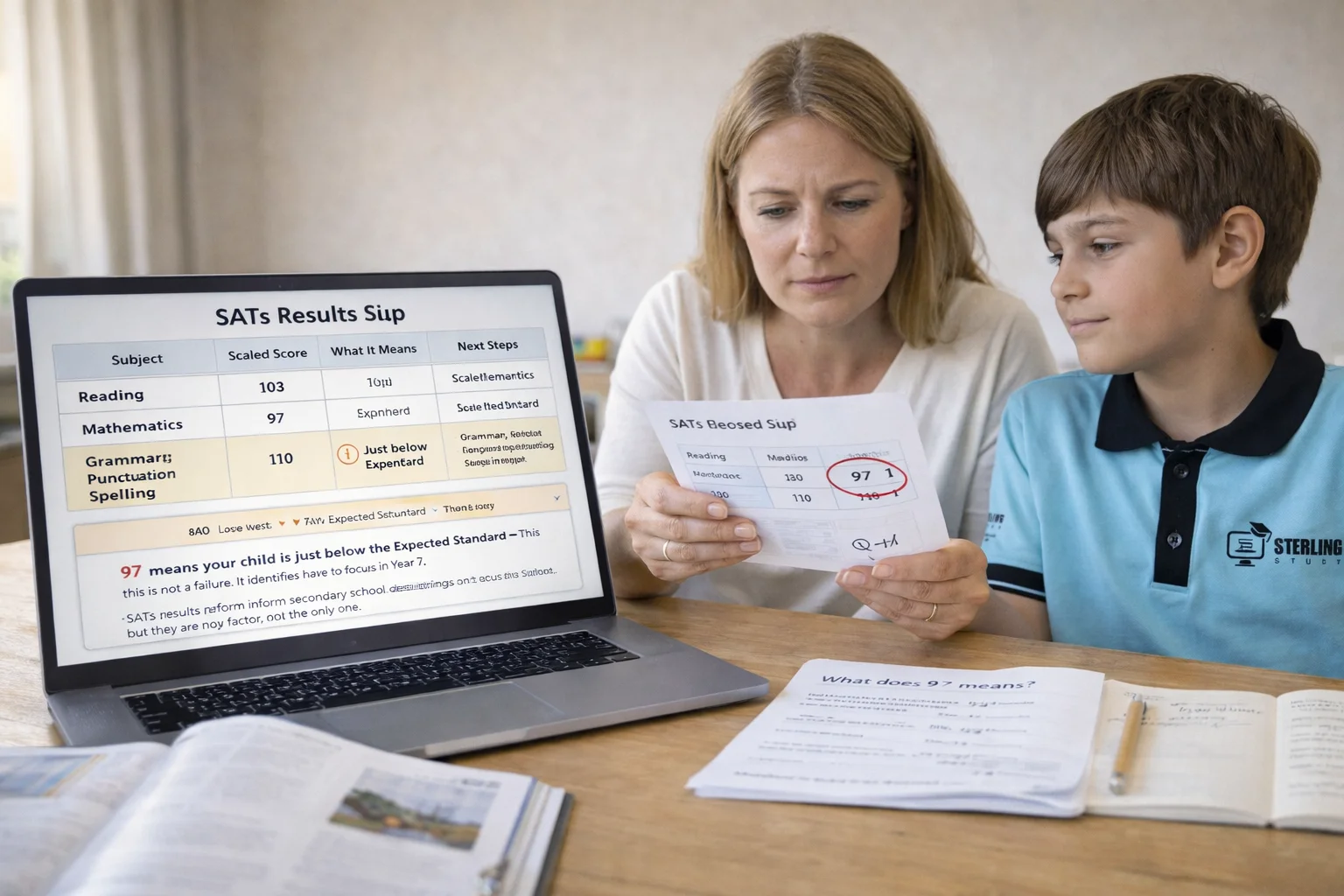
Your child's SATs results sheet shows a scaled score between 80 and 120 for Reading, Maths, and Grammar, Punctuation and Spelling (GPS), plus a teacher assessment for Writing. A score of 100 or more means they have met the expected standard for Year 6. The exact number matters more than most parents realise: a 101 and a 109 both count as "meeting the standard," but they tell very different stories about where a child is heading into Year 7. This guide explains what each score actually means, what a good SATs score looks like, and what to do next whichever way the results have gone.
Results envelopes have a habit of arriving on a morning that already feels busy, and SATs results are no exception. The page itself is short: three numbers, a teacher assessment grade, and a line about the expected standard. Understanding what to do with it can feel like being handed a puzzle with the instructions missing. Sterling Study's tutoring approach was shaped by our co-founder Dr Parth Patel, who holds a PhD in Neuroscience from UCL, and this guide draws directly on that background to explain, properly and without jargon, how to interpret SATs results, what a good SATs score means for your child, and what the numbers do and do not tell you about the years ahead.
1. What Are SATs Results?
SATs, or Standard Assessment Tests, are taken by almost every child in England at the end of Year 6. They cover Reading, Maths, and Grammar, Punctuation and Spelling, known as GPS. Writing is not tested in the same way; instead, it is assessed by the class teacher across the whole year using a national framework. These are the statutory national curriculum assessments set out by the government for the end of key stage 2.
The results your child brings home are not exam grades in the way GCSEs are. There is no pass or fail printed anywhere on the sheet. Instead, each subject gets a scaled score, and the report states plainly whether that score has met the expected standard for the end of primary school.
It helps to know what the tests are actually checking. Reading is assessed through a single paper covering a mix of fiction and non-fiction extracts. Maths is split across three papers: one arithmetic paper and two reasoning papers, which is why a child can be strong in one and shakier in the other while still landing on a single combined score. GPS is also split into two components, a grammar and punctuation paper and a separate spelling test, marked together into one scaled score. Understanding that split matters, because a single number on the results sheet can quietly average out a real strength and a real weakness within the same subject.
Some Year 6 families are also navigating the 11+ around the same time. It's worth knowing the two run on entirely separate timelines and exam boards, so our Complete 11+ Guide is worth reading separately rather than assuming the same preparation covers both.
2. What Information Will Parents Receive?
The results report itself is short and mostly numerical. Here is what typically appears on it.
| What's on the report | What it tells you |
|---|---|
| Reading scaled score | A number from 80 to 120 based on the Reading test |
| Maths scaled score | A number from 80 to 120 based on the Maths papers |
| GPS scaled score | A number from 80 to 120 based on the grammar, punctuation and spelling test |
| Writing teacher assessment | A judgement (working towards, expected, or greater depth), not a scaled score |
| Expected standard statement | Confirms whether each scaled score of 100 or above has been reached |
Some schools also include a short written summary or a comparison with the school and national average, though this is not compulsory and varies from one school to the next.
3. Raw Scores vs Scaled Scores: What's the Difference?
A raw score is simply the number of marks your child got right out of the total available in a paper. A scaled score converts that raw mark onto a fixed 80 to 120 scale, so that results are comparable year on year even when the difficulty of the test papers changes slightly.
This is why the same raw mark can produce a different scaled score depending on the year. If a paper is judged to be marginally harder than the previous year's, fewer raw marks are needed to reach a scaled score of 100, and vice versa. The Standards and Testing Agency sets these conversions after the tests have been sat, based on how pupils nationally performed.
| Raw score example | Approximate scaled score | What this means |
|---|---|---|
| Low raw marks, near the bottom of the paper | Around 80–89 | Well below the expected standard; likely needs targeted catch-up support |
| Middling raw marks | Around 95–104 | At or close to the expected standard |
| High raw marks, most questions correct | Around 110–120 | Comfortably at the higher standard |
These bands are illustrative rather than fixed, since the exact raw-to-scaled conversion is published by the Standards and Testing Agency's scaled score conversion tables each year once marking is complete.
4. Understanding the 80–120 Scaled Score System
Every SATs subject score sits somewhere on the same 80 to 120 scale, which makes it easy to compare a child's relative performance across Reading, Maths and GPS even though the underlying tests are completely different. A score of 100 is the fixed threshold for the expected standard in every subject, every year, regardless of how the raw marks were converted.
| Scaled score range | What it means | What parents can do |
|---|---|---|
| 80–89 | Well below the expected standard | Speak to the class teacher promptly; focused catch-up support tends to help most here |
| 90–99 | Just below the expected standard | Often a gap of only a handful of marks; targeted practice on specific weak areas closes this quickly |
| 100–104 | Meeting the expected standard | A solid foundation; keep building consistency rather than assuming the job is done |
| 105–109 | Comfortably meeting the standard | Strong performance; a good moment to build confidence and stretch further |
| 110–120 | Working at the higher standard | Among the strongest performers nationally; look at extension and challenge rather than repetition |
It is worth remembering that 100 is not an average score in the way a class test mark might be. It is a fixed line set to represent what the government expects a typical Year 6 pupil to know by the end of primary school, and the distribution of scores around it shifts slightly each year.
Ready for Year 7?
Explore Year 7 Preparation →5. How Do I Interpret My Child's SATs Results?
The honest answer is that no single number tells the whole story. Interpreting SATs results properly means looking at all three scores together, not reading each one in isolation, and asking what the pattern between them suggests rather than just whether each one cleared 100.
Reading SATs Score
The Reading score reflects comprehension: how well a child can retrieve information from a text, make inferences, and explain vocabulary in context. A score in the 80s usually points to difficulty with reading stamina or unfamiliar vocabulary rather than an inability to read the words themselves. A score around 100 to 104 tends to mean solid literal comprehension, with inference questions being the area most likely to have cost marks. Scores above 110 usually reflect confident, independent reading across a range of text types, including the trickier non-fiction extracts.
Maths SATs Score
Maths is split across arithmetic and reasoning papers, so a single scaled score can hide quite different pictures. A child scoring in the high 90s may have strong arithmetic but lose marks on multi-step reasoning questions, or the reverse. Scores from 100 to 109 generally show secure number fluency with room to build on problem-solving under time pressure, while scores at 110 and above usually reflect confident reasoning as well as accurate calculation.
GPS SATs Score
The grammar, punctuation and spelling test rewards precision, and it is often the subject where a small number of consistent errors, such as apostrophe use or a handful of misspelt high-frequency words, can hold a score back even when a child's writing itself is strong. A score around 100 typically means solid grammatical understanding with occasional slips, while scores above 110 usually reflect near-complete accuracy across spelling, punctuation and terminology.
Strengths: Maths reasoning and calculation are clearly a high point, and Reading is solidly above the expected standard. Area to watch: GPS sits just below 100, which on its own is not a cause for alarm, but is worth a closer look at which specific paper (grammar, punctuation, or spelling) pulled the score down. Suggested next step: a short, focused review of spelling patterns and punctuation rules over the summer, rather than broad revision across every subject, since the gap here is narrow and specific rather than fundamental.
6. What Is the Expected Standard in SATs?
The expected standard is a scaled score of 100 or above in each subject. It represents the level of knowledge the Department for Education considers typical and appropriate for a child finishing Year 6, and it is used consistently across Reading, Maths and GPS. Meeting it in all three subjects means a child has demonstrated the core knowledge expected before starting secondary school; it is not, on its own, a measure of how bright or capable a child is more broadly.
7. What Is the Higher Standard in SATs?
The higher standard refers to a scaled score of 110 or above. Children reaching this level in a subject are performing well beyond the minimum expectation, and schools sometimes use higher standard results, alongside other evidence, when considering setting or grouping in Year 7. It is not an official pass mark in the way 100 is, but it is widely treated as the marker of strong, secure performance.
8. What Is Considered a Good SATs Score?
There is no single number that qualifies as "good" for every family, because it depends on what you are comparing it against. In practical terms, most educators would describe a good SATs score as anything from around 105 upward, since this comfortably clears the expected standard with a genuine margin. A score of exactly 100 is not a weak result, it is a pass of the expected standard, but it leaves less room for the natural variation that happens between one test and the next. The most useful comparison is rarely against a fixed benchmark at all: it is against where your own child was a year earlier, and whether the gap between subjects is narrowing or widening.
9. Real SATs Results Examples Explained
These eight profiles cover the score combinations parents are most likely to actually see on a results sheet. Each one includes what the scores mean together, key strengths, areas for improvement, recommended next steps, and how it typically translates into Year 7 readiness.
- What this means
- All three scores sit below the expected standard, with GPS the closest to the line.
- Key strengths
- GPS at 90 suggests foundational literacy skills are closer to secure than the other two scores imply.
- Areas for improvement
- Reading and Maths need the most attention, most likely core fluency (decoding, vocabulary, arithmetic) rather than advanced skills.
- Recommended next steps
- Short, consistent daily practice on fundamentals rather than broad revision, plus a direct conversation with the class teacher about exactly which topics are weakest.
- Year 7 readiness
- Likely to receive early additional support in Reading and Maths; not a reason to delay starting secondary school, but worth prioritising over the summer.
- What this means
- All three scores have just cleared the line, evenly, with no subject lagging behind the others.
- Key strengths
- A consistent, balanced profile rather than one strong subject propping up a weak one.
- Areas for improvement
- Little margin for an off day; small, specific gaps likely remain in each subject even though all three have technically passed.
- Recommended next steps
- Steady, well-rounded practice across all three rather than singling one out, and identifying which specific question types cost marks in each.
- Year 7 readiness
- Should transition without additional intervention, though worth keeping an eye on all three subjects equally rather than assuming the job is fully done.
- What this means
- Comfortably above the expected standard across the board, without quite reaching the higher standard in any subject.
- Key strengths
- Balanced, secure performance in all three areas with a genuine margin above the line.
- Areas for improvement
- Room to push into the higher standard with a bit more stretch, particularly in Maths reasoning.
- Recommended next steps
- Extension material and less familiar question formats rather than repeating already-consolidated content.
- Year 7 readiness
- Well placed for standard-track Year 7 classes, and a likely candidate for top sets in most schools.
- What this means
- Working at the higher standard in every subject, among the strongest performers nationally.
- Key strengths
- Genuinely well-rounded strength, with Maths the standout of the three.
- Areas for improvement
- Very little to fix technically; the real risk here is under-stimulation rather than any skills gap.
- Recommended next steps
- Shift focus entirely to challenge, breadth and independent learning habits rather than more SATs-style practice.
- Year 7 readiness
- A strong candidate for top sets and, longer-term, academically selective options; the priority is keeping them engaged rather than coasting.
- What this means
- A wide spread, with verbal skills well ahead of numeracy.
- Key strengths
- Reading comprehension is a genuine, confidence-building strength.
- Areas for improvement
- Maths sits meaningfully below the expected standard and is the clear priority.
- Recommended next steps
- Consistent, structured Maths practice focused on identifying whether arithmetic, reasoning, or both are behind the gap, rather than generic worksheets.
- Year 7 readiness
- Likely to need Maths support early in Year 7; worth flagging directly to the new school rather than waiting for it to surface on its own.
- What this means
- The reverse pattern: numerical reasoning well ahead of literacy skills.
- Key strengths
- Maths reasoning and calculation are a clear, secure strength.
- Areas for improvement
- Reading is the priority, most likely comprehension and inference rather than decoding; GPS is close behind and worth a light review too.
- Recommended next steps
- Regular reading of varied text types, not just fiction, with a focus on "why" and "how" questions, alongside a short GPS review of recurring errors.
- Year 7 readiness
- May need extra reading support in Year 7 English; Maths set placement should be unaffected.
- What this means
- Two subjects comfortably clear the standard; one falls just short.
- Key strengths
- Reading and Maths are both solid, comfortably-above-standard results.
- Areas for improvement
- GPS is the one area holding the overall profile back, likely a small number of recurring errors rather than a broad gap in understanding.
- Recommended next steps
- A short, targeted GPS review rather than spreading effort evenly across all three subjects.
- Year 7 readiness
- Unlikely to need broad intervention; a few focused weeks of GPS practice before September is usually enough.
- What this means
- At or virtually at the very top of the scale in all three subjects.
- Key strengths
- About as strong a set of results as the scale allows for.
- Areas for improvement
- Genuinely little; the challenge is finding material that stretches a child already working well beyond the curriculum ceiling.
- Recommended next steps
- Look beyond SATs-style practice entirely: wider reading, maths enrichment, or subjects SATs doesn't test at all.
- Year 7 readiness
- An extremely strong foundation; the main task now is keeping them engaged and challenged, not confirming readiness.
- ✓ A proper look at your child's Reading, Maths and GPS scores together
- ✓ Honest feedback on which gaps matter and which don't
- ✓ A clear, practical plan for the summer before Year 7
- ✓ No pressure, no obligation to sign up to anything
10. What Happens If My Child Doesn't Meet the Expected Standard?
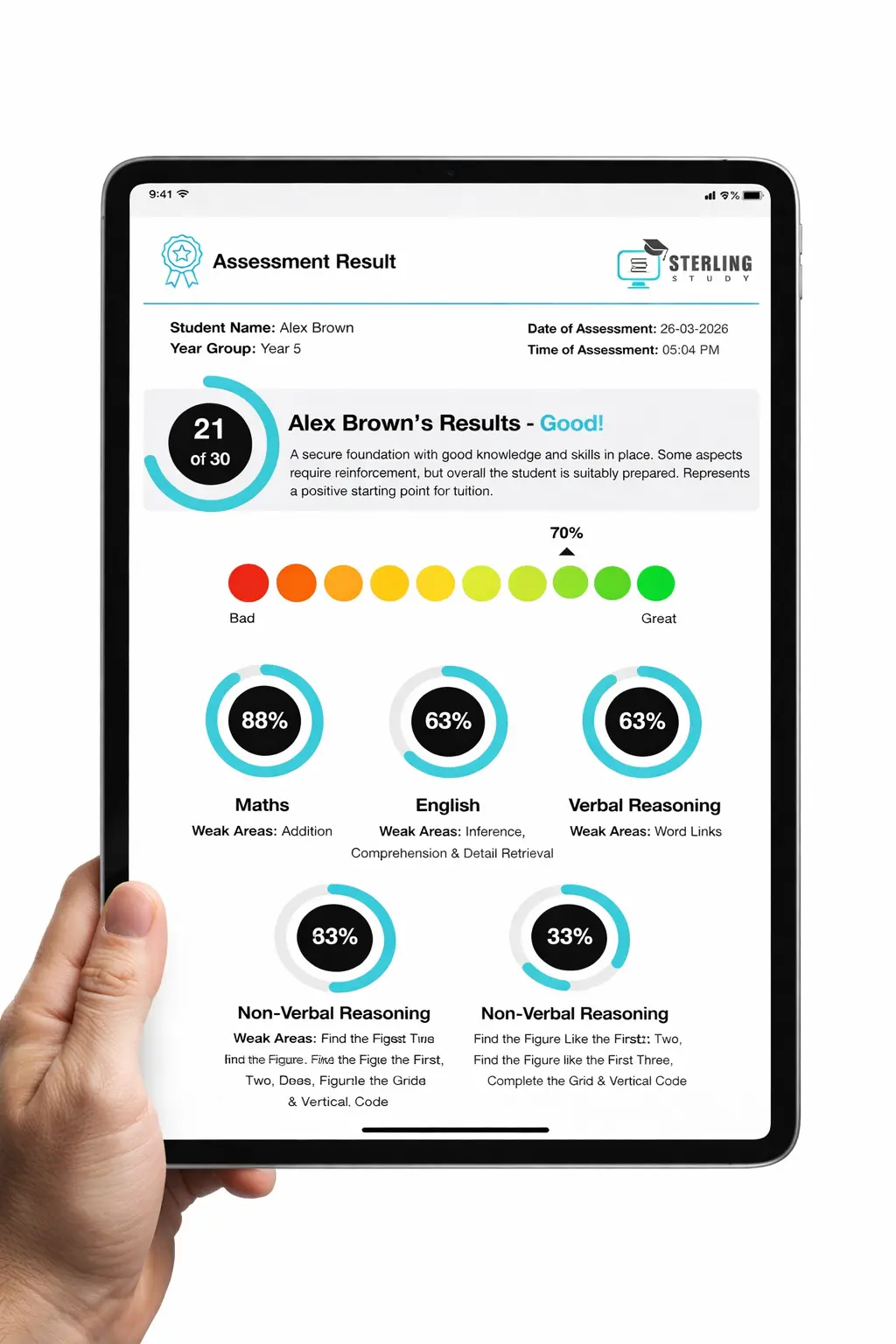
If one or more scores comes in below 100, the first thing worth knowing is how common this is. A meaningful proportion of children do not meet the expected standard in at least one subject every year, and it changes very little in practical terms. There is no repeat SATs test at primary school, and it does not affect which secondary school a child attends, since secondary school places are allocated separately and well before results arrive.
What it does mean is that your child's new secondary school will likely put some extra support in place early in Year 7, often through setting, additional literacy or numeracy sessions, or simply closer monitoring in that subject during the first term. This is standard practice, not a sign that something has gone wrong.
A lot of parents start looking into summer tutoring for the first time right after SATs results, often in a bit of a hurry. Whoever you choose, it's worth asking plainly how they vet their tutors. At Sterling Study, every tutor working with a child is DBS-checked, and our safeguarding practice is overseen by a named Safeguarding Officer, Company Director Ms Yesha Mukhtiar. Any provider you're considering should be able to answer that question without hesitation, and it's a reasonable one to ask before committing to anything.
11. Can SATs Papers Be Remarked or Reviewed?
Yes, though the process is more limited than it is at GCSE or A-level. Schools can apply for a review of marking on a child's behalf if a result looks unexpectedly low compared with their usual classroom performance, but this request has to come through the school, not directly from a parent, and there are set windows each year in which it can be requested. It is worth raising with your child's teacher as soon as results arrive if something looks genuinely out of step with what you'd expect.
12. How Secondary Schools Use SATs Results
Secondary schools receive SATs results before a child's first day, and most use them, alongside their own baseline assessments in the first few weeks, to decide on setting and groupings for core subjects. A strong Maths score, for instance, might place a child in a higher set from day one, while a lower GPS score might prompt some early literacy support alongside the main English curriculum. Here is the practical sequence of what happens to those numbers between results day and the first term of Year 7.
| Stage | What happens | What it means for your child |
|---|---|---|
| Results day | Your child's school shares the scaled scores and teacher assessment with you | This is the only point the numbers are yours to interpret alone |
| Before September | The primary school sends the full academic record, including SATs scores and teacher assessments, to the new secondary school | Your child's new teachers see the full picture before day one, not just one number |
| First 1–2 weeks of Year 7 | Most secondary schools run their own baseline tests alongside reviewing SATs data | Setting and ability group decisions typically combine both, not SATs alone |
| Ongoing | Teachers build a fuller picture through classwork, homework and observation | Any influence of the SATs numbers fades quickly once the school has its own data |
It is worth being clear about what SATs results are not used for. They play no part in secondary school admissions, since places are offered through a separate admissions process that runs earlier in the school year. Class setting and ability groups, where a school uses them, are rarely decided by SATs scores alone either: most schools weigh them alongside their own baseline assessment and, particularly for English, the Year 6 teacher assessment for Writing, since that reflects a full year of work rather than a single test morning.
This is also why one lower score, in isolation, carries far less weight than it can feel like it does on results day itself. A new school builds its view of a child from several sources over the first term, teacher handover notes, its own baseline tests, and a child's actual work in the first few weeks, not from one number on a summer sheet.
A couple of practical things are worth doing over the summer, beyond subject revision itself: share the results, and any specific weak areas, directly with the new school rather than assuming staff will dig through the paperwork unprompted, and focus effort on the one or two subjects that genuinely need it rather than a broad refresh of everything.
13. Teacher Assessment vs SATs Scores
Writing is judged differently from Reading, Maths and GPS because it does not lend itself to a single timed test in the same way. Instead, teachers assess a full portfolio of a child's writing across the year against a national framework, judging whether it sits at "working towards," "the expected standard," or "greater depth."
| SATs scaled score (Reading, Maths, GPS) | Teacher assessment (Writing) | |
|---|---|---|
| How it's measured | A single test paper, marked externally | A full year's writing, judged by the class teacher |
| What it shows | Performance on that specific day, in that specific test | Consistency and development over time |
| Which matters more | Neither, in isolation. Together, they give a genuinely rounded picture of where a child stands, which is exactly why writing is judged differently rather than being squeezed into a single exam paper. | |
14. How Can Parents Support Their Child After Receiving SATs Results?
Whatever the results say, the summer before Year 7 is a genuinely useful window, not because there is any exam pending, but because it is one of the few stretches of the school calendar where support can be targeted without competing against a packed timetable of homework and assessments. If you're looking for concrete revision approaches rather than general principles, our guide to what actually moves the score in SATs revision at home goes into that in more depth.
- ✓ If a subject sits below 100, focus on specific gaps rather than broad revision. A short list of exactly which question types went wrong tends to be more useful than a general workbook.
- ✓ If everything is comfortably above 100, use the summer to build breadth and confidence rather than repeating what's already secure.
- ✓ Talk to your child's current teacher before the end of term. They will usually know precisely which topics cost the marks, often in more detail than the results sheet itself shows.
- ✓ Keep an eye on reading stamina and independent problem-solving specifically, since these are the two skills Year 7 leans on hardest from the first week.
If you'd rather have a structured programme carry this through rather than managing it all yourselves, our Get Ahead of Year 7 KS3 tuition is built specifically around this transition.
15. Are SATs Results Important?
They matter, but not in the way results day can sometimes make them feel. SATs results are a genuinely useful snapshot of where a child stands at one moment, and a helpful starting point for conversations with a new secondary school. They are not, on their own, a verdict on a child's ability, and they do not fix the path a child is on for the next five years. Plenty of children who score below the expected standard in Year 6 go on to do perfectly well at secondary school once the right support is in place early, and plenty who score well above it still need encouragement and structure to keep that momentum going. The number on the page is a starting point for the conversation, not the end of it.