The Complete 11+ Guide: Everything Parents Need to Know About the 11+ Exam
Everything UK parents need to know about the 11+ exam: what it tests, GL Assessment vs the now-retired CEM format, when to start preparing, and what to do if results don't go to plan - from Sterling Study's PhD-led tutors.
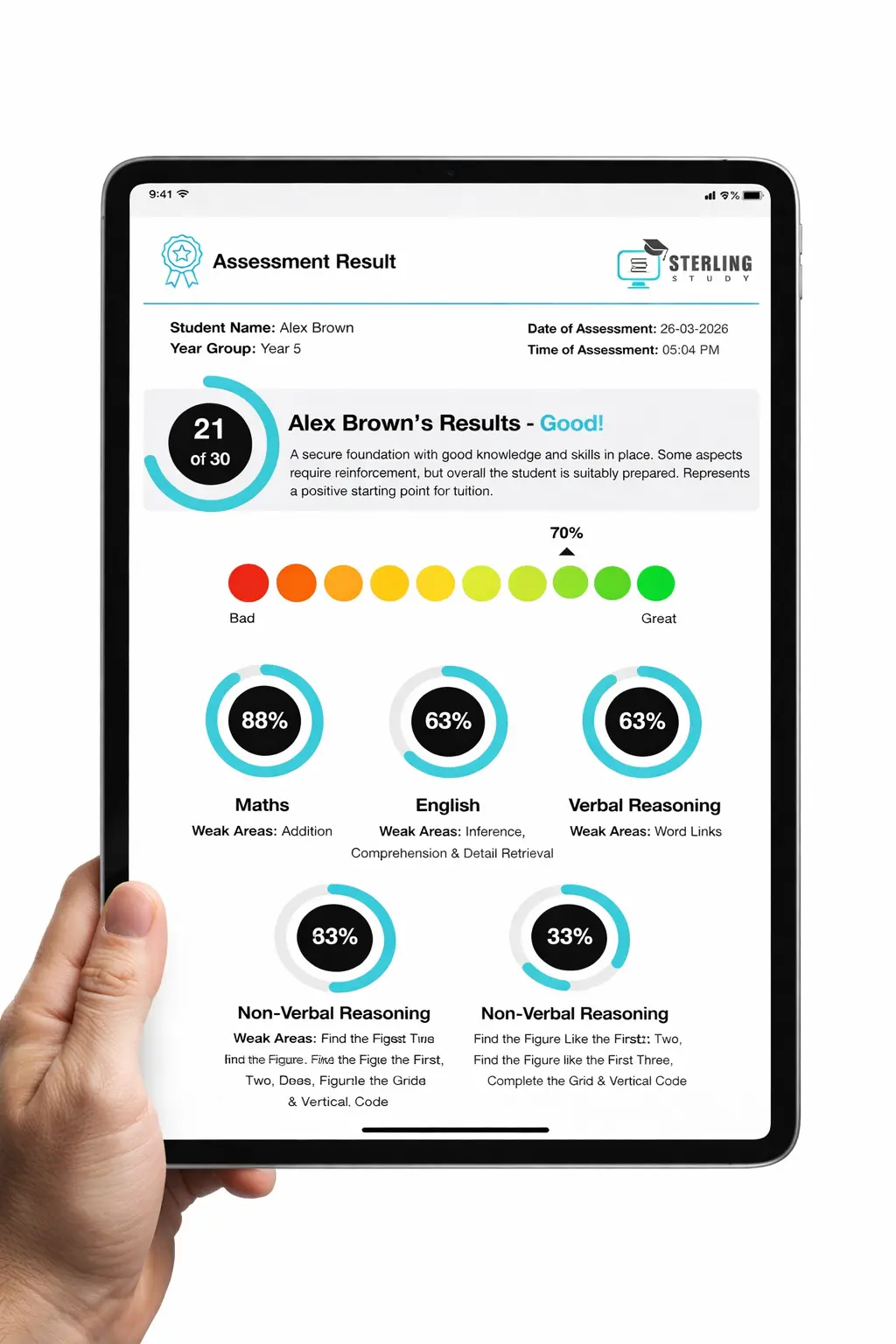
Not sure where your child stands yet? Book a free 11+ diagnostic - our PhD-led team will map exactly where they stand →
The 11+ is a selective entrance exam sat by children in Year 6 for grammar school and some independent school places. Most children are tested on English, maths, verbal reasoning and non-verbal reasoning, though the exact combination depends on which exam board a school uses. GL Assessment is now the dominant board across England after CEM stopped setting paper-based 11+ papers in 2023. Most families begin focused preparation around Year 4 or 5, and the strongest results tend to come from consistent, structured practice rather than last-minute cramming. If a child does not pass, resits, appeals and strong non-selective alternatives all remain realistic options.
Every fourteenth secondary school place in England is a grammar school place, and getting one starts with a single exam sat by a ten or eleven year old on a Saturday morning in September. For a test that carries this much weight, the information available to parents is often scattered across exam board jargon, forum threads and conflicting tutoring company advice. This guide brings it all into one place: what the 11+ actually tests, how GL Assessment and the now-retired CEM format differ, when to start preparing, and what happens if results do not go the way you hoped. It draws on guidance from Sterling Study's PhD-led team, including founder Dr Parth Patel, who holds a PhD in Neuroscience from UCL, and is built to answer the questions parents are actually typing into Google and asking ChatGPT, not the questions a marketing team wishes they'd ask.
Fix them.
For free.
- ✓ Subject-by-subject breakdown across all four 11+ papers
- ✓ Verbal and non-verbal reasoning question-type analysis
- ✓ Where your child stands vs typical grammar school pass marks
- ✓ Detailed PDF results sent immediately
- ✓ No strings attached
1. What Is the 11+ Exam?
The 11+ (also written eleven plus) is a selective entrance examination sat by children in the final year of primary school, used to decide admission to grammar schools and a number of academically selective independent schools. It grew out of the 1944 Butler Education Act, which introduced the tripartite school system, and while most of that system was dismantled from the 1960s onwards, 163 state grammar schools remain in England today, educating around 176,000 pupils.
Unlike GCSEs or SATs, the 11+ is not a National Curriculum test. It is designed by exam boards to assess a child's reasoning ability, verbal fluency and mathematical thinking, often stretching well beyond what is taught in a typical Year 6 classroom. This is precisely why targeted preparation matters: a bright, hardworking child can still be caught out by question formats, such as word analogies or spatial pattern sequences, that simply never come up in normal school lessons.
Grammar school entrance exam requirements vary by local authority and by individual school, so the honest answer to "what is the 11+ exam" is that it is really several related exams, unified by purpose but not by format. A family in Kent, a family in Buckinghamshire and a family applying to a London grammar school through the Sutton consortium will each meet a noticeably different paper.
2. Who Should Take the 11+ Exam?
Any child hoping to attend a state grammar school, or many academically selective independent schools, needs to sit the relevant entrance exam, typically in September of Year 6. Registration is a separate step from the exam itself and usually needs to happen months in advance, often by the end of Year 5 or the summer before Year 6, so missing a local authority's registration window can rule a child out even if they are entirely capable of the academic content.
Beyond the logistics, the more useful question for parents is whether the 11+ route suits their particular child. Grammar schools group pupils of broadly similar prior attainment, which many families value for the pace and stretch it allows. Equally, plenty of children thrive in non-selective schools with mixed-ability teaching, strong pastoral care and a less exam-driven Year 6. Neither path is objectively "better," and a child's temperament, resilience under exam pressure, and genuine interests are worth weighing as heavily as raw academic ability when deciding whether to pursue the grammar school entrance exam route at all.
It's also worth being realistic about competition. Places at the most oversubscribed grammar schools, particularly in London and the South East, can attract several applicants for every seat, so preparation quality tends to matter as much as natural aptitude.
3. How Many 11+ Exams Are There?
There is no single, unified 11+ exam. Instead, several different exam boards and formats operate across England, and which one a child sits depends entirely on where they live and which schools they are applying to. Most children will sit between one and four separate exam sessions across the local authorities and schools they've applied to.
| Exam board / format | Where it's used | Format |
|---|---|---|
| GL Assessment | Most grammar schools across England, including much of Kent, Buckinghamshire and London | Separate multiple-choice papers per subject, marked by OMR sheet |
| CEM (legacy) | Formerly used by many grammar schools; CEM stopped setting paper-based 11+ exams in 2023 | Mixed verbal/comprehension papers; most former CEM schools have now moved to GL Assessment |
| CSSE | Essex and Southend consortium schools | English (including extended writing) and maths, set independently of GL |
| SET | Sutton consortium schools in London (e.g. Wilson's, Sutton Grammar, Nonsuch) | Own selective eligibility test, distinct from GL papers |
| Independent school papers | Individual selective independent schools | School-set papers, often alongside an interview |
Because formats differ so much, "generic" 11+ preparation only goes so far. Once you know which schools your child is applying to, checking each one's exam board and past paper style should shape the second half of your preparation plan.
4. What Subjects Are Included in the 11+?
Most 11+ exams test some combination of four subjects: English, maths, verbal reasoning and non-verbal reasoning. GL Assessment, the dominant board, tests all four as separate papers. Newer formats such as FSCE replace verbal and non-verbal reasoning with a creative writing paper instead, so it is worth confirming the exact subject list for each school your child is applying to rather than assuming a standard set.
| Subject | What it tests |
|---|---|
| ✓11+ English | Reading comprehension, vocabulary, spelling, punctuation and grammar, usually built around one or more unseen passages. |
| ✓11+ Maths | Draws on the Key Stage 2 curriculum but pushes into faster mental arithmetic, multi-step problem solving and unfamiliar question wording designed to test transferable thinking, not just recall. |
| ✓Verbal Reasoning | Word-based logic: analogies, hidden words, letter sequences, codes and vocabulary puzzles that are rarely taught explicitly in primary school. |
| ✓Non-Verbal Reasoning | Pattern recognition, spatial awareness and shape sequencing, again a skill set that sits outside the National Curriculum. |
The reasoning papers tend to cause parents the most anxiety, precisely because they aren't covered in school. A child can be excellent at maths and English and still need dedicated practice to become fluent in verbal and non-verbal reasoning question types, simply because they've never encountered that style of question before.
5. GL Assessment vs CEM: What's the Difference?
This is one of the most-searched 11+ questions, and it's also one where the honest answer has changed recently. CEM, developed by the Centre for Evaluation and Monitoring at Durham University, stopped offering paper-based 11+ exams in 2023. Most schools that previously used CEM have since switched to GL Assessment, and CEM's remaining offering (CEM Select) is now delivered online and used mainly by a small number of independent schools rather than the mainstream grammar school system.
In practical terms, this means the majority of families preparing for the 11+ in 2026 will be preparing for GL Assessment, not CEM. It's still worth understanding the historical distinction, because some regions and some older guidance still reference it, and a handful of schools retain CEM-style elements in their own papers.
| Feature | GL Assessment | CEM (legacy, pre-2023) |
|---|---|---|
| Paper structure | Separate papers per subject | Mixed papers, subjects blended together |
| Verbal reasoning format | 21 published, learnable question types | Unpublished, blended with comprehension |
| Past papers available | Yes, widely published | No official past papers were released |
| Current status | Dominant board across England | Paper-based testing discontinued 2023 |
Because GL Assessment publishes its question types, it rewards the kind of systematic, structured preparation Sterling Study builds its 11+ programme around: working through each of the 21 verbal reasoning types methodically, rather than hoping general "cleverness" carries a child through an unfamiliar paper.
6. When Should 11+ Preparation Begin?
There is no single correct start date, but most families preparing seriously for a competitive grammar school begin focused work in Year 4 or Year 5, roughly twelve to eighteen months before the exam itself. Starting earlier isn't automatically better: a Year 3 child drilled too intensively on exam technique can burn out well before the exam that actually matters, whereas a child who starts in Year 5 with strong core English and maths skills can still prepare thoroughly.
If your child is already in Year 6 and hasn't started yet, don't panic: focused, well-structured preparation over a few months can still make a meaningful difference, particularly on the reasoning papers where technique improves quickly with the right guidance.
7. How Long Does 11+ Preparation Take?
Most children preparing for a competitive grammar school benefit from around twelve to eighteen months of preparation, though the right length depends heavily on where a child is starting from. A child already reading and calculating well above their year group might need less time focused purely on reasoning technique. A child who needs to build core English or maths fluency alongside learning entirely new reasoning skills will benefit from a longer runway.
What matters more than total duration is consistency. Twenty to thirty minutes of focused practice most days tends to outperform occasional two-hour weekend sessions, because reasoning skills in particular are built through repeated, spaced exposure to different question types rather than a single burst of intensive study. Cramming in the final six weeks before the exam rarely closes a genuine skills gap and often increases exam anxiety instead.
8. How Do You Prepare for the 11+ at Home?
Home preparation works best when it's structured rather than ad hoc. Buying a stack of practice papers and hoping repetition alone will build skill is one of the most common (and least effective) approaches families take, because it drills exam format without necessarily building the underlying reasoning skill.
- ✓ Start with a diagnostic to identify genuine gaps before choosing resources, rather than guessing which subject needs the most work.
- ✓ Use short, frequent sessions (20 to 30 minutes) rather than infrequent long ones, particularly for children aged 9 to 11.
- ✓ Introduce verbal and non-verbal reasoning as new subjects to be taught, not just tested; a child needs to be shown each question type before being expected to solve it under time pressure.
- ✓ Build daily reading into the routine across varied genres and authors, since vocabulary breadth quietly underpins both the English and verbal reasoning papers.
- ✓ Introduce timed conditions gradually, only once your child is comfortable with the content itself, so timing pressure doesn't become the main source of anxiety.
- ✓ Mark and review every practice paper together, focusing on why an answer was wrong, not just marking it incorrect and moving on.
9. How Should Parents Help With 11+ Preparation?
Parents play a genuinely important role in 11+ preparation, but the most useful role is usually as a calm, consistent organiser rather than the child's primary teacher, particularly for verbal reasoning question types that most parents never encountered themselves at school. Keeping sessions short, protecting downtime and school-life balance, and staying visibly relaxed about results all measurably reduce a child's exam anxiety.
Where families bring in outside support, whether that's an online course, a tutor, or a tuition centre, it's worth asking direct questions about who is actually working with your child. Every tutor at Sterling Study is DBS-checked before working with students, and our safeguarding policy sits under the direct oversight of a named Safeguarding Officer, Company Director Ms Yesha Mukhtiar. This isn't an unusual question to ask any provider, and a reputable one should be able to answer it without hesitation.
Whoever you choose to help with 11+ preparation, ask about safeguarding vetting directly rather than assuming it's covered. It's a reasonable question, and it tells you a great deal about how seriously a provider takes its responsibility to your child.
10. What's the Best 11+ Revision Timetable?
The most effective 11+ revision timetables rotate subjects across the week rather than blocking a single subject into one long session, and they build in genuine rest. Below is a sample structure Sterling Study uses as a starting point with families, adjustable depending on how many exam boards a child is preparing for.
| Day | Focus | Duration |
|---|---|---|
| Monday | Verbal reasoning (one or two question types) | 25 mins |
| Tuesday | Maths problem solving | 25 mins |
| Wednesday | Free reading + vocabulary | 20 mins |
| Thursday | Non-verbal reasoning | 25 mins |
| Friday | Rest / no formal practice | - |
| Saturday | English comprehension | 30 mins |
| Sunday | Full timed practice paper (fortnightly, closer to exam) | 45-60 mins |
This is a starting template, not a fixed rule. A child who is significantly ahead in maths but new to verbal reasoning should have that balance shifted accordingly, which is exactly why a diagnostic assessment before building a timetable tends to save families months of misdirected effort.
11. How Can Verbal Reasoning Improve?
Verbal reasoning improves fastest through structured, type-by-type practice rather than generic "word puzzle" exposure. GL Assessment publishes 21 distinct verbal reasoning question types, including word analogies, hidden words, letter sequences, codes and compound word formation, and each has its own learnable method. A child who has been shown the underlying logic of, say, a hidden-word question will recognise the pattern instantly in the exam, whereas a child seeing that format for the first time will waste valuable time working out what's being asked.
Vocabulary breadth is the other major lever. Many verbal reasoning questions hinge on knowing a word's precise meaning under time pressure, so regular reading across varied genres, combined with deliberate vocabulary building, compounds over months in a way that last-minute revision simply cannot replicate. Working through each of the 21 GL Assessment question types methodically, then layering in timed mixed practice once each type is secure, is the approach that tends to produce the most consistent improvement.
12. How Can Non-Verbal Reasoning Improve?
Non-verbal reasoning tests spatial awareness, pattern recognition and logical sequencing using shapes, codes and figures rather than words or numbers. Because it isn't taught in the National Curriculum at all, it is often the subject where children improve fastest with dedicated practice, simply because they've had no prior exposure to correct.
Improvement tends to come from recognising recurring categories: rotation and reflection sequences, odd-one-out grouping, shape analogies, and code-matching puzzles, among others. As with verbal reasoning, working through each category individually before mixing them together under timed conditions builds both accuracy and speed. Puzzle-based games, tangrams and pattern-building activities away from formal practice papers can also build the same underlying spatial reasoning skills in a lower-pressure way, particularly useful for younger children in Year 4 who aren't ready for full timed papers yet.
13. Where Can Parents Find Free 11+ Practice Papers?
A genuine, high-quality free 11+ papers PDF is easier to find than many families realise, provided you go to the right sources. GL Assessment itself publishes free familiarisation papers covering verbal reasoning, non-verbal reasoning, English and maths, designed specifically to show children the format they'll actually meet in the real exam.
Beyond GL Assessment's own materials, established publishers such as Bond and CGP produce widely-used practice papers aligned to the GL format, and many local authorities publish their own familiarisation guidance for regional tests such as the Kent Test or CSSE. Sterling Study also provides free GL practice papers as part of our 11+ programme, built to mirror the real exam's format and difficulty rather than generic reasoning puzzles.
Four full-length GL-format papers, completely free. Designed by our expert team and sent instantly to your inbox.
- ✓ GL Maths Paper
- ✓ GL English Paper
- ✓ GL Verbal Reasoning
Papers sent instantly. No spam, ever.
Not every "free 11+ papers PDF" online is accurate or up to date. Prioritise materials published by GL Assessment directly, or by established, reputable publishers, over unverified downloads from unfamiliar sites.
14. Are Online 11+ Courses Worth It?
Online 11+ courses can be genuinely effective, particularly for families who need flexibility around school and other commitments, but their value depends heavily on quality and structure rather than the format itself. A strong online course should offer a clear curriculum mapped to the actual exam board a child is sitting, regular assessment to track progress, and a way for parents to see meaningful feedback rather than just a completion percentage.
This is where it's worth being a discerning consumer. A course built and taught by subject specialists, with small group sizes and genuine progress reporting, tends to deliver noticeably better outcomes than generic, one-size-fits-all reasoning drills. Sterling Study's 11+ programme is built by our PhD-led team, uses small classes, personalised learning plans, and regular mock exams, and gives parents direct progress reports through our parent app rather than leaving families guessing at how their child is actually progressing. Across our students, 65% go on to achieve a grammar school offer, a figure we track and stand behind rather than quote loosely.
Whichever course or tutor you choose, it's worth asking directly about staff vetting before committing. Every tutor at Sterling Study is DBS-checked, overseen by our named Safeguarding Officer, Ms Yesha Mukhtiar. A reputable provider should never hesitate to answer that question.
15. How Are 11+ Results Calculated?
Most 11+ exam boards, including GL Assessment, use standardised age scoring rather than a simple raw percentage. This means a child's raw score is adjusted based on their exact age in months at the time of the test, so a child who is one of the youngest in their year group isn't disadvantaged compared with a classmate born several months earlier. The standardised score is what's compared against a school's or local authority's pass mark, not the raw number of questions answered correctly.
Pass marks vary considerably between local authorities and individual schools, and are typically set each year based on that year's overall cohort performance rather than being fixed permanently. This is one reason it's difficult to compare "what score do I need" precisely across different regions: the honest answer is that it depends on the specific school, the specific year, and the specific exam board.
16. What Happens After Passing the 11+?
Passing the 11+ (reaching the required standardised score) is not automatically the same as being offered a place. Grammar schools in England are state-funded and fee-free, but many are heavily oversubscribed, meaning a child can pass the exam and still miss out on a place at their first-choice school if there are more qualifying applicants than available spaces. In these cases, admission is usually decided by criteria such as distance from the school, sibling links, or overall ranking of standardised scores.
Families should apply through their local authority's standard secondary school admissions process alongside registering for the 11+ itself, listing grammar and non-selective preferences together, since the two processes run in parallel rather than one replacing the other. If your child doesn't receive an offer from their preferred grammar school, options include waiting lists (places do become available as families move or decline offers), formal appeals in some circumstances, and strong non-selective alternatives, which remain excellent options for many children regardless of 11+ outcome.
Common 11+ Preparation Mistakes to Avoid
Expert Tips From Sterling Study's PhD Tutors
Dr Parth Patel, Sterling Study's founder, holds a PhD in Neuroscience from UCL and built our 11+ curriculum around a simple principle: a child should understand why an answer is correct, not just recognise that it is. This is the difference between a child who can handle a question type they've drilled a hundred times, and one who can handle a genuinely new question on exam day.
Small class sizes matter more than most families expect. In a genuinely small group, a tutor can spot exactly where a child's reasoning breaks down on a specific question type and correct it immediately, rather than moving the whole class along at a fixed pace. Regular mock exams, sat under real timed conditions, also matter well before the final month: they reveal timing and stamina issues early enough to actually fix them, rather than discovering them for the first time on results day.