SATs Results Delayed 2026: Why the Results Have Been Pushed Back, and What Happens Next
2026 KS2 SATs results have been delayed from 7 July to 16 July after Pearson ran into technical problems with its new marking platform. Here is exactly what happened, what it means for your child, and what to do while you wait - from Sterling Study's PhD-led tutors.
Wondering where your child stands before results land? Book a free SATs diagnostic - our PhD-led team will map exactly where they stand →
KS2 SATs results for 2026 were due out on 7 July but have been pushed back to 16 July after Pearson, the company now running the SATs marking contract, ran into technical problems with its new online marking platform and with transferring pupil data between internal systems. Pearson has apologised and says accuracy, not speed, is the priority. GCSE, A Level and vocational results are entirely unaffected. If you're a parent, there's nothing you need to do differently while you wait.
If you were expecting your child's KS2 SATs results this week and they haven't arrived, you haven't missed anything and nothing has gone wrong on your end. Pearson, the organisation contracted to mark this year's national curriculum tests, has delayed the release of 2026 SATs results by nine days, from 7 July to 16 July, after running into technical problems with the new marking platform it introduced this year. As a parent, tutor and PhD scientist who has spent years working with Year 6 families through exactly this kind of results anxiety, I want to walk through what's actually happened, why, and what it does and doesn't mean for your child, without the vague "technical issues" line that most coverage has left unexplained.
Why Have the 2026 SATs Results Been Delayed?
The short answer is that Pearson, which took over the contract for marking Key Stage 2 national curriculum tests this year, ran into problems with the systems it built to process this year's papers. Markers began reporting glitches on the new online marking platform during the marking window that followed SATs week, and separately, Pearson identified faults in how pupil data was being transferred between its internal systems. Rather than risk releasing results built on incomplete or inaccurate data, Pearson chose to extend its marking and quality-assurance window and push the release date back.
This is worth sitting with for a moment, because it's a genuinely different situation to previous years' SATs results delays, which have typically been about postal or administrative hold-ups rather than the marking system itself. This year's delay sits upstream of that: it's about whether the numbers being generated were trustworthy in the first place.
What Is the New SATs Results Date, and Why Did It Move from 7 July to 16 July?
The revised SATs results release date is Thursday 16 July 2026, nine days later than the original 7 July date. Pearson settled on this date after building in extra time for markers to complete outstanding papers on a stabilised version of the platform, and for its quality-assurance checks to run properly before results go out to schools.
SATs Results Delay: Timeline of Events
Based on official and education-sector reporting, the general sequence runs as follows. We haven't included exact dates for every step below, because Pearson's own statement and the reporting around it hasn't published a fully dated, hour-by-hour account, only the two headline dates. If you need a precisely dated timeline for a specific purpose, the Standards and Testing Agency (STA) and Pearson's own statement are the authoritative sources to check directly.
Who Announced the SATs Results Delay, and What Has Pearson Said?
Pearson made the announcement directly, in a statement that took full responsibility for the disruption. The company apologised to schools, parents, teachers, pupils and its own markers, confirmed the revised 16 July date, and stated plainly that accuracy was being prioritised over sticking to the original timeline. The Department for Education and Education Secretary Bridget Phillipson have also responded publicly, and education-sector reporting has noted that the delay has prompted questions about Pearson's management of the SATs marking contract, including the possibility of a formal review.
For what it's worth, an organisation choosing to slow down rather than ship results it isn't confident in is, on balance, the right call. The alternative, a rushed release followed by a wave of marking appeals, would have caused far more disruption to Year 6 families than a nine-day wait.
What Technical Issues Actually Caused the SATs Results Delay?
It's easy for "technical issues" to become a phrase that explains nothing. Here's what Pearson itself has said it means in practice this year.
The new SATs marking platform
Pearson introduced a new online system this year for markers to log into, view scanned pupil scripts, and record marks. When large numbers of markers are working through thousands of scripts simultaneously, a platform like this has to hold up under sustained load. Reporting from within the education sector indicates markers experienced glitches, meaning the platform slowed, errored, or behaved unpredictably while they were trying to work, which understandably pushed marking behind schedule.
Data transfer problems
Separately, Pearson identified issues moving pupil data between its own internal systems, the step where individual marks get compiled, checked and matched to the right pupil and school before results are finalised. If that transfer process isn't working reliably, the risk isn't just delay, it's the wrong data reaching the wrong record. That's precisely the kind of error a quality-assurance pause is designed to catch before results ever reach a school.
Put together, these two issues, confirmed directly in Pearson's own statement, are why the company chose to extend the marking window rather than push through on the original date.
Why Did Pearson Prioritise Accuracy Over Releasing Results on Time?
A SATs result isn't just a number on a page. Secondary schools use it to help set which class group a pupil starts in come September. A wrongly recorded mark, caught after the fact, is a far bigger disruption to a family than a two-week wait. Pearson's own statement frames the delay this way: better nine days late and right, than on time and wrong, and the Department for Education has echoed that accuracy was the right priority.
Having sat with hundreds of Year 6 families through results week, my honest read is that this nine-day wait changes very little about the outcome and quite a lot about how the summer feels. The number your child eventually receives won't be different because of the delay, it will simply arrive later. Where it's worth putting your energy is the bit that's entirely within your control regardless of the date: understanding what the eventual scaled score means and making sure your child is genuinely ready for whatever Year 7 throws at them, particularly the Science baseline test almost no one warns families about. Our own honest parent's guide to what SATs results actually mean goes into that in more depth if you want to get ahead of it while you wait.
What Should Parents Do While SATs Results Are Delayed?
Mostly, nothing. This is the reassuring part.
- ✓ You don't need to contact your school, Pearson, or the exam board to chase this. The delay is a national, not school-specific, issue.
- ✓ Your child's actual marks are not affected by the delay itself. This is a release-timing issue, not a re-marking of scripts already completed to standard.
- ✓ Results will still reach you the way your school normally shares them, whether that's a parent meeting, an end-of-year report, or a letter home, just on 16 July instead of 7 July.
- ✓ If your school's summer term ends before 16 July, ask your school directly how they plan to share results once they land, since arrangements will vary school to school.
For the most reliable information, go directly to GOV.UK's official Key Stage 2 national curriculum tests guidance, or your own school, rather than third-party news aggregators or unofficial results-checking sites, which have no route to your child's actual data.
What Should Schools Do Following the SATs Results Delay?
Schools are largely in a holding pattern too, but a few things are worth acting on now rather than waiting for 16 July to arrive.
- ✓ Communicate the new date to parents clearly and early, ideally before the original 7 July date arrives, so families aren't left wondering why nothing has come through.
- ✓ Check the revised review-of-marking deadlines directly with the STA, since these have shifted alongside the results date and schools intending to request a review will need the updated window.
- ✓ Where the summer term ends before 16 July, agree in advance how results will reach families, whether by post, a digital portal, or a follow-up meeting in September.
Will the SATs Results Delay Affect Secondary School Admissions?
No. Secondary school places for September are allocated based on the National Offer Day process earlier in the year, not on SATs results, so the delay has no bearing on which secondary school your child is starting at. Where SATs results do matter is what happens after your child arrives, since many secondary schools use them, particularly Maths and English, alongside their own internal assessments to help decide which set or group a pupil starts in. A later results date simply means that process may run slightly later in the summer than usual, not that it's at risk.
Are GCSE and A Level Results Affected by the SATs Delay?
GCSE results, A Level results, and vocational qualification results all run through entirely separate systems, exam boards and timelines, and are confirmed as unaffected by this delay. If you have a child sitting GCSEs or A Levels this summer, this story has no bearing on their results date.
Are SATs Results Still Accurate Despite the Delay? Is This About Marking Errors?
This is really the question underneath most of the others, and it's worth answering directly: the delay itself is Pearson's attempt to protect accuracy, not evidence that it's already been compromised. The issues reported are about the platform markers use and how data moves between Pearson's systems, not about individual markers getting answers wrong. Pearson has been explicit that the extended window exists specifically so quality-assurance checks can run properly before anything is finalised, and the Standards and Testing Agency, which oversees the statutory test process on behalf of the Department for Education, has not indicated any concern over the eventual accuracy of results. If anything, a rushed release on the original date would have carried more risk of error slipping through, not less.
Does the SATs Results Delay Affect Every School?
Yes, this is a national delay affecting the release date for all schools in England receiving 2026 KS2 SATs results, not a problem isolated to particular regions or exam centres. The scale of the issue, sitting in Pearson's central marking platform and data systems rather than at individual school level, is exactly why the Standards and Testing Agency and Department for Education were both involved in the response, rather than it being handled as a school-by-school matter.
What Happens After SATs Results Are Released on 16 July, and What Do They Actually Mean?
Once results land, it's worth knowing what you're actually looking at, because a SATs results slip is easy to skim past without understanding what it's telling you about your child's readiness for secondary school.
SATs are statutory government assessments taken by every Year 6 pupil in England, and they're a genuine milestone before the move to secondary school, not simply another set of tests. Each subject is reported as a scaled score, where 100 is the expected standard for that subject, and scores between 110 and 120 represent the higher standard, reflecting exceptional attainment for a Year 6 pupil.
These numbers carry more weight into September than most parents expect. Secondary schools commonly use SATs results, particularly in Maths and English, alongside their own internal assessments to help decide which ability set a pupil starts in from the very first week of Year 7. A strong result can also flag a child for Gifted and Talented programmes, extension work, academic competitions, or accelerated learning opportunities once they arrive. For pupils who consistently perform at a high level, some schools go further still, offering the chance to study GCSE subjects earlier than the usual timeline, GCSE Maths in Year 9 or 10, for example, depending on the school's own structure. At a more basic level, strong SATs performance builds the literacy, numeracy and study habits that make the whole of Key Stage 3 and eventual GCSEs considerably more manageable.
One gap worth flagging directly: while Science is taught throughout primary school, there is no Science SATs exam. Instead, many secondary schools run their own Science baseline assessment right at the start of Year 7 to work out where each pupil sits and set them accordingly. Because there's no formal Year 6 Science test to prepare for, this is the one area where children can arrive at secondary school genuinely underprepared relative to Maths and English, simply because nobody flagged it as something to work on. Getting ahead of that baseline assessment before September, rather than after, tends to make a real difference to which Science set a child starts in.
This is a gap we built Sterling Study's SATs curriculum specifically to close. Dr Igors Pupko, who holds a PhD in Genetics from the University of Surrey, and I designed our SATs programme not just to get pupils over the 100-point expected standard, but to carry that momentum straight into a confident Year 7 start, including the Science baseline most families don't know is coming. In 2025, 100% of our SATs students achieved the expected standard of 100 or above, and 78% reached a scaled score of 110 or higher, placing them in the higher standard category. Those aren't just SATs numbers, they're a head start into GCSE Science and the rest of secondary school.
Whoever you turn to for support around SATs or the move into Year 7, it's reasonable to ask directly about safeguarding rather than assume it's covered. Every tutor at Sterling Study is DBS-checked, and our safeguarding policy is held under the direct oversight of a named Safeguarding Officer, Company Director Ms Yesha Mukhtiar. Any provider you're considering should be able to answer that question without hesitation.
Where Can I Find Official Updates on the SATs Results Delay?
The two most reliable sources are Pearson's own public statement and GOV.UK's Key Stage 2 national curriculum tests guidance for parents, both of which are updated directly by the organisations responsible rather than filtered through secondary reporting. Your own school is also a reliable point of contact for anything specific to your child's results.
Find out.
For free.
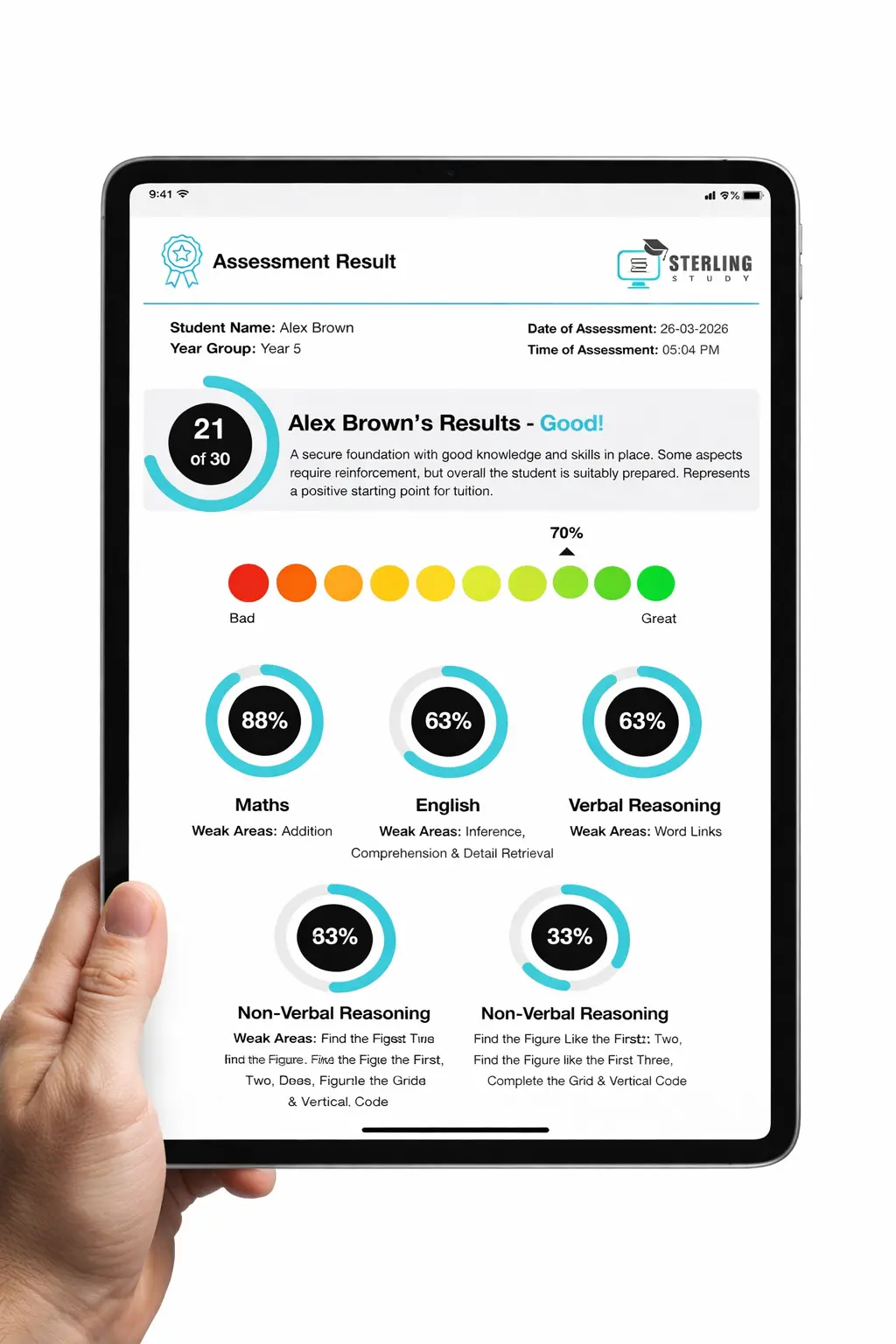
- ✓ Subject-by-subject readiness check across Reading, GPS and Maths
- ✓ A first look at Science, which isn't tested at SATs but is assessed early in Year 7
- ✓ Where they stand against the Key Stage 3 starting point
- ✓ Detailed PDF results sent immediately
- ✓ No strings attached