IGCSE Results Lower Than Expected? Resits, Reviews & What Parents Should Do Next
If your child's IGCSE results are lower than expected, it can be difficult to know what to do next. This guide explains what parents should do after disappointing results, including when a review of marking may be appropriate, how resits work, what to do if a sixth-form place is at risk, and what alternative routes may be available.
A lower-than-expected IGCSE grade is not an automatic verdict on your child's next step. The right response, whether that's a review of marking, a resit, or simply moving forward, depends on the exam board, how far the grade is from the boundary that matters, and what your child actually needs next. The step-by-step answer is below.
If your child's IGCSE results are lower than expected, the first question is usually: what should we do now? Should you request a review of marking, consider a resit, or simply move forward with the grades achieved?
The answer depends on the exam board, subject, grade, distance from the relevant grade boundary and, most importantly, what your child needs for their next step. This guide explains what parents should do after disappointing IGCSE results, including what to check on results day, when a review of marking may be appropriate, how IGCSE resits work, what to do if a sixth-form place is at risk, and what alternative routes may be available.
The important thing is not to make a major decision based on the grade alone. First understand what the result means, what your child actually needs, and which options are available.
This article assumes you have already read the results and understood roughly what each grade means. If you need a refresher on grading scales, grade boundaries or how results are actually released, our companion guide, IGCSE Results 2026: Results Day, Grades, Boundaries and the Results Analyser, covers that in full. Sterling Study's academic team has put together this guide to help parents work through the practical decisions that can follow disappointing IGCSE results.
- Pause before making a major decision. Results day can be emotional, so give yourself time to understand the results properly.
- Check every subject against the actual requirement your child needs for sixth form, college, A-levels or another pathway.
- Find out the exam board and exact marks, where available, particularly if the result is close to an important grade boundary.
- Speak to the school's exams officer about the result, possible reviews of marking, deadlines and resit opportunities.
- Consider a review of marking carefully if the grade is close to a boundary and there is a genuine reason to question the marking.
- Consider a resit if the subject is important for your child's next step and there is a realistic opportunity to improve.
- If a sixth-form place is at risk, contact the sixth form directly rather than assuming the offer has been withdrawn.
- If the original plan no longer works, look at alternative pathways before assuming your child's options have closed.
IGCSE Results Lower Than Expected: Review, Resit or Move Forward?
For most families, the decision comes down to three possibilities: review the result, resit the subject, or move forward with the grades already achieved. A review is about checking whether the original assessment was marked correctly, a resit is about giving the student another opportunity to demonstrate their knowledge, and moving forward means accepting the result and choosing the best available next step.
The right option depends on whether the grade actually affects your child's plans. A result that feels disappointing may not require any action if it still meets the requirements for the next stage.
Not sure what your child needs to work on next? A free diagnostic assessment can help before you decide, see how to identify what your child needs to improve below.
What Counts as a Disappointing IGCSE Result?
"Bad result" is a subjective label, and it is usually not a very useful one. A grade can be lower than a predicted grade, lower than a mock result, below a sixth-form's published requirement, or simply lower than a student's usual standard in one subject, while everything else is fine. None of these situations are the same, and none of them deserve the same response.
Rather than asking whether a grade is "bad", it is more useful to ask what consequence it actually has. A Grade 5 that a sixth form needed as a Grade 6 is a real problem. A Grade 5 that nobody downstream requires anything higher for is disappointing, perhaps, but not urgent. For parents, the most useful question is therefore not "Is this a bad grade?" but "Does this grade prevent my child from doing what they want to do next?"
What to Do If IGCSE Results Are Lower Than Expected
What should I do if my child's IGCSE results are lower than expected? Check every subject against the exact requirement your child needs, avoid requesting anything or making a decision within the first few minutes, contact the school's exams officer the same day, and treat a review of marking and a resit as separate questions to work through once you understand the facts, not automatic reactions to a disappointing number.
The first ten minutes
- ✓Check every subject, not just the ones you were worried about.
- ✓Note the grading scale used for each subject: Cambridge, Pearson and OxfordAQA don't always present results identically.
- ✓Take a screenshot or photograph of the results if they have been issued digitally, and keep a copy of the official statement.
- ✓Note any unusual codes or missing results and flag these to the school immediately.
- ✓Identify which grades are below what was expected, and which are below what is actually required.
- ✓Don't request a review of marking simply because the grade is disappointing. Ask the exams officer about the raw mark, grade boundary, available script, possible review service, and what other support or deadlines apply.
The rest of the day and the following 24 hours
Post-results deadlines are relatively short and vary by exam board and service. For the June 2026 series, Cambridge International's deadline for Enquiries About Results is 20 September 2026. Pearson Edexcel's standard deadline for International GCSE Review of Marking and Moderation (ROMM) Services 1, 2 and 3 is 24 September 2026. OxfordAQA's review-of-marking deadline is 25 September 2026, while its clerical re-check and review-of-moderation deadlines are different. Priority services and internal school deadlines can both be earlier than these dates.
Don't compare your child's results with their friends' results, out loud or otherwise. Don't request a review of marking before understanding what the possible outcomes actually are. Don't assume one disappointing grade means the entire original plan is over.
If One or More Grades Are Low
The right response differs quite a lot depending on whether this is one subject that went wrong or a pattern across several.
One unexpectedly low grade
Where everything else landed roughly where you expected and one subject stands out, it is worth investigating that subject specifically. Compare the grade against the exact requirement it needs to meet, ask the school whether a review of marking might be relevant, and consider whether targeted subject support would help if a resit becomes the plan.
Two or three lower-than-expected grades
Don't request multiple reviews of marking automatically just because several subjects disappointed. Instead, discuss with the school whether there's a pattern (a particular exam board, a particular paper style, a specific gap in preparation) and work out which grades actually carry a consequence for the next step, since not all of them will.
Several significantly low grades
Where the results are substantially below expectations across multiple subjects, the most useful first step is usually not a review of marking at all, it's a conversation about the next stage itself. Discuss sixth-form or college options honestly, consider whether resits make sense for one or two priority subjects rather than everything, and identify the underlying learning gaps before committing to further study in the same subjects.
What If My Child Failed an IGCSE?
What counts as a "fail" depends on the qualification and grading scale used, and there is no single universal rule for what happens next. Some schools set their own minimum requirements for progression; some sixth forms or colleges require particular grades for particular subject combinations; some pathways don't require the subject at all. The only reliable source for what happens in your child's specific case is the school or the exams officer.
What If My Child Failed IGCSE Maths or English?
What happens after a low Maths or English result depends on the qualification and where the student is studying. The rules for GCSE English Language and Maths in England should not automatically be applied to International GCSE qualifications. For students taking IGCSEs, parents should ask the school or exam centre whether a resit is required, recommended or simply available as an option. The answer can depend on the exam board, qualification, country, school policy and the student's intended next step.
Maths and English can be important for sixth-form entry, later university applications and some employment or apprenticeship routes. If either result is below what your child's next step requires, treat it as a priority rather than an afterthought, regardless of whether the school technically requires a resit.
Should My Child Request a Review of Marking?
Can an IGCSE review make the grade go down? Yes. A post-results review does not guarantee that a grade will increase. Depending on the exam board and service, the result may remain unchanged or the mark and grade may change. Parents should therefore understand the possible outcomes before requesting a review and discuss the decision with the school's exams officer.
A review of marking is a formal post-results check of whether the marking was applied correctly against the exam board's mark scheme. It isn't a completely fresh marking of the paper simply because a parent or student disagrees with the result. It exists to catch genuine marking or clerical errors, not to close a gap between the grade a student wanted and the grade they received. It is worth discussing with the school when there's a specific reason to think marking may have gone wrong, particularly when a student is close to a grade boundary that actually matters. It is generally not worth pursuing simply because a result is disappointing, with no specific concern behind it and no realistic effect on the next step.
When a review may be worth discussing
- ✓The grade sits close to a boundary the school or your child believes was genuinely within reach.
- ✓The school has a specific reason to think the marking or recorded marks may need checking.
- ✓The outcome could materially change the next step, such as a sixth-form place or subject choice.
Being close to a grade boundary is not, by itself, evidence that a review will change the result. The important questions are whether there is a specific reason to question the marking and whether a changed grade would actually affect the student's next step.
When a review may not be the best option
- ✓The grade is comfortably below the required boundary, with a gap a review is very unlikely to close.
- ✓There's no specific marking concern, just general disappointment with the result.
- ✓A different grade wouldn't actually change the pathway available to your child.
What can happen after a review?
Depending on the board, a review can involve a clerical re-check (confirming marks were totalled and recorded correctly), a full review of marking (a senior examiner checks the mark scheme was applied correctly), or a review of moderation for coursework. None of these are a re-mark from scratch, and none of them come with a guarantee the grade will improve. Before proceeding, ask the exams officer what service is being requested, what it costs, what the deadline is, and whether a copy of the marked script can be seen first to help decide if a review is worth it at all.
Cambridge vs Pearson vs OxfordAQA: How the Review Process Differs
Procedures, terminology and deadlines are not identical across Cambridge, Pearson Edexcel and OxfordAQA. Always check the board named on your child's own results statement rather than assuming one board's process applies to another.
Cambridge International: What Parents Need to Know
Cambridge calls its post-results process an Enquiry About Results (EAR). Requests are submitted by the school or exam centre through Cambridge International Direct rather than directly by parents or students. The available service depends on the qualification and component and can include a review of marking or re-moderation. The outcome may leave the result unchanged or result in a change, so parents should discuss the specific case with the exams officer before proceeding. For the June 2026 series, the deadline for Enquiries About Results is 20 September 2026, although schools may set an earlier internal deadline. Cambridge states that enquiries are processed in the order received and that the outcome is normally communicated within 30 days of receiving the enquiry. Cambridge also has priority enquiry services for eligible UK candidates in certain circumstances, so if a progression or university decision is time-critical, ask the exams officer which service applies to your child's qualification. Always check the current Cambridge guidance through your school before requesting a post-results service.
Pearson Edexcel: What Parents Need to Know
Pearson calls its post-results process Review of Marking and Moderation (ROMM). Requests are made through the school or exam centre. For the June 2026 series, the standard deadline for ROMM Services 1, 2 and 3 for International GCSE is 24 September 2026. Pearson also provides priority services for certain candidates whose progression depends on the outcome, with earlier deadlines. Pearson recommends that schools consider Access to Scripts and other available results information before deciding whether a review of marking is appropriate. This free service allows schools to view a candidate's marked script first. Because a review can result in a change to the outcome, candidates should give the required consent and discuss the possible consequences with their exams officer before proceeding.
OxfordAQA International: What Parents Need to Know
OxfordAQA provides post-results services including Access to Scripts, clerical re-checks, reviews of marking and reviews of moderation. Requests are submitted through the school or exam centre. For the May/June 2026 series, the review-of-marking deadline is 25 September 2026, while the clerical re-check and review-of-moderation deadlines are different. A review can result in the outcome remaining unchanged or changing, so it should be considered carefully rather than treated as an automatic response to a disappointing grade. OxfordAQA also has priority services in certain circumstances, so parents should ask the exams officer which service applies. Always confirm the current deadline and service available for the specific qualification with the school.
Board-by-board comparison
| Exam board | Qualification | Post-results process | Can outcome change? | Who submits? |
|---|---|---|---|---|
| Cambridge International | Cambridge IGCSE | Enquiries About Results (EAR) | Yes, depending on service | School / exam centre |
| Pearson Edexcel | International GCSE | Review of Marking and Moderation (ROMM) | Yes | School / exam centre |
| OxfordAQA | International GCSE | Reviews of Results | Yes | School / exam centre |
Important: the exact service, fee, deadline and possible outcome depend on the qualification, component and exam series. Always confirm the current position with the exam centre before submitting a request.
Should My Child Resit an IGCSE?
Can you resit an IGCSE? A resit may be possible, but it is not automatically available for every subject, qualification or exam series. The options depend on the exam board, subject, assessment structure, available series and the centre through which the student enters. The first question to ask is not simply "Can my child resit?" but "Which exam series can my child enter, and which components would they need to retake?" Before deciding to resit, ask the school or exam centre which series are available, when entries close, which components must be retaken and what preparation would be needed to make a meaningful improvement.
When a resit may make sense
- ✓The required grade was narrowly missed and the subject is genuinely needed for the next step.
- ✓The student can realistically improve with focused preparation before the next series.
- ✓The school recommends it and a suitable exam series is available for the subject.
When a resit may not be the best option
- ✓Several subjects need significant improvement, and resitting all of them isn't realistic.
- ✓A different pathway is available that doesn't require the subject at the missed grade.
- ✓The intended school or college doesn't actually require that specific grade.
- ✓The student needs targeted support to close a learning gap before a resit would be worthwhile.
Cambridge and Pearson both run additional series later in the academic year for many subjects, but not every subject is offered in every series, and private candidates face different entry routes again. Confirm directly with the school which series is realistic for your child's specific subjects before building a plan around it.
When Is an IGCSE Resit Actually Worth It?
A resit is most useful when the additional grade will make a meaningful difference to your child's next step. If your child missed a required grade by a small margin, needs the subject for A-level study, or needs the qualification for a particular pathway, a resit may be worth serious consideration. If the grade already meets the requirement, however, there may be little benefit in retaking the exam simply to achieve a higher number.
Before committing, consider four questions:
- 1Does the grade actually matter for the next step?
- 2How much improvement is realistically achievable?
- 3When is the next available exam series?
- 4What would your child need to change in their preparation to improve?
A resit should be based on a realistic improvement plan, not simply on the hope that another attempt will produce a different result.
Review or Resit? How to Decide
A review and a resit solve different problems. A review asks whether the original marking should be checked, while a resit gives the student another opportunity to sit the relevant assessment in an available exam series. If your child is only a small number of marks below a grade that genuinely matters, it may be worth discussing a review with the school. If the gap is larger, there is no specific concern about the marking, or the student needs to strengthen their knowledge and exam technique, a resit may be the more realistic route. In either case, start by checking the exact requirement your child needs and the options available through their exam centre.
| Situation | Review worth discussing? | Resit worth discussing? | First step |
|---|---|---|---|
| Very close to required grade | Possibly, depending on the marking information | Yes, if the grade is genuinely needed | Speak to exams officer |
| One full grade below requirement | Usually not, unless there is a specific marking concern | Often worth considering | Check the mark gap and resit availability |
| Several grades below expectations | Only if there is a specific concern | Consider priority subjects selectively | Discuss wider pathway |
| Grade already meets requirement | Usually unnecessary | Usually unnecessary | Confirm next-step requirements |
| Sixth-form place at risk | Discuss urgently if a review could affect admission | Possibly | Contact sixth form immediately |
What If My Child Missed Their Sixth-Form Requirements?
This is one of the most urgent situations on results day, and it needs a direct conversation with the sixth form itself, not just the school your child is leaving. Admissions decisions belong to the receiving institution, and no guide can promise what any individual sixth form will decide.
Missing a published requirement does not always mean the decision is final. Some sixth forms may have flexibility, depending on their admissions policy, available places and the student's overall results, but this varies considerably between institutions.
- ✓Contact the sixth form the same day, ideally by phone, and explain the situation clearly.
- ✓Ask whether there's any flexibility on the specific grade that was missed.
- ✓Check whether the requirement applies to the exact qualification your child sat; some sixth forms treat Cambridge, Pearson and OxfordAQA grades slightly differently.
- ✓Ask whether an alternative subject combination might still work with the grades achieved.
- ✓Ask whether a review of marking, if one is being considered, could realistically affect the decision, and by when it would need to conclude.
- ✓If the answer is no, start looking at another sixth form, college, or Level 3 pathway promptly rather than waiting.
What If My Child Has Missed the Grade for Their Chosen A-Level?
A sixth form may have both general entry requirements and additional requirements for individual A-level subjects. Missing the subject-specific requirement can therefore be different from missing the school's overall entry threshold.
For example, a school may accept a student into Year 12 but require a particular GCSE or IGCSE grade in the relevant subject, commonly Maths, Further Maths, Chemistry, Biology or Physics, before allowing them to study it at A-level. If your child has missed that grade, ask whether another subject combination is possible, whether the school offers an alternative route, or whether a resit could allow them to meet the requirement later.
Always check the individual sixth form's published requirements rather than relying on a general grade rule.
What If the Original Plan Doesn't Work?
If the intended sixth-form place, subject combination or pathway is no longer realistic, there are usually more options than it feels like on the day itself. An alternative route is not necessarily a setback. The best option depends on the student's strengths, ambitions, preferred learning style and the qualifications they need for their longer-term goal. A different sixth form, vocational qualification, apprenticeship, resit or later progression route can all lead to further education and employment.
- ✓A different sixth form or college with a place still available.
- ✓An alternative A-level subject combination at the same school.
- ✓Level 3 vocational or technical qualifications, where available.
- ✓T Levels or other Level 3 technical qualifications, where available and appropriate.
- ✓Foundation or bridging options where a sixth form or college offers them.
- ✓Resitting a small number of priority subjects while starting the next stage elsewhere.
- ✓Apprenticeship routes, where age and eligibility allow.
- ✓A short delay to reset, retake, and start the next stage from a stronger position.
How Parents Should Talk to Their Child After Disappointing Results
How results day goes for your child often has more to do with how the conversation is handled than with the number on the page. It's worth pausing before reacting, particularly in the first hour.
"You didn't work hard enough." "What will everyone think?" "Your friends did better than you."
"Let's understand the result properly before we decide anything." "One result doesn't decide everything about what happens next." "We'll work through the options together, and speak to the school first."
If your child is visibly upset
Give them space rather than immediately moving into problem-solving mode. Avoid comparing their results with anyone else's, listen before offering opinions, and where possible delay major decisions until everyone, including you, has had a chance to think clearly. Involving a trusted teacher can help take some of the emotional weight off the conversation at home. If your child seems seriously distressed rather than simply disappointed, it is worth seeking appropriate support from the school or a qualified professional rather than trying to resolve everything through academic planning alone.
How to Identify What Your Child Needs to Improve Before a Resit
If a resit is being considered, the most useful question is not simply "How can my child study harder?" but "What caused the marks to be lost in the first place?"
The answer might involve specific subject gaps, exam technique, timing, interpreting questions, or a combination of factors. Understanding this before preparing for a resit can make the preparation much more targeted.
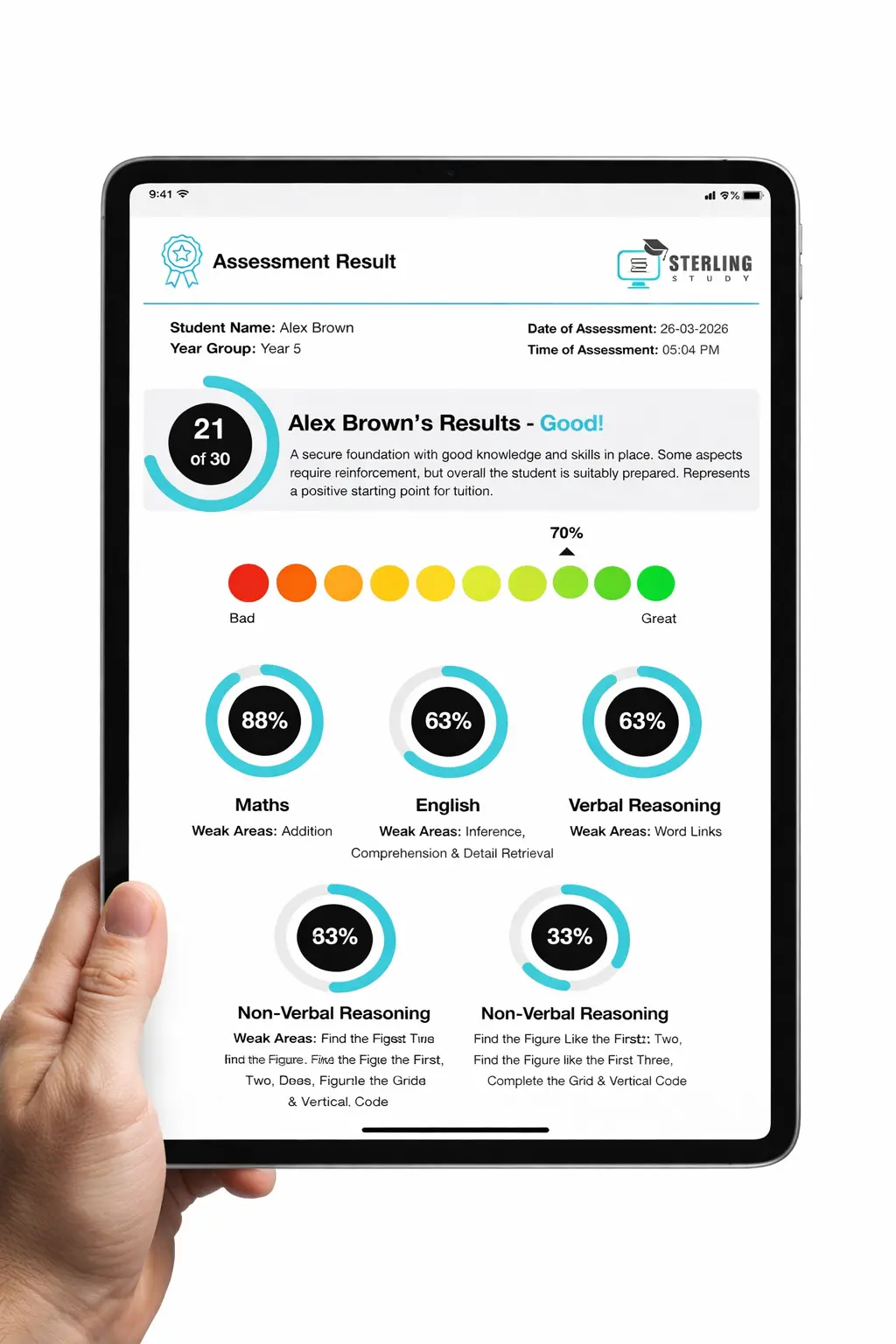
A diagnostic assessment can help identify these areas. Sterling Study offers a free diagnostic assessment for families who want a clearer picture of where their child may need support before deciding on their next academic step.
- ✓ Subject-by-subject breakdown of strengths and gaps
- ✓ Built by Sterling Study's PhD-led academic team
- ✓ Useful whether your child is resitting, moving to A-levels, or exploring another route
- ✓ Detailed results sent immediately, no obligation to continue
What to Do Next After Lower-Than-Expected IGCSE Results
A disappointing IGCSE result is information, not a final verdict on your child's future. Start by understanding exactly what the result means, what their next step requires and which options are genuinely available. A review may be appropriate in some cases, a resit may make sense in others, and sometimes the best decision is simply to move forward with the grades already achieved. The important thing is to make that decision using the facts, the exam board's current guidance and your child's individual circumstances, rather than the emotion of results day.
IGCSE Results: Parent Checklist
- ✓Check the exact qualification and exam board before relying on any general advice about reviews or resits.
- ✓Read every subject on the statement, not just the ones expected to disappoint.
- ✓Compare each grade with the exact requirement your child's next step actually needs.
- ✓Contact the school's exams officer the same day for facts, not decisions.
- ✓Ask about review of marking only where there's a specific reason to think it's worthwhile.
- ✓Ask about resit timing and availability for the specific subjects involved.
- ✓Contact any sixth form or college directly if a place looks at risk.
- ✓Talk to your child before talking about your child, and involve them in the decision.
- ✓Consider a diagnostic assessment to understand the underlying gaps before committing to a plan.
Questions to Ask Your Exams Officer
- 1What qualification and syllabus did my child actually sit?
- 2What mark did my child receive, what was the grade boundary, and how many marks separated the two?
- 3Is a review of marking available for this component, and is it worth requesting?
- 4What are the possible outcomes, including the risk the grade could fall?
- 5What is the school's internal deadline, and what does the process cost?
- 6Can we access the marked script before deciding whether to request a review?
- 7What resit opportunities exist for this subject, and when?
- 8Would a review or resit realistically affect the sixth-form decision?
- 9What alternative pathways does the school recommend, if any?
Frequently Asked Questions
What should I do if my child's IGCSE results are lower than expected?+
Can my child resit an IGCSE?+
Should my child resit an IGCSE?+
Can an IGCSE review of marking make the grade go down?+
How close to a grade boundary should my child be before requesting a review?+
What are the 2026 IGCSE review-of-marking deadlines?+
How much does an IGCSE review cost?+
What if my child missed their sixth-form entry requirements?+
Can my child still do A-levels after disappointing IGCSE results?+
What happens if my child gets several low IGCSE grades?+
What if my child failed IGCSE Maths or English?+
Do lower IGCSE grades affect university applications?+
What should parents say after disappointing exam results?+
Read These Next
 Results Day Guide
 Results Day Guide
 Results Day Guide