IGCSE Results 2026: Results Day, Grades, Boundaries and the Results Analyser
Cambridge IGCSE results were released to schools on 18 August 2026, and Pearson Edexcel International GCSE results follow on 20 August. This guide explains how students actually receive their results, what the grades mean, where to find official grade boundaries, and what to do if a result is lower than expected, with a free interactive Results Analyser built for Cambridge and Edexcel grades.
Want a clearer picture of a set of results? Jump straight to the free Results Analyser →
Cambridge IGCSE results for the June 2026 series were released to schools on 18 August 2026, while Pearson Edexcel International GCSE results reach students on 20 August 2026. Both boards route results through your school, use different grading scales in places, and publish grade boundaries separately after each series. If a result comes in lower than expected, a review of marking or a resit are both normal next steps. Use the free Results Analyser below to see the overall shape of a set of results.
IGCSE results can be confusing, particularly if your child has taken subjects with different exam boards. Cambridge IGCSE results for the June 2026 exam series were released to schools on 18 August 2026, while Pearson Edexcel International GCSE results are released to students on 20 August 2026. This guide explains when results are released, how students receive them, what the different grading systems mean, how grade boundaries work, and what to do if a result is lower than expected. It also includes a free IGCSE Results Analyser to help you understand the overall picture.
IGCSE Results 2026 at a Glance
| Cambridge IGCSE | Pearson Edexcel International GCSE | |
|---|---|---|
| 2026 results date | 18 August, 06:00 BST/UTC+1 — released to schools/centres | 20 August — released to students |
| Results to centres | 18 August, via Cambridge International Direct | 19 August, under restricted access |
| Student access | Through school/centre arrangements; some schools use the Candidate Results website | Through school/college; ResultsPlus Direct from 9am UK time if registered |
| Main grading | Depends on subject: A*–G or 9–1 | 9–1 |
| Grade boundaries | Published by Cambridge, per syllabus and series | Published by Pearson, from results day |
| Post-results service | Enquiries about results | Review of marking and moderation (ROMM) |
Some detail varies by qualification and centre. Always check the specific syllabus with your school.
Before, on, and after results day
When Are IGCSE Results Released in 2026?
IGCSE results dates depend entirely on which exam board a student sat their papers through, and the two major boards do not release on the same day. This catches families out most often when a child has sat some subjects with Cambridge and others with Edexcel.
Both boards send results to schools before students see them, and both leave the exact time and method of student access to the school. Neither board emails results directly to a student's personal inbox.
Your school or exam centre is the main route to your results. The exact method varies between schools: you may collect a printed statement, receive results through a school portal, or be given access to an online results service. Check with your exams officer before results day so you know exactly how your results will be issued.
Cambridge IGCSE Results 2026
Cambridge released June 2026 IGCSE and O Level results from 18 August 2026 at 06:00 BST/UTC+1, according to Cambridge's official results information. Results are made available to schools and centres through Cambridge International Direct, after which schools can issue them to candidates according to their own arrangements.
- ✓Direct is the school/centre-facing system; individual students don't log into it themselves.
- ✓Your school decides how you receive your results, in person, by email, or through a portal.
- ✓Some schools enable student access through Cambridge's own Candidate Results website, a separate, student-facing system, but login details are issued by the school, not by Cambridge directly.
- ✓Private candidates should check directly with the organisation they registered through, such as the British Council or another approved exam centre, for their results arrangements and login details.
- ✓If you don't know how you'll receive your results, contact your school's exams officer rather than searching for a generic "Cambridge results login."
Pearson Edexcel International GCSE Results 2026
Pearson released International GCSE results to centres under restricted access from 19 August 2026, with results reaching candidates on 20 August 2026. Students registered by their centre for ResultsPlus Direct can access results from 9am UK time.
- ✓Centres receive results a day ahead, under confidentiality rules, purely to organise results day arrangements.
- ✓ResultsPlus Direct is Pearson's own online service, but only for students their centre has registered for it.
- ✓If you don't have ResultsPlus Direct login details, your school or college sets the time and method for collecting results.
- ✓ResultsPlus Direct also shows some detail on performance by paper, useful context before checking grade boundaries.
How Do I Check My IGCSE Results?
For most students, the school or exam centre remains the main starting point for accessing results. The exact process depends on the exam board and the arrangements made by your centre. You may collect a printed statement, receive your results through a school portal, or be given access to an online results service. If you have problems accessing your results on results day, contact your exams officer rather than repeatedly trying to log in.
A few things are worth confirming with your school before results day itself, rather than on the morning: whether you'll collect a printed statement in person, receive a digital copy by email, or need login details for a portal; who to contact if something looks wrong; and, for private candidates, whether the registering organisation (such as the British Council) is the one issuing login credentials rather than the school. Private candidates in particular sometimes assume Cambridge or Pearson will contact them directly. In practice, it's almost always the organisation you registered through.
What if my child took both Cambridge and Pearson?
Some students take different IGCSE subjects with different exam boards. If that applies to your child, you will not receive one combined set of results. Cambridge and Pearson issue results separately, so the dates and method of access may differ. Check each result against the relevant exam board's grading system and the entry requirements for your child's next step.
The Free IGCSE Results Analyser
Enter your child's subjects, exam board and grades to get a simple picture of their overall results profile. The analyser is designed as a quick interpretation tool and works in your browser; it does not replace the official results statement issued by Cambridge or Pearson.
How the IGCSE Results Analyser works
Enter each subject, select the relevant exam board and choose the grade shown on the official results statement. The analyser groups results into broad performance bands to help you see the overall profile of a set of results. It does not calculate official grades, predict grade boundaries or provide an official conversion between Cambridge and Pearson grading systems. For sixth-form applications, university applications or any formal decision, always use the official result and the specific entry requirements of the institution.
How to Read an IGCSE Results Slip
An IGCSE Statement of Results looks fairly plain, but each line carries specific information.
| Field | What it means |
|---|---|
| Candidate details | Name, candidate number and centre number; confirm these match before reading further. |
| Subject & syllabus code | The exact subject and syllabus variant taken. |
| Grade | The final awarded grade, as a letter (A* to G) or a number (9 to 1). |
| Component/paper information | Where shown, a breakdown by individual assessment component. |
| Result codes | UNGRADED, PENDING or NO RESULT; covered further down this guide. |
Results statement vs certificate
The slip you see on results day is a same-day statement, not your formal certificate. The certificate is issued separately, usually reaching the school a few months later. Most sixth forms and colleges will accept the results statement as interim evidence in the meantime.
What Do IGCSE Grades Mean?
Cambridge and Pearson Edexcel do not use identical grading systems, and not every Cambridge IGCSE subject uses the same scale either.
Cambridge IGCSE: A*–G
Most Cambridge IGCSE subjects use the traditional A* to G scale, A* the highest, G the lowest pass grade. Not every Cambridge IGCSE subject uses this scale, so check the specific syllabus.
Cambridge IGCSE: 9–1
A smaller number of Cambridge IGCSE qualifications are reported on a 9-to-1 scale instead, 9 the highest. Which scale applies depends on the subject and syllabus.
Pearson Edexcel International GCSE: 9–1
Pearson's International GCSE qualifications use the 9-to-1 numerical scale throughout, broadly mirroring the system used for GCSEs in England.
The two scales are broadly comparable at certain points, but there is no official, universal formula converting one grade directly into the other. A results slip showing both scales across different subjects should be read subject by subject, not flattened into a single number.
What Are IGCSE Grade Boundaries?
A grade boundary is the minimum raw mark needed, on a paper or across a whole subject, for a particular grade to be awarded. Boundaries are not fixed year to year. Both Cambridge and Pearson set them after each exam series using statistical evidence and examiner judgement, partly to account for papers being harder or easier than the previous series.
This means a mark that earned a grade 7 last year might land on a 6 this year, purely because that year's paper was more demanding, not because standards shifted. Last year's boundary cannot reliably predict this year's grade. Pearson's Summer 2026 results support page confirms this year's official grade boundaries are published from results day, alongside notional paper-level boundaries used for future mock marking.
How Grade Boundaries Work: A Simple Example
Imagine a student scores 72 marks on a subject. That number alone doesn't tell you whether they achieved a 7, an 8, or a 9. You'd need to know the specific qualification, how the paper or components are weighted, and the grade boundaries published for that exact subject and series. The same 72 marks could sit on either side of a boundary depending entirely on how demanding that particular exam series was. This is why we haven't quoted an actual 2026 boundary figure in this guide: the real numbers are subject- and series-specific, and only the exam board's own published tables are a reliable source.
No. The tool below can help you interpret a set of results, but official boundaries always come from Cambridge or Pearson directly, never from a third-party calculator.
Where should I find the official 2026 boundaries?
Use the grade-boundary information published by the relevant exam board for the exact qualification, syllabus and exam series. Do not rely on screenshots, social-media posts or third-party boundary calculators, particularly when a grade is close to an important entry requirement. See Cambridge grade boundaries and Pearson grade boundaries for the current published figures.
- ✓ Subject-by-subject breakdown across Cambridge and Edexcel IGCSE syllabuses
- ✓ Comparison against published grade boundaries
- ✓ Where marks were lost vs the threshold needed
- ✓ Detailed PDF results sent immediately
- ✓ No obligation
What Is a Good IGCSE Result?
There's no single number that makes a result "good." A good result depends on:
- ✓The specific entry requirements of the sixth form or college your child is applying to.
- ✓The A-level subjects they intend to take, and any grade thresholds those subjects carry.
- ✓Longer-term ambitions, such as medicine or engineering, which often carry higher Science thresholds.
- ✓How the result compares with previous mock or practice performance.
- ✓Whether the grade narrowly missed a requirement, in which case a review may be worth exploring.
A grade 6 may be more than enough for one sixth-form course but may not meet the requirement for another. The important question is therefore not simply whether a grade is "good", but whether it meets the requirements for the student's intended next step. Always check the specific entry requirements of the sixth form, college or course.
What Do UNGRADED, PENDING and NO RESULT Mean?
Result codes can vary between exam boards and qualifications, so treat the table below as a general guide and check the exact meaning against the relevant board's guidance or with the school's exams officer. NO RESULT in particular can cover several different situations, including where a candidate was absent from or withdrawn from a component, not only "no result issued", so don't assume a single cause without checking.
| Result code | What it may mean | What to do |
|---|---|---|
| UNGRADED | Mark fell below the threshold for the lowest pass grade | Check the result and speak to the school |
| PENDING | Result not yet finalised, often a component still being processed | Contact the exams officer immediately |
| NO RESULT | Can indicate an outstanding component, absence, or withdrawal, exact meaning is board-specific | Contact the school straight away |
What If My Child's IGCSE Results Are Lower Than Expected?
A result below expectations can be difficult, but it is not necessarily a dead end. The most useful first step is to understand exactly what the result means for your child's next step before making any decision about a review, resit or alternative pathway.
- Don't make a decision immediately. Give it a day if you can.
- Check the individual subjects, not just the overall impression.
- Check the required grades for the specific next step in question.
- Speak to the school before deciding on anything formal.
- Consider a review of marking if a grade looks unusually low or narrowly missed a boundary.
- Consider a resit if a review isn't appropriate or doesn't resolve it.
- Look at alternative pathways where relevant, bridging arrangements, BTECs or apprenticeships.
A result taken on a handful of mornings doesn't capture everything a student knows. Many students who resit perform considerably better the second time, largely because they already understand the format.
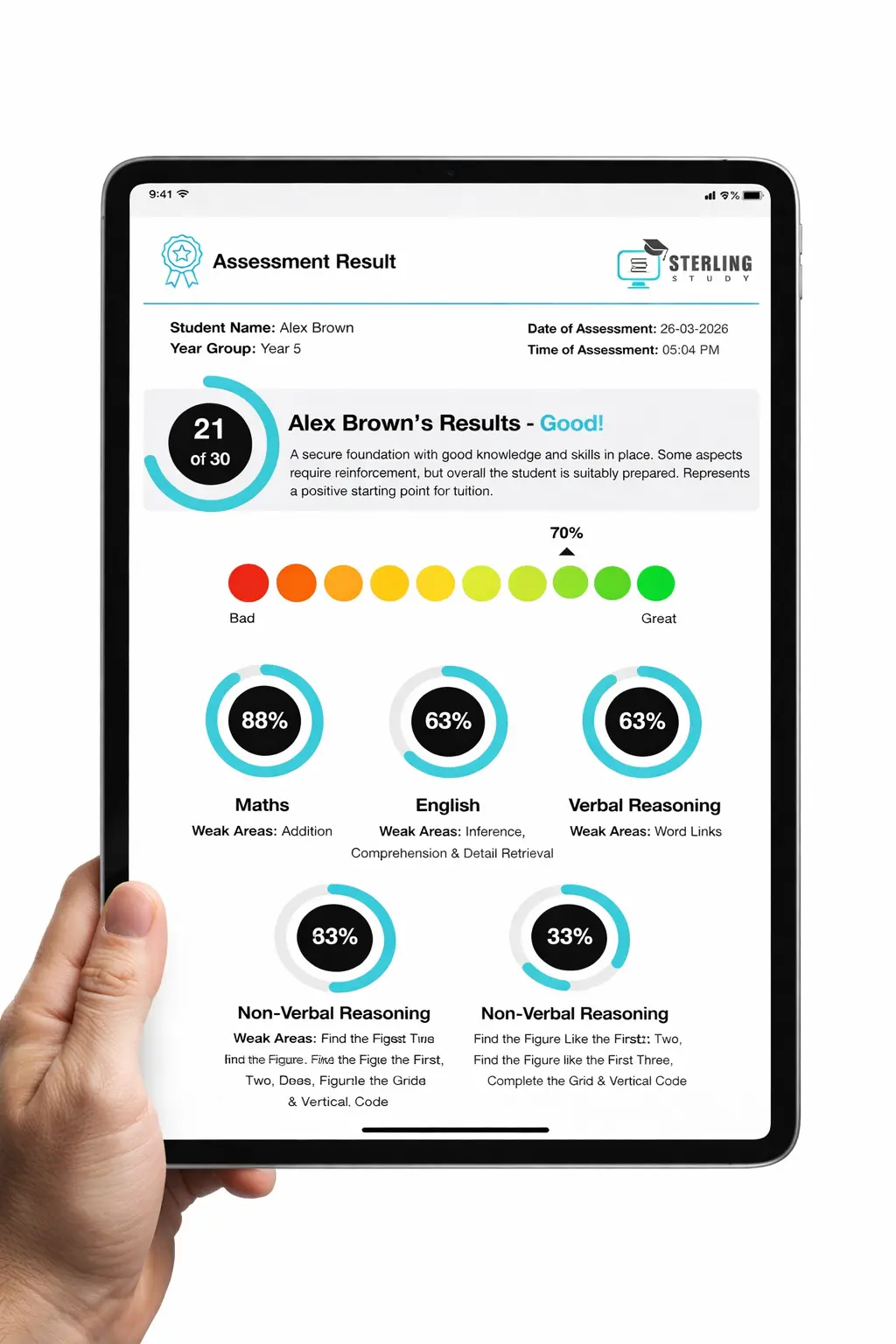
Sterling Study's PhD-led team, co-founders Dr Parth Patel and Dr Igors Pupko, offers a free diagnostic assessment to identify specific learning gaps before the new school year. Every tutor is DBS-checked under a named Safeguarding Officer. Book a Free Diagnostic →
Can I Request a Review of an IGCSE Result?
Cambridge calls its post-results process an enquiry about results, while Pearson uses the term review of marking and moderation (ROMM). These services are requested through the school or exam centre. Depending on the service, a result can remain unchanged, increase or decrease, so students should speak to their exams officer before requesting a review.
A review is not automatically worthwhile simply because a result is lower than expected. It may be worth discussing with the school when there is a specific reason to believe the marking should be checked, particularly if a student is close to an important grade boundary or entry requirement. Before requesting a review, ask the exams officer about the possible outcomes, costs and deadlines.
- ✓Pearson's 2026 guidance sets a ROMM deadline of 24 September 2026 for GCSE, A level and International GCSE.
- ✓Cambridge's enquiry deadlines are set per series; check with your school for the exact date.
- ✓There may be a cost involved, depending on the board and service level; confirm this with your exams officer.
What About Other IGCSE Boards?
Cambridge and Pearson Edexcel are two major providers of international secondary qualifications, but they aren't the only ones. Some schools use OxfordAQA International GCSEs instead, and a small number of qualifications sit under other awarding organisations entirely. If your child's results slip doesn't mention Cambridge or Edexcel, don't assume this guide's dates or grading scales apply directly, check the awarding body named on the slip itself and go to that board's own results and post-results pages, since release dates, access arrangements and review deadlines are all set independently by each awarding organisation.
Can My Child Resit an IGCSE?
In many cases, yes, but the options depend on the exam board, qualification and available exam series. If your child is considering a resit, speak to the school or exam centre first. They can confirm which subjects can be retaken, the next available exam series and the relevant entry deadline.
What Do IGCSE Results Mean for Sixth Form?
Sixth-form and A-level entry requirements are built directly on IGCSE performance, particularly for Maths-heavy subjects, but exactly what's required varies by sixth form, school, specific A-level subject, course and, for international applicants, by institution. There is no single national threshold.
Two sixth forms can quote different requirements for the same A-level subject: one might ask for a grade 6 in the relevant IGCSE, another a 7, and a more academically selective school may set the bar higher still, particularly for Maths, Further Maths and the sciences. International schools and colleges add another layer of variation, since some set their own internal thresholds on top of, or instead of, a board's headline grade. Meeting the minimum entry requirement does not always guarantee a place, particularly where a course or sixth form is oversubscribed. The only reliable way to check is against the specific published entry requirements of the sixth form, college or course your child is applying to, rather than a general rule of thumb, and to confirm directly with the admissions team if the published requirement is ambiguous about which qualification or grading scale it refers to.
IGCSE Results Day Checklist for Parents
- ✓Check every subject.
- ✓Check the grading scale used for each one.
- ✓Check for unusual result codes.
- ✓Compare grades against the required entry grades.
- ✓Save or download the results statement.
- ✓Speak to the school if something looks wrong.
- ✓Check the official grade boundaries once published.
- ✓Consider post-results options if appropriate.
- ✓Confirm the sixth-form or college place.
- ✓Decide whether further support is needed, and for which subject specifically.
What Should Students Do Next?
- ✓Take a moment to recognise what went well before moving to what didn't.
- ✓Identify the one or two subjects that genuinely need attention, rather than worrying about everything at once.
- ✓Confirm the specific requirements for your next step, not a general assumption about what's "needed."
- ✓Speak to your subject teachers, they know the paper and your performance on it better than anyone else.
- ✓Try not to compare your results with classmates', it rarely helps and often distorts the picture.
- ✓Make decisions based on your own pathway, not what seems to be the default choice around you.
IGCSE Results FAQs
When were Cambridge IGCSE results released in 2026?+
When are Pearson Edexcel International GCSE results released in 2026?+
How do I get my IGCSE results?+
Can I get my IGCSE results online?+
What grades do IGCSEs use?+
Are IGCSE and GCSE the same?+
What are IGCSE grade boundaries?+
What happens if my IGCSE result is lower than expected?+
Can I request a review of my IGCSE result?+
Can my child resit an IGCSE?+
What does UNGRADED mean on an IGCSE result?+
What should I do after receiving my IGCSE results?+
Read These Next
 Sterling Study Insights
 Sterling Study Insights
 Sterling Study Insights