Back to School 2026: The Complete UK Parent & Student Guide
Everything you need to get your child settled, understand where they stand academically, and build better habits for the 2026-27 school year - checklists, routines, holiday dates for all four UK nations, and what to do if things don't settle. Written for parents, with a version for students too.
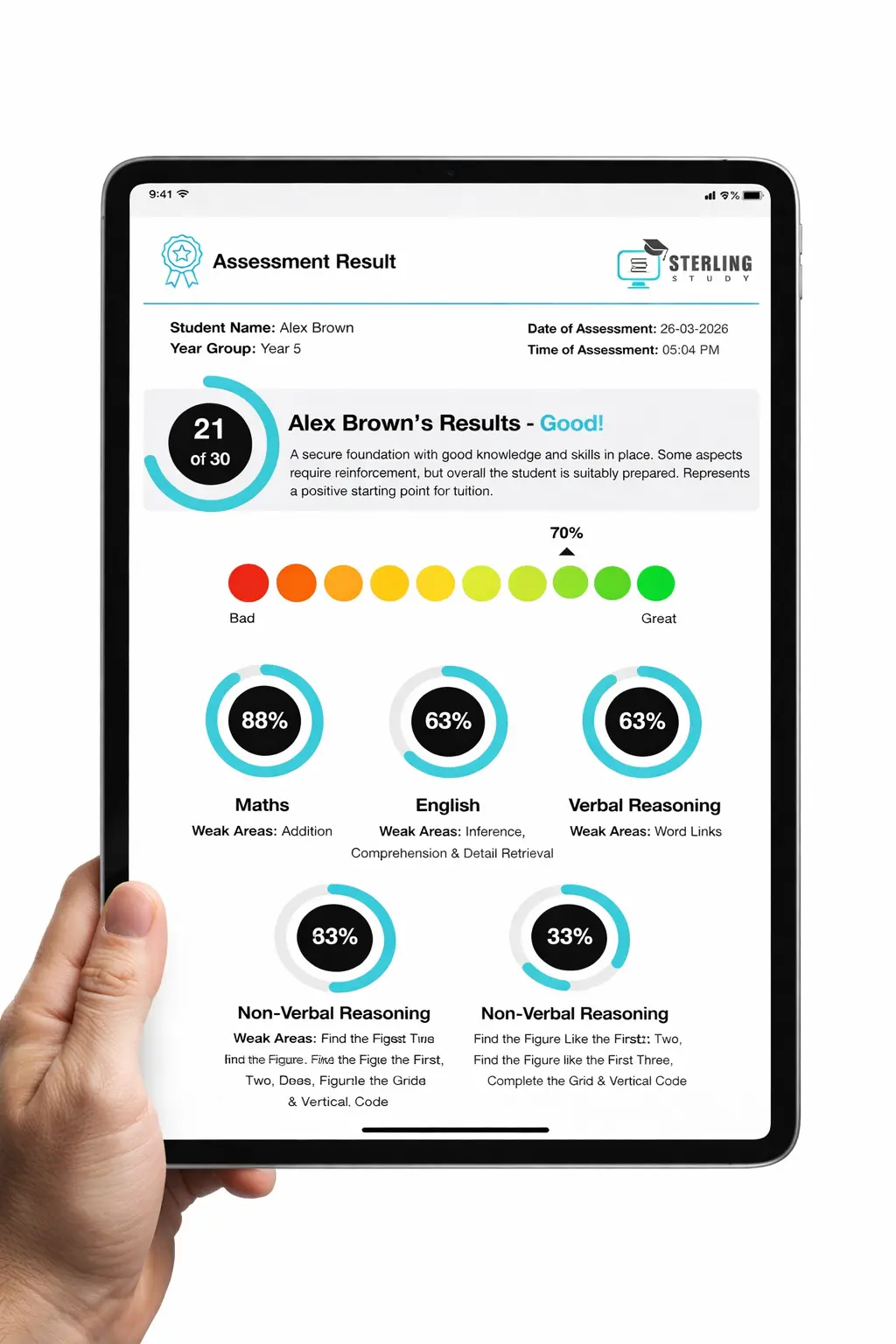
Want a clearer picture of where your child stands? Our free assessment is one way to find out →
Last updated on 2 September 2026
School return dates vary by nation, local authority and individual school, so always check your own school's published calendar. Many schools in England, Wales and Northern Ireland return in early September 2026, while Scottish schools typically start a couple of weeks earlier, in mid-August. This guide is built around four stages: reset the routine, understand where your child actually stands, stabilise the first month, then build habits for the year ahead.
September often feels like a fresh start, but it can also reveal problems that were easy to overlook during the holidays - a subject that was already shaky in July, a routine that's slipped, a child who's quieter about school than they used to be. This guide is built around a structure we use with families year-round at Sterling Study - Reset, Understand, Stabilise, Build - so each section has a clear job, and you can come back to whichever part is relevant at the time. It's written by Dr Parth Patel, who co-founded Sterling Study and holds a PhD in Neuroscience from UCL, alongside co-founder Dr Igors Pupko, who holds a PhD in Genetics from the University of Surrey.
Who Is This Guide For?
Mainly for parents. But there's plenty here students can use directly too - the checklist and goal-setting sections especially. Whether you've got a child starting Reception for the first time, a Year 7 facing secondary school, a GCSE student under real pressure, or a sixth former learning to study independently, this should still be useful. No need to read it cover to cover. Dip into whichever bit you need.
What Actually Changes When the New School Year Starts?
"Be more prepared" isn't actionable advice, so let's get specific about what's actually changing. Sleep schedule. Morning routine. Screen time. Mealtimes. Homework expectations. The level of organisation expected. Friendships. Teacher expectations. Workload. Independence. Often extracurricular commitments on top. All of it shifting at roughly the same time.
That's a lot to readjust to at once. So if a child seems unsettled in the first week or two, that usually isn't "unprepared" in any meaningful sense - it's just the shift from a loose holiday routine into a tight one, and that takes time to bed in. For almost every child. Not just the ones who find school hard.
What should a good start actually look like?
A good start doesn't mean perfect mornings, top grades, or a child who bounces home thrilled every day. September is really just about getting the basics working again - and what "the basics" means depends entirely on the child. Younger, it might be feeling comfortable in a new classroom, knowing where things go, separating from a parent without a scene. In Year 7, it might just mean finding the right room, remembering the timetable, working out how several different teachers each like things done. For a GCSE student, it's usually about understanding what's expected in each subject and getting back into some kind of study rhythm.
A few signs things are heading the right way: mornings getting less chaotic, your child knowing what they need for the day, homework being recorded and done with less prompting. They know who to ask when something doesn't make sense. They can tell you which subjects feel easy and which feel hard. And bit by bit, they're taking on more themselves. The important word there is gradually. Nothing needs to be sorted by the second week of September - what matters is the direction of travel, easier rather than harder.
The Back-to-School Checklist
Print it, stick it on the fridge, whatever works for you. Four stages, so you're not doing all of it in the last 48 hours.
2-3 weeks before school
- Confirm term dates, INSET days and start time with the school
- Check uniform still fits and order anything missing
- Check school supplies and stationery
- Confirm transport arrangements, whether that's a bus pass, walking route or lift share
- Have an honest look back at how last year ended academically
- Check the new timetable if it's already available
- Check school emails and the parent portal for anything you've missed over summer
- Start talking, casually, about what the new year will look like
1 week before
- Start moving bedtime and wake-up time gradually toward school hours
- Re-establish the morning routine - showers, breakfast, getting dressed
- Organise uniform and pack a spare set if needed
- Set up or tidy the homework/study space
- Plan lunches for the first few days so it's one less decision
- Check pencil cases, calculators and any subject-specific kit
The night before
- Pack the school bag together
- Lay out uniform
- Charge any devices that go to school
- Prepare breakfast and lunch, or at least decide what they'll be
- Set the alarm, and check the travel plan one more time
The first week
- Go over the timetable together so it's not a mystery each morning
- Start the homework routine early rather than easing into it
- Check in on how they're settling, without making it feel like an interrogation
- Keep evenings fairly light - this isn't the week to add three new clubs
- Flag any early academic worries rather than waiting to see if they pass
When Should You Start Preparing?
You don't need weeks of lead-in. Start too early and the whole summer turns into a countdown to school - not much fun for anyone. The Department for Education's back-to-school guidance suggests starting the practical reset around a week out: bringing school-time bedtimes back gradually, reintroducing small routines like laying out uniform or packing a bag the night before, instead of flipping the switch on the first morning.
What can happen earlier - in the last two or three weeks - is the quieter groundwork. Confirm term dates. Check the uniform still fits. Be honest about how last year actually ended academically. If a subject was shaky in July, six weeks off hasn't fixed it. September is a much better time to deal with that than October, after the first assessment has already flagged it for you.
Resetting Sleep and Routine
Sleep is usually the first routine to slip over summer, and the one that causes the most trouble once term starts. A child who's been going to bed at 10pm all summer isn't switching to 7:30pm the night before school and waking up fine. It doesn't work that way. GOV.UK's guidance recommends shifting it gradually over the final week rather than all at once - how gradual depends on your child and how far things have drifted, so treat this as a general approach, not a formula.
Screen time needs the same gradual handling. Agree the school-night rules before term starts, so it isn't a fresh argument on night one. There's a point in GOV.UK's back-to-school reset guidance worth holding onto: small, genuine choices - which bag, how to organise the pencil case - give children a sense of control that helps the wider transition. It looks minor. It isn't.
What's Normal in the First Week, and What Should Be Better by the End of the Month?
Normal in the first week
- Tiredness, even if bedtime looks fine on paper
- Forgetting things - kit, permission slips, homework
- Messy, rushed mornings while everyone finds their feet
- Nerves, especially about new teachers or a new class
- Coming home and wanting to do nothing for a while
- Not being entirely sure what's expected of them yet
Reasonable to expect by the end of the first month
- They know their timetable without checking every morning
- They know where homework gets recorded, and use it
- There's a workable, if imperfect, evening routine
- They have a rough sense of what each teacher expects
- They can name which subjects feel comfortable and which don't
- They've settled socially, even if it's just one or two solid friendships
If most of that second list still looks unfamiliar after four weeks, check in with the school. Don't just assume it'll click on its own.
The First 30 Days Back
What to watch for in the first ten school days
A month can feel like a long wait, so keep half an eye on a few things earlier than that. Is the morning routine getting easier, or still chaos? Does your child know what they need each day without being told? Are they keeping up with homework, or already slipping? Is one subject repeatedly causing trouble, or was that just a bad day? Is their confidence about school going up or down as the days pass? None of these need action by themselves. Just notice the direction things are moving in - don't react to any single day.
The Sunday Reset: A 20-Minute Weekly System
A lot of school-week stress comes from Monday morning surprises: a forgotten project, a test nobody mentioned, PE kit still sitting in the wash. Twenty minutes on Sunday evening heads off most of it.
Works best when the child runs it, and a parent just checks in - not the other way round. More on that in the independence section further down.
Checking Your Child's Academic Starting Point
Do this whether tutoring is on your radar or not. Every child comes back from six weeks off at a slightly different point, and the sooner you know where the actual gaps are, the less catching up there is to do later. It also matters what kind of gap you're looking at - "struggling with maths" can mean several quite different things.
Knowledge, skill, organisation or confidence: which gap is it?
"I'm bad at maths" often isn't a general problem. It's usually a specific one wearing a general disguise, and the fix depends entirely on which one it turns out to be. A knowledge gap means the topic itself hasn't clicked yet. A skill gap means they get the idea but can't reliably apply it under pressure. An organisation gap means they know what to do, they just aren't managing the deadlines or the materials. A confidence gap is sneakier - they usually know more than they think, but avoid attempting work in case they're wrong. There's an exam-technique gap too, where the subject knowledge is fine but marks get lost in how questions are answered. And sometimes it isn't any one topic at all - it's a workload problem, where nothing individually is too hard, but the sheer amount of it is what's overwhelming them.
A 20-minute check-in, subject by subject
For maths, ask which topics felt easiest last year, and which ones they avoided. Can they still work through a topic from last year off the top of their head? What kind of question do they usually get wrong? For English, start with whether reading or writing feels harder. Then get more specific: how confident are they analysing a text they haven't seen before? If longer answers are the problem, is it the structure that falls apart, or do they just not know what to say? For science, a simple test works well - can they explain the topic out loud without looking at their notes? If not, is it the knowledge itself that's missing, or the exam questions that trip them up?
Create a September baseline
A baseline doesn't need to be complicated. Just write something down now that you can look back at later. Strongest subject, and what they're actually confident doing in it. Weakest subject, and where they need the most help. Any topic they can't yet explain, or keep getting wrong. What recent tests or teacher comments actually show - not just the grade. How confident they feel about it. Whether they can do related work without you standing over them. Revisit the same questions at the end of the autumn term. What you end up with is genuinely more useful than just asking "are they doing better?" - you can actually compare confidence, understanding, organisation and results over time, not just one grade.
A simple four-point check works at both ends of that comparison: what can they do now that they couldn't before, what still trips them up, what's got easier, and what needs to change next. A lower grade in September isn't automatically bad news, and a high one doesn't mean there are no gaps either - look for the pattern behind the result, not just the number itself.
where things
actually stand.
- ✓ Subject-by-subject breakdown
- ✓ Compared against the current year group's expectations
- ✓ Results sent to you directly
- ✓ No obligation to book anything further
How to Read a School Report or Test Paper
A grade is useful. It just doesn't tell you everything. When a report lands, read it in a rough order - start with what's going well, since that tells you what your child can already do with confidence. Then go hunting for the specific weakness rather than the vague one. "Needs to improve maths" isn't specific enough to actually do anything with. Algebra is. Fractions is. So are exam technique, written explanation, and organisation - those are things you can actually act on.
From there, it's worth working out whether the issue is knowledge or application. Can they explain the topic fine in conversation but freeze the moment an actual question is in front of them? Or is the underlying concept just not there yet? Check whether it's isolated, too - one weak assessment isn't the same thing as a pattern across several. And instead of asking "why did they get this grade?", a better question is "what's the next skill they need?" It's a small shift in phrasing that turns an assessment from a verdict into a starting point.
If Your Child Is Falling Behind: Where to Start
Not every disappointing mark means a child is falling behind. A hard test, a new teacher, an unfamiliar question style - any of those can dent a single result on its own. What actually matters is whether you're seeing a pattern. One poor result is just information. A repeated one is something to act on.
The same topic causing trouble again and again. Results staying low despite extra practice. Work that builds on earlier topics they simply can't complete. Homework taking far longer than it should, night after night. Growing dependence on a parent just to finish ordinary schoolwork. The same weakness turning up in teacher feedback more than once. A subject being avoided outright. Confidence dropping because they've started expecting to get things wrong before they've even tried. One bad week doesn't mean any of this on its own - it's the pattern that matters, not the single instance.
| What you're seeing | Usually normal | Worth investigating |
|---|---|---|
| Tired after school | ✓ | Persistent exhaustion, weeks in |
| Doesn't want to get up in the morning | ✓ at first | Continues for several weeks |
| Forgot equipment once or twice | ✓ | Repeatedly unprepared |
| One subject feels difficult | ✓ | Falling behind across several subjects |
| Nervous about the new term | ✓ | Persistent distress, not easing |
| Homework takes a bit longer than expected | ✓ at first | Consistently overwhelming, every night |
| Doesn't say much about their day | ✓ | Complete withdrawal from conversation |
| One friendship wobble | ✓ | Ongoing isolation or signs of bullying |
If it lands in the "worth investigating" column, here's a sensible order to work through it in. Start by identifying the subject - is it one, or is it spreading across several? Then identify the type of problem, using the gap types further up: knowledge, organisation, confidence, attendance, or homework. Speak to the school. Ask what topics are causing difficulty. Ask whether progress is below what's expected. Ask what they'd recommend practising, and what improvement would realistically look like from here. Give it a short period to respond, a couple of weeks of a clear plan rather than immediately piling on extra work on top of an already full week. And if it still isn't shifting, that's the point to escalate - whether that's more structured support from the school, or looking at tutoring, which is covered further down.
Every child settles at a different pace, and none of this is meant to label a child. If anxiety is affecting sleep, eating or daily functioning over a sustained period, or a child is persistently avoiding school, it's worth talking to the school directly and, where appropriate, a GP or a school counsellor rather than managing it alone.
Building Independent Learners
A lot of back-to-school advice circles the question of how much a parent should be doing, without ever quite landing on an answer. Here's ours: the goal isn't to become your child's personal teacher. It's to gradually hand responsibility back to them, at whatever pace actually works for that particular child. A child who's always had a parent remembering the homework, packing the equipment, organising the revision, can't just switch to doing all of it alone overnight - a gradual handover beats an abrupt one, every time.
Think of it in four rough stages. First, do it together - pack the bag together, check the timetable together, look at the homework platform together. Then let them lead - ask "what do you need for tomorrow?" and actually wait for the answer before stepping in. From there, shift to checking rather than organising - instead of packing the bag yourself, ask "have you checked everything you need?" And eventually, step back entirely. Once the habit's established, let them own it.
The point isn't to let a child struggle unnecessarily. It's to make sure support becomes scaffolding, not something they can't function without. This matters most from Year 7 onward, though starting earlier, where you can, only helps.
Advice by Year Group
Every year group faces a different version of "settling in." Here's what tends to matter most at each stage.
Reception
The main challenge here is independence and separation - often for the first time in a child's life. Parents can help by practising the basics beforehand: getting dressed, using the toilet independently, opening lunch containers without a fight. And keep goodbyes short and calm, even when it's hard to. If settling difficulty doesn't ease after the first couple of weeks, mention it to the teacher. Reception staff have seen this before, more than you'd think.
Years 1-2
Building reading habits and basic classroom routines is the main job at this stage. Keep reading a daily, low-pressure habit rather than a chore - that distinction matters more than it sounds. Stay in touch with the teacher about how homework is landing. And let the child start taking small responsibilities themselves, like packing their own book bag.
Years 3-6
Homework demands grow here, and so does the shadow of secondary school looming ahead. Support a regular homework slot without quietly taking it over. Start talking about secondary school well before Year 6, if that transition's coming. And let them begin managing their own bag and equipment - writing down what's due and when is a habit worth building now, not in Year 7 under pressure.
Year 7: a survival guide
For a lot of families, Year 7 is the biggest single jump a child makes between Reception and Year 13, which is why it gets extra detail here. It isn't really an academic jump, not at first - it's an organisational one. A bigger site. Multiple teachers instead of one. A proper timetable. Homework set through a platform instead of shouted across a classroom on the way out the door. And a level of independence primary school never asked for.
A few things genuinely help in the first few weeks. Go over the timetable together so it isn't a daily guessing game. Walk the route to school before term starts, if it's a new one. Check PE kit the night before, not the morning of. And push them to ask a teacher directly when they're confused, rather than saving it up for a parent to sort out later. Getting lost between classrooms, forgetting a book, losing an entire timetable in the first fortnight - all of it is genuinely common, and none of it means something's wrong.
What parents shouldn't do is keep organising everything indefinitely. As the term goes on, gradually hand the equipment, the homework and the timetable back to them - the independence section above covers how that handover tends to go best.
Starting at a new school partway through
Year 7 isn't the only point students start again. Moving schools, changing sixth forms, joining partway through a year - it's unsettling in a similar way, and it deserves the same patience. In the first few weeks, forget the bigger picture and focus on the practical stuff: the timetable, finding the rooms that matter, how homework actually gets communicated, who to ask when something's unclear. Friendships take longer than people admit. Give them time, and don't read an awkward first week as proof the decision was wrong - it usually isn't. Being new just means there are things you don't know yet. Asking questions is part of settling in. It's not a sign of being behind.
Years 8-9
This is the quiet stretch before GCSE options - and that's exactly the problem. No exam pressure yet means gaps can build for a full year before anyone notices. Parents can use the lull well: build real subject confidence now instead of waiting for GCSEs to force the issue later, when there's far less time to fix it. And students themselves can start paying attention to which subjects actually feel enjoyable versus which ones feel like a slog - that distinction is worth remembering once option choices come round.
Year 10: the foundation year
GCSE content starts properly here. The habits built this year tend to matter more than people expect - more, in some ways, than the content itself. A few things are worth the effort. Understand what the specification actually covers, rather than just following whatever the lesson happens to land on that week. Catch weak topics early instead of waiting for a mock to expose them. Learn to use a mark scheme properly, so marks aren't lost on technicalities that have nothing to do with understanding. And build retrieval practice into revision from the start, rather than bolting it on later. And don't fall into the obvious trap - leaving everything until Year 11, when there's suddenly much less room to fix it. Our GCSE Maths and GCSE Science programmes are built around exactly this kind of early gap-finding.
Year 11: the exam year
This is where the pressure genuinely ramps up. A few things are worth focusing on. Know the exam timetable early, so revision can be planned around it. Prioritise weak topics instead of spreading time evenly across everything. Work through past papers under timed conditions. And practise exam technique specifically - not just content knowledge, since marks are lost on both. Protecting sleep matters through what's a demanding year. And use mock results honestly to set realistic grade targets - don't panic over them, but don't wave them away either.
Year 12: what actually changes
The single biggest mistake families make here is treating A-levels as GCSEs with harder content. They're not. There's less spoon-feeding, far more reading expected outside lessons, longer stretches of independent study, and teachers who won't chase you for what's due when. Keeping notes properly organised from week one matters more here than it ever did at GCSE, simply because there's more material to hold onto. It's also a sensible point to start thinking, even loosely, about university or career direction.
Year 13: decisions, not just more studying
Year 13 isn't just "more of Year 12." UCAS deadlines, personal statements, predicted grades and apprenticeship applications often land at exactly the moment the academic workload is heaviest it's ever been. Treat the decision-making side as its own project rather than something squeezed around revision, and talk through a contingency plan for results day calmly, in advance - not for the first time on the day itself.
The Student's Guide to Starting the Year Well
A new school year can feel like a lot all at once, and none of it needs to be fully figured out by September. Really it comes down to four things. Know your timetable, deadlines, teachers and expectations. Organise your notes, equipment and homework into a system you'll actually keep using, not just set up once and abandon. Ask early when something doesn't make sense, since waiting rarely makes a hard topic easier. And review each week - what went well, what still needs attention.
A few habits carry more weight than the rest: knowing your timetable properly rather than roughly, packing your bag the night before every single time, writing homework and deadlines down as soon as they're set rather than trying to remember them, and not leaving difficult work until the night before it's due. Ask for help early - a five-minute question now beats an hour of confusion later. Keep notes organised by subject, even if that just means separate folders. Protect your sleep, since it affects concentration more than most people admit. And try not to measure your progress against everyone else's - that comparison rarely helps and almost never tells you anything useful.
Your first-month challenge
By the end of September: find every classroom without help. Know where homework and deadlines get recorded. Pack your own bag. Ask a teacher when you need to. Name your strongest and weakest subject. Know at least one topic you need to improve. Have some kind of realistic study routine. Sleep enough to actually function. And stop comparing yourself to everyone else. That's the target. Doesn't need to be a perfect month - just one where you're getting more capable of running school yourself.
Setting Academic Goals for the New Year
"Work harder" rarely survives past October. It's too vague to check on. Something specific sticks better - a goal you can actually measure, not just feel nice writing down.
| Weak goal | Better version |
|---|---|
| "Improve my maths." | "Complete two algebra practice sets a week and review every mistake." |
| "Get better at revision." | "Spend 20 minutes on retrieval practice after each science topic." |
| "Be more organised." | "Check the planner every evening at 6pm, before anything else." |
One trick that actually works: pick a goal in each of four areas, no more than that. Something subject-specific for academics. A daily habit you can actually check for organisation - not "be tidier," something checkable. For confidence, pick one small thing that pushes slightly past comfortable, like putting a hand up in class more often. And something protective for wellbeing - a fixed bedtime works, it's boring but it works. Write all four down somewhere you'll actually see them, not just in your head. Goals that only exist in your head tend not to survive October.
The September student audit
Honestly, this bit works better if the student fills it in themselves - hand them the pen, not the other way round. It's their year, not something being managed for them. Get them to jot down a strongest subject and a weakest one. A topic they still don't really get. A habit worth fixing. One question they've been meaning to ask a teacher but haven't yet. Then three small goals - one academic, one about organisation, one about just feeling okay - plus a single thing they'd like to be doing on their own by October. Five minutes, tops. Doesn't need to be neat.
Building a Homework Routine
Every September, homework fights make the top of the complaints list. And the urge to step in - to just sit next to them and sort it out - makes total sense. Doesn't mean it helps, though. There's a bit of research from the Education Endowment Foundation worth knowing about here, on parental engagement specifically: piling on more parental involvement in homework isn't reliably linked to better results. Especially not once "helping" quietly turns into re-teaching the topic yourself, or fixing the answers before they're handed in.
A predictable structure beats an ambitious one, most of the time. A child who normally spends 30-40 minutes on homework often does better with a consistent 5pm start than with a vague "do it sometime this evening" - even though the vague version sounds more flexible. It isn't. A workable evening might look like: home and a snack at 4pm, a proper break until 5pm, homework 5pm to 5:40pm, a short breather, priority task finished by 6:15pm. Nobody needs to copy that exactly - it's just an example of how specific a routine can usefully get. Once that structure is holding, the independent portion can grow gradually from there.
When homework takes forever
Taking a long time once isn't a concern by itself. If it keeps happening, work out why before adding more supervision. Does the child actually understand the work, or is there a knowledge gap underneath it? Do they understand it fine but keep getting distracted - which points more to organisation or screens than to the subject itself? Are they simply stuck on one question, not knowing when to give up and ask for help? Is it one subject, in which case the subject teacher's the right person to speak to - or several, which points to the overall workload. One useful rule: don't answer a homework problem by adding more homework. Work out why the original work is taking so long, first.
It's also worth knowing when to step back and contact the school instead. If homework is consistently taking far longer than it should, or your child seems to genuinely not understand the material rather than just being reluctant, that's usually more useful raised with the teacher than solved at the kitchen table.
The Study Skills Students Actually Need
More time at a desk doesn't automatically mean more learning, especially as children get older. A handful of habits carry most of the weight. Retrieval practice: close the book, try to recall it, then check. Spaced practice: come back to it repeatedly instead of cramming it into one sitting. Practice questions: recognising something on the page isn't the same skill as producing it in an exam. Error review: work out why an answer was wrong instead of just marking it and moving on. Self-explanation: try explaining a concept out loud, in their own words - struggling to do that usually means it wasn't as understood as it felt. And closer to exams, practice in the actual assessment format. None of this is about turning every evening into a revision session. It's about making the time already spent count for more.
What good revision looks like changes with age, too. In primary school, reading, core skills, and simple curiosity matter more than long sessions. Through KS3, real retrieval and organisation habits can start forming. At GCSE, revision needs to get properly deliberate - retrieval, practice questions, mark schemes, past papers, targeted work on the weak spots. At A-level, students carry the load themselves: independent reading, consolidation, exam prep, with far less scaffolding provided for them. The shift to aim for, across every stage: from "how long did I study?" to "what can I do now that I couldn't do before?"
If Your Child Says "I Hate School"
Easy to hear that as laziness or a bad mood and move on. Worth pausing on it instead, because the phrase covers a lot of ground. Workload. A friendship problem. A difficult relationship with one teacher. Academic confidence. Anxiety. Tiredness. Feeling behind. Plain boredom. Or simply not feeling like they belong yet - which is common after a transition like starting a new school.
Don't argue with the statement. Get curious about what's underneath it instead - "what's the worst part of today, specifically?" gets further than "school isn't that bad, is it?" There's a real difference between the occasional "I don't want to go to school today" (part of life, most children say it) and that becoming a repeated pattern. Persistent distress. Repeated difficulty getting in the door. A noticeable change in behaviour. Ongoing withdrawal. These deserve closer attention, not a discipline talk. Is there a particular lesson worrying them? A friendship issue? Exhaustion? A recent change of school or year group? A sense of not keeping up? Something at school they simply haven't mentioned? If it continues, speak to the school - don't try to solve persistent avoidance entirely at home.
Better Conversations Than "How Was School?"
"Fine" isn't a very useful answer, and it's usually all "how was school" gets you. Different questions work better at different points in the term.
- First day: "What are you most looking forward to?"
- End of the first week: "What turned out easier than you expected?"
- Two weeks in: "Is there anything that's starting to feel difficult?"
- One month in: "If you could change one thing about school right now, what would it be?"
When Should You Contact the School?
It's not always obvious who to go to, or when it's even worth reaching out. As a rough guide: form tutor or class teacher for day-to-day concerns. Subject teacher for anything specific to one subject. Head of year for anything wider or ongoing. SENCO if you suspect an unidentified learning need. Pastoral or attendance team for wellbeing or attendance specifically. You don't need to wait for a big problem before the first conversation. A short, specific chat early on tells you far more than waiting until something's obviously wrong.
Skip "how is my child doing?" - it's too broad to get anywhere useful. Try: what are they doing particularly well right now? What's the biggest area to improve? Are they at the level expected for this stage? Any recurring topics or skills causing trouble? How independent are they with their work? Anything worth practising at home? And the most useful one, often: what would you expect them to be able to do by the next assessment? That last one hands you something concrete to aim for - not a vague "keep practising."
Why Attendance Matters
Current Department for Education guidance ties attendance closely to learning, wellbeing, and how well a child settles socially - not just as a box to tick. Missed days mean missed content. A child returning to a classroom that's moved on without them often finds coming back harder, not easier, than the absence itself. That's as true of a scattered run of odd days as it is of one longer stretch.
Missing school doesn't just mean missing one lesson. That missed work often becomes the foundation the next lesson assumes, which is how coming back ends up harder than the absence itself. A better question than "how do we catch up on everything" is "what do they actually need to know before they can move on comfortably?" For repeated absence, talk to the school about what support exists, and what might be behind it in the first place.
If your child's anxious about attending, raise it with the school early - don't let absences build up while you look for a solution alone. This guidance is specific to England. Wales, Scotland and Northern Ireland run their own attendance frameworks, so check your own nation's guidance directly if you're elsewhere.
UK School Holidays 2026-27
There's no single UK-wide school calendar. England, Wales, Scotland and Northern Ireland each set their own term dates, and academies, trusts and local authorities within each nation can vary further still. Treat the dates below as a starting point, not a guarantee for your child's specific school.
| Break | England (typical) | Wales (typical) | Scotland (typical) | Northern Ireland (typical) |
|---|---|---|---|---|
| Autumn term begins | Early Sept 2026 | Early Sept 2026, broadly aligned with England | Mid-Aug 2026 | Early Sept 2026 |
| October half term | 26-30 Oct 2026 | 26-30 Oct 2026, some variation by area | 12-16 Oct 2026 | Often shorter - non-instructional days rather than a full week |
| Christmas holidays | Late Dec 2026 - early Jan 2027 | Similar window, confirm locally | Similar window, varies by council | Similar window, confirm locally |
| February half term | Mid-Feb 2027, varies by area | Mid-Feb 2027, varies by area | Confirm with local authority | Confirm with school |
| Easter holidays | Late Mar - mid-Apr 2027 | Similar window | Pattern varies by local authority; some break before Easter, some after | Similar window, confirm locally |
| May half term | Last week of May 2027 | Similar week | Confirm with local authority | Confirm with school |
| Summer holidays begin | Late July 2027 | Late July 2027 | Late June / early July 2027, earlier than England | Early July 2027 |
Academies, free schools and voluntary-aided schools can set their own term dates independently of the local authority, and most schools add five INSET days across the year on top of the dates above. Treat this table as a planning guide, not a substitute for your school's own published calendar.
What Counts as Learning During the Holidays?
Holiday learning doesn't have to look like worksheets. Widen the definition. Academic practice - revision, reading, past questions - is one form of it. But so is practical learning, like cooking or basic budgeting. Cultural learning, like a museum visit. Independent learning, chasing something they're genuinely curious about. Physical learning through sport. Creative learning through music, art, writing, coding.
None of that needs a workbook. A child cooking a meal is practising measurement, sequencing, independence. A teenager working out train times and a budget for a day trip with friends is doing time management, budgeting, problem-solving, without calling it that. A museum visit sparks questions that turn into reading later. A child reading about something they're genuinely into is still building vocabulary and knowledge, even if it looks nothing like "revision." The point isn't to turn every ordinary activity into a lesson. It's to notice that learning doesn't actually stop just because school does.
How to Use Each School Holiday
Holidays work best when they don't quietly turn into extra school. A loose four-part structure - rest, explore, read, review - holds up far better than a strict revision timetable.
October half term
A genuine break, after the first half term back. If anything from September felt shaky, this is a low-pressure moment to revisit it before it compounds through the winter term. Not a week for worksheets.
Christmas holidays
Rest and family time in the first week matter more than people expect. A little reading or light review mid-holiday is fine. A gentle return to routine in the final few days makes January much easier.
February half term
A natural checkpoint, not a holiday to fill with work. Has confidence changed since September? Is homework being kept on top of? Are any subjects being quietly avoided? Worth a real conversation - not just a glance at a report card.
Easter holidays
The right approach differs sharply by year group here. Younger children generally get more out of reading and curiosity-led activities than formal revision. Year 10 students are well placed to start finding GCSE gaps early. Year 11 students are usually well into structured revision by this point, and Easter is a big chunk of that.
May half term
For GCSE and A-level students close to exams, this isn't the moment to relearn everything. Known weak topics, past papers, protected sleep - that combination helps far more than restarting the whole syllabus from scratch.
How Much Should Children Study During the Holidays?
There's no single number of hours that suits every child. Be suspicious of anyone who gives you one without knowing your child. What actually makes sense depends on a few things: their age, what the school expects, whether an exam's coming up, whether there are specific gaps to close. And sometimes the honest answer is that rest is what they need more than practice right now. A few rough principles by stage: for younger children, up to KS2, reading and light practice and plain curiosity matter far more than formal study. Through KS3, it's reading, consolidation, and occasional structured practice - the habit matters more than the volume at this point. In the GCSE years, revision needs to get regular and focused, with retrieval practice as assessments approach, targeted at the known weak spots. And at A-level, it shifts toward more independent study and deeper consolidation, particularly over the summer before Year 13.
Not every holiday before a transition needs the same approach
The right balance shifts depending on what's coming next. Before Year 7: independence, reading, confidence matter more than recreating secondary school at home. Before Year 10: the summer is well spent strengthening core knowledge and closing obvious gaps, before GCSE content gets heavier. Before Year 11: identify weaknesses, organise resources, set a sustainable revision routine - don't try to squeeze an entire year's revision into six weeks. Before Year 13: review Year 12 content, consolidate anything shaky, and make sure the student understands just how much more independent study the final year demands. The closer to important exams, the more targeted holiday study needs to be. But even in exam years, rest stays part of a sustainable plan - not a luxury to be cut.
A Simple Summer Reading Challenge
Works for most ages, needs no preparation. Pick five books over the summer - fiction, non-fiction, whatever they'll actually pick up. For each one: title and author, a favourite character or idea, one thing they learned or found interesting, a rating out of five, one question they're still curious about. A notebook or a few sticky notes is enough. The point is keeping reading active instead of passive, without ever calling it homework.
Digital Organisation Matters Too
For older students, organisation increasingly lives online, not on paper. A simple system makes a real difference. Clearly named subject folders. Deadlines in one calendar, not scattered across five apps. The school's homework platform checked regularly, not just when something's overdue. Important documents backed up somewhere safe. Notifications off while actually studying. School and personal files kept apart. And a clear sense of where past feedback and results actually live when needed. The best system isn't the most sophisticated one - it's the one the student will keep using six weeks from now.
Using AI for Studying, Sensibly
AI tools are already part of most students' study life, whatever the school's official policy does or doesn't say. Better to set expectations early, before a problem comes up, than after. Start with the school's own AI policy - these vary a lot now, and are getting increasingly specific about what's acceptable for homework versus coursework.
Where it actually helps
Getting a tricky concept explained a different way, but only once they've had a real go at it themselves first. Generating extra practice questions on whatever topic they already know is weak. Turning a page of messy notes into flashcards, which is honestly a job AI's quite good at. Quizzing themselves on something once they think they've learned it, to check it actually stuck. Or getting feedback on how a piece of writing is structured - not what it says, just how it hangs together.
Where it usually goes wrong
Generating a finished piece of homework or an essay to hand in as their own is the obvious one. Less obvious: copying an answer down without ever working out why it's actually correct, which quietly guarantees the same mistake next time. Treating whatever AI says as automatically true is another - it can invent facts and references with total confidence, and it will, so nothing from it should go into a piece of work unchecked. And using it before even attempting a problem, rather than after, skips the part where the actual learning happens.
The rule worth teaching is simple: use AI to get better at the work, not to make the work go away. Asking it to explain photosynthesis differently, then closing the answer and explaining it back yourself, is a completely different use to asking it to write the essay. Asking for five practice questions on simultaneous equations and attempting them unaided is different from asking it to solve them. Asking what's missing from an essay's structure, then fixing it yourself, is different from asking it to rewrite the thing outright. Check the school's rules before using it for anything assessed - they differ by assignment and exam context.
Eight Back-to-School Mistakes That Make Things Harder
Trying to fix everything in September is probably the most common one - pick the one or two things that matter most and leave the rest for later. A close second is building an unrealistic timetable, since a routine nobody can actually stick to tends to fall apart within a fortnight. Doing the homework for them solves tonight's problem and quietly creates next month's. Comparing them to siblings or classmates lands badly even when it's said kindly - it almost always does. Turning every evening into a study session forgets that downtime isn't wasted time. Letting sleep slide affects everything else on this list more than people expect, which is why it deserves its own mention. Waiting until the mocks to deal with a problem noticed back in September rarely pays off - earlier is almost always easier. And assuming a poor grade always means a lack of effort misses the mark more often than not; it's usually a knowledge, confidence or exam-technique gap instead.
Is Your Child's Week Too Full?
Before adding another activity, tutoring session or revision block, look at the whole week - not just the academic slice of it. School, commuting, homework, tutoring, sport, clubs, family commitments, sleep, meals, downtime. All of it takes real hours. An academic problem doesn't always need another hour of academic work bolted on top. Sometimes the fix is improving the existing routine. Pinning down the specific gap. Easing unnecessary pressure. Or just speaking to the school. The right question isn't "how much more can we fit in?" It's "what does this child actually need right now?"
The Academic Year Roadmap
The monthly parent check-in
Once a month, ten to fifteen minutes on the bigger picture catches things a weekly glance misses. Academically: what's improved, what still feels difficult? Organisation: is homework managed independently, are deadlines being missed? Wellbeing: does your child seem settled, tired, worried, increasingly withdrawn? And the single most useful question of all - what's the one thing worth paying attention to next month? You don't need to solve everything at every check-in. One clear priority beats a long list of things to fix.
When Should You Try to Solve the Problem Yourself First?
Not every academic wobble needs outside support straight away. Before looking at tutoring or anything more formal, give your own efforts a fair run first - a few weeks of a clear homework routine, a direct conversation with the subject teacher, a bit more time for your child to settle. That resolves a lot on its own. Additional support is worth considering once the same problem is still there despite reasonable effort at home and a conversation with the school - not before.
When Does Extra Academic Support Make Sense?
It's worth considering when there are persistent gaps, not a one-off dip, when results in assessments stay low, a child who can't yet work independently on a subject, school feedback that identifies a specific, recurring weakness, dropping confidence in a subject, or an upcoming exam that clearly needs more structured preparation than classroom time alone allows.
It's just as worth being honest about when tutoring isn't really the answer. If the underlying issue is sleep, if a child is generally overloaded rather than behind in one subject, if the problem is about friendships and not academics, if they simply haven't had time to settle yet, or if the school hasn't been spoken to at all, those are usually better addressed directly before adding another commitment to the week.
What good academic support should look like
Whatever form the support takes, you should be able to answer a few basic questions about it. Where is the child actually starting from? What exactly are they trying to improve? How will you know if it's working? What happens if they aren't making progress? And - probably the most important one - is it making them more independent, or just completing the work for them? Good support leaves a child with more clarity and confidence over time. Not permanent dependence on someone else.
If you are looking at a tutor, questions worth asking first
- Do they know the relevant exam board and specification?
- How do they assess a student's actual starting level?
- How is progress measured and reported back to you?
- Are lessons adapted to the individual student, or generic?
- What safeguarding checks are in place for tutors?
- Is there a contract, and what happens if it isn't working?
By the End of September, Can You Answer These Questions?
This is the parent's version of the student audit above - a bigger-picture review rather than the student's own self-check. If you can answer most of these, you already have a clearer picture of how the year is going than most families do by this point.
About school: does my child know their timetable? Are they comfortable with their daily routine? Do they know who to ask for help?
About organisation: are they recording homework? Are deadlines being met? Are they becoming more independent?
About academics: what's their strongest subject, and their weakest? Are there specific knowledge gaps? What did their first assessment or teacher feedback actually show?
About wellbeing: are they settling socially? Are they getting enough sleep? Do they seem generally comfortable at school? Has anything changed noticeably since term began?
About the next step: what's the one thing worth working on in October?