11+ Results Day 2026: Everything You Need to Know
Buckinghamshire results are released on 9 October, followed by Essex on 12 October and Kent on 15 October. Redbridge results are expected in mid-October, although an exact date has not yet been published. This guide covers how each area sends results, how to read the score, and what happens between results day and a school offer.
Results land between 9 October and the middle of the month, depending on where you live (exact dates in the table below). A pass means your child can be considered for a grammar school. It doesn't mean they've got a place. Whatever the result, your secondary school application is due with your home council by 31 October 2026, and offers come out on 1 March 2027.
If your child sat the 11+ in September, you're probably checking the calendar more than you'd like to admit. This guide brings everything together in one place, so you don't have to piece it together from four different council websites. It covers when results come out in Buckinghamshire, Essex (CSSE), Kent and Redbridge, how each one reaches you, what the numbers actually mean, and what still has to happen before anyone is offered a school place. Every date comes from the council's or consortium's own guidance, linked so you can check it yourself. It's written by the team behind Sterling Study's 11+ preparation.
When are 11+ results out in 2026?
| Area | Results date | Time | How it arrives |
|---|---|---|---|
| Buckinghamshire | Friday 9 October 2026 | After 4pm | Email (for most families) |
| Essex (CSSE) | Monday 12 October 2026 | After close of business, allow 24 hours | |
| Kent | Thursday 15 October 2026 | Not stated on the council's page | Email to the registration address, or first class post |
| Redbridge | Mid-October 2026 | Not yet published |
What is the full 11+ timeline for 2026 to 2027?
| Date | What happens |
|---|---|
| 10 September 2026 | Buckinghamshire Secondary Transfer Test |
| 18 September 2026 | Redbridge 11+ test |
| 19 September 2026 | CSSE (Essex) 11+ test |
| 9 to mid-October 2026 | Results released (see table above) |
| 30 October 2026 | Deadline for a Buckinghamshire Selection Review (for results received on 9 October) |
| 31 October 2026 | Secondary school application deadline, all areas |
| 12 February 2027 | Buckinghamshire Selection Review outcomes |
| 1 March 2027 | National Offer Day |
| Late March 2027 | Deadline to lodge a timely admission appeal in Buckinghamshire (other areas publish their own) |
Each area runs its test differently, which is where most of the confusion comes from. Here's how they line up, using only what each one has published.
| Bucks | Essex (CSSE) | Kent | Redbridge | |
|---|---|---|---|---|
| Test papers | GL Assessment; verbal, maths and non-verbal sections | Two papers: English and maths, each worth 50% | English, maths and reasoning | GL Assessment; English and verbal reasoning, maths and non-verbal reasoning |
| What you're sent | One standardised score | Raw score per subject plus an overall standardised score | Three standardised scores plus a total | Result by email |
| Qualifying rule | 121 or above | No offers below a total of 303; schools rank by score within their own criteria | Total and each individual score must clear that year's threshold | Must live in the common catchment area; places allocated by the schools' admissions rules |
| Schools covered | 13 grammar schools | The CSSE member schools (not CCHS) | Kent grammar schools only | Ilford County High, Woodford County High |
| If you miss out | Selection Review, then admission appeal | You can still apply; appeal after offers | You can still apply; appeal after 1 March | Check the council's admissions guidance; appeal after offers |
When do Bucks 11+ results come out?
When it lands
Bucks is first: Friday 9 October 2026, some time after 4pm. Buckinghamshire Council sends most families the result by email. There's one test for all 13 grammar schools in the county, so you'll get one number, not a score per school. GL Assessment marks it, and the score is adjusted for your child's age on the day, then weighted across the verbal, maths and non-verbal sections. That's why it won't look like a mark out of anything you recognise.
The number to look for: 121
A score of 121 or more means your child is "qualified" and can be considered for a Bucks grammar school. Exactly 121 is enough. Below that, a child usually isn't eligible. Qualified still doesn't mean offered, though. Each school then applies its own admission rules, and for most of them the home address that counts is the one you lived at on 1 September 2026 (a few use an earlier date, so it's worth checking).
Below 121? There's still a route
Bucks has something most areas don't: a Selection Review. To be clear about what it isn't, it's not a resit and it won't add marks to a score. You write to explain why your child is suited to grammar school, and a panel of two grammar school heads and one primary head looks at the evidence: how your child is doing academically, and what was going on around the test. If they agree, your child is treated as if they'd scored 121.
The timing is tight. If your result came on 9 October, the full case has to be in by 30 October. The council is honest that most successful reviews have been for children who scored between 110 and 120, and that lower scores rarely get through. The panel wants two things: proof your child works at grammar school level (school reports, the headteacher's summary sheet, letters from teachers) and evidence that something out of the ordinary affected the test, like illness, a bereavement, or a very recent move of house or school. Don't send examples of schoolwork or lists of clubs; the panel won't consider them. Outcomes come out on 12 February 2027, and a successful review only helps with grammar schools you've already put on your application.
One more thing worth knowing: children entitled to Pupil Premium funding can sometimes be considered without qualifying. If that's you, read the council's admission rules.
Review or appeal: what's the difference?
People mix these up all the time. A Selection Review happens before offers and asks for your child's qualification to be looked at again. An admission appeal happens after a school has turned your child down, and it's about that refusal. You can still appeal if a review fails, but the appeal panel will first decide whether the review was done fairly, and the council points out that panels have almost always found that it was.
When are Essex CSSE results released?
Essex results go out on Monday 12 October 2026, by email after close of business. The CSSE Information Guide for 2027 entry asks you to allow 24 hours, so if your inbox is still empty on Monday night, that's expected. Children sat the main test on Saturday 19 September.
What's in the email?
You'll see a raw score for each subject and one overall standardised score. There are two papers, English and maths, and once they're standardised and weighted each counts for half. If you want to see how the sum works, the CSSE puts its standardisation formula on its website shortly after results go out.
What score do you need?
The figure you'll hear quoted is 303. The CSSE won't make an offer to any child with a total below that. But please don't read 303 as "the pass mark for my school". It's the floor, not the target. Popular schools can need a lot more in practice, and several give priority to children living in a set priority area.
On results day the CSSE also publishes a sheet showing the score of the last child offered a selective place at each school in the previous round. It's a useful guide to how competitive a school has been. The CSSE is careful to say it's history, not a promise: the real cut-offs aren't known until after National Offer Day, and it can still be worth applying if your child is below last year's figure. Offers come from your local authority, not the CSSE.
CCHS isn't part of the CSSE test. It runs its own, on its own timetable, so check the school's admissions page for its results date.
When are Kent Test results released?
Kent results come out on Thursday 15 October 2026. Kent County Council only emails the address you used to register, so if you've switched email since the summer, keep an eye on the old account. If you didn't give an email address, the result comes by first class post on the day, and if that letter doesn't turn up, your child's primary school can give you the scores the day after.
What scores will I get?
You'll get three standardised scores, one each for English, maths and reasoning, plus a total. Each score sits somewhere between 69 and 141, so the most anyone can get overall is 423. The scores compare your child with everyone else who sat the same test, with a small allowance for age.
What is the qualifying threshold?
Kent sets a new threshold every year. To give you a sense of scale, the 2025 threshold was a total of 332 or more, with no single score under 108. Please don't treat those as this year's numbers. Kent will publish the 2026 threshold with the results in October.
What if the result is below the threshold?
You can still put a Kent grammar school on your application, but the council is blunt about it: that application will be refused on 1 March 2027. After that, you have the right to appeal. Bear in mind the Kent Test only counts for Kent grammar schools. If you're curious where your child's total sits, Kent publishes a yearly report showing how many children got each score.
When are Redbridge 11+ results released?
Redbridge is the one without a fixed date. Children sat the test on Friday 18 September 2026, and Redbridge Council just says results will be emailed in the middle of October. It's best not to plan around any particular day. The council's 11+ page is the place to watch.
It's the test for Ilford County High School for Boys and Woodford County High School for Girls, set by GL Assessment in two papers: English with verbal reasoning, and maths with non-verbal reasoning. Your child needs to live inside the 11+ common catchment area, which you can check on the council's online map under "education". And as everywhere else, the result is read alongside the two schools' admission arrangements. It isn't an offer on its own.
The council doesn't publish score bands, and this guide won't guess at any. What it does publish is data from earlier years: how many registered, how many sat the test and score details for entry. That's the most reliable picture of how competitive the two schools are.
What does an 11+ score actually mean?
Almost nobody gets a plain raw mark. Roughly, this is what happens between your child putting the pencil down and the number arriving in your inbox. The exact maths varies from one testing system to another, so treat it as the general idea.
This is why two children who got exactly the same number of questions right can end up with different scores. A child born in late August is nearly a year younger than one born the September before, and where age standardisation is used, the score takes that into account.
And please don't compare scores across areas. A Bucks score, a Kent score and a CSSE score aren't measured on the same scale. The tests are different, the scoring is different and the qualifying rules are different, so there's no way to convert one into another. It's tempting when a cousin in the next county is comparing notes. It just doesn't tell you anything.
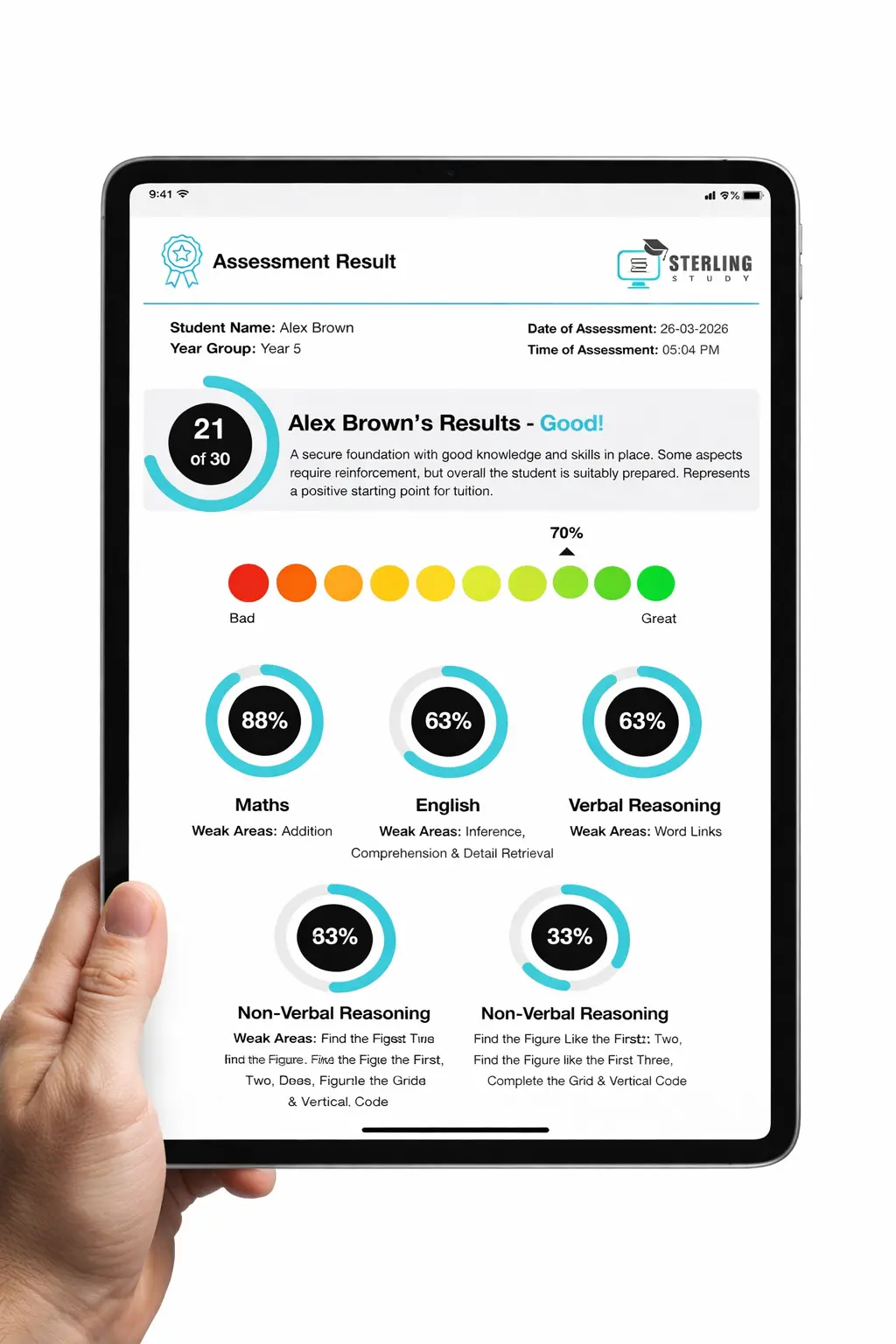
Find the gaps now.
For free.
- ✓ Topic-by-topic breakdown across English, maths, verbal and non-verbal reasoning
- ✓ Time-per-question analysis
- ✓ Where your child stands against the 11+ standard
- ✓ Detailed PDF results sent immediately
- ✓ No strings attached
Does passing the 11+ guarantee a grammar school place?
No, and this is the bit that catches the most families out. Passing means your child is in the running. Whether a school actually offers a place depends on its admissions criteria, how many children apply and how many places it has. Those are two separate decisions, made months apart.
- Your child sits the test (September).
- The result is issued (October).
- Your child meets the qualifying requirement, or doesn't.
- You submit your school preferences to your home council (by 31 October).
- Each school applies its admissions criteria to everyone who named it.
- Your local authority coordinates offers across all schools.
- You receive an offer on National Offer Day (1 March 2027).
When a school has more qualified children than places, it falls back on its oversubscription criteria. Nationally, the School Admissions Code generally puts looked-after and previously looked-after children first, though selective schools that admit purely in score order are an exception. After that it really does vary: catchment or priority area, distance, score ranking, Pupil Premium or free school meals, siblings. The only place to get the real answer is each school's current admissions policy on its website. Read it before you fill in your form, not after.
Can I apply for grammar schools outside my area?
You can, and plenty of families do. The catch is that a result from one area won't automatically qualify your child somewhere else. Some schools run their own tests, and others have rules about which results they'll accept. Check each school's policy and test requirements before you rely on a result from a different area.
What if my child is placed on a waiting list?
A waiting list isn't a queue. Under the School Admissions Code, an oversubscribed school has to keep one until at least 31 December of the year your child starts, and it's ranked by the school's admissions criteria, not by who joined first. Every time someone new is added, the list is re-ranked, so your child's position can go up as well as down. The school will have its own details on how its list works.
What happens after 11+ results day?
The 11+ result doesn't apply for a school on your behalf. You still have to name your schools on your home council's secondary application by 31 October 2026, even if they're in a different area. List them in the order you'd genuinely like them. Councils use an equal preference system, so putting a grammar school first won't hurt your chances at the schools further down. And put at least one non-selective school on there that your child would be happy at. If they miss out on everything you've named, the council will offer a place somewhere else, and you'd rather that was a school you chose.
Then it's the long wait to National Offer Day on 1 March 2027, when you find out which school has offered your child a place. If none of your grammar school choices come through, your local authority will explain how its waiting lists and appeals work.
What if my child doesn't qualify?
First, the practical bit: the 31 October deadline doesn't move. Fill in the application and name schools you'd genuinely be happy for your child to go to. After that, what you can do depends on where you live (there's more detail in each area's section above):
- ✓Bucks: request a Selection Review by 30 October.
- ✓Kent: you can name a grammar school and appeal after it is refused on 1 March.
- ✓Essex (CSSE): a total of 303 or more still allows an application, and past cut-offs aren't guarantees either way.
- ✓Redbridge: check the council's admissions guidance for the two schools.
It's also worth keeping in perspective. The 11+ is one part of how secondary places are decided. It doesn't decide how your child will get on at school.
What if my 11+ results email doesn't arrive?
| Situation | What to do |
|---|---|
| Nothing in your inbox | Check spam and junk folders first. |
| You've changed email since registering | Check the old account. Results only go to the address used at registration. |
| Essex result missing on Monday night | Wait. The CSSE asks families to allow 24 hours. |
| Kent result missing | Check inbox and spam. If you were expecting it by post, you can ask your child's primary school for the scores the day after results go out. |
| Redbridge result not yet out | Check the council's 11+ page. No exact date has been published. |
| Still nothing | Contact your council's or consortium's admissions team. |
11+ results day checklist for parents
☐ Confirm which email address you registered with
☐ Bookmark your area's official results page
☐ Shortlist schools and read their admissions policies
☐ Save the email or PDF
☐ Check whether your child qualified
☐ Note any review or appeal deadlines (30 October for a Bucks Selection Review)
☐ Rank schools in your true order of preference
☐ Include at least one non-selective school you'd be happy with
☐ Submit through your home council's portal and save the confirmation
How should younger siblings prepare for next year's 11+?
If there's a younger brother or sister coming up, now's a good time to think ahead. Take these timings as a rough guide; test dates and formats vary between areas, so check yours before you plan anything.
Year 4. Keep it low-pressure. Lots of reading, a growing vocabulary, solid comprehension and confident arithmetic. A few verbal and non-verbal reasoning puzzles here and there means they won't come as a shock later.
Early Year 5. Bring in timed practice and mixed-topic papers, and start working on exam technique. This is usually when the same mistakes start showing up again and again, and those deserve most of your time.
Summer before Year 6. Full papers under real timing, building accuracy and stamina, with revision aimed at whatever gaps are left. GL Assessment's free familiarisation papers are good for getting used to the layout.
Frequently Asked Questions
When do the 11+ results come out in 2026?+
Does passing the 11+ guarantee a grammar school place?+
What happens if my child scores exactly the qualifying mark?+
Can I use a Kent, Bucks or CSSE result for another grammar school area?+
Can I appeal an 11+ result?+
Do I still need to apply to secondary schools after passing?+
When is National Offer Day 2027?+
What should I do if my results email doesn't arrive?+
Is online 11+ tutoring safe for my child?+
Read These Next
 Parent Guide
 Results Day Guide
 Results Day Guide