GCSE Results Day 2026: What to Expect, What It Means, and What to Do Next
GCSE Results Day 2026 falls on Thursday 20 August. Here is exactly when results come out, what they mean for your next steps, and what to do if things do not go to plan - with guidance from Sterling Study's PhD-led tutors.
Not sure where your gaps are? Book a free diagnostic - our PhD Scientist-led team will find exactly what's holding you back →
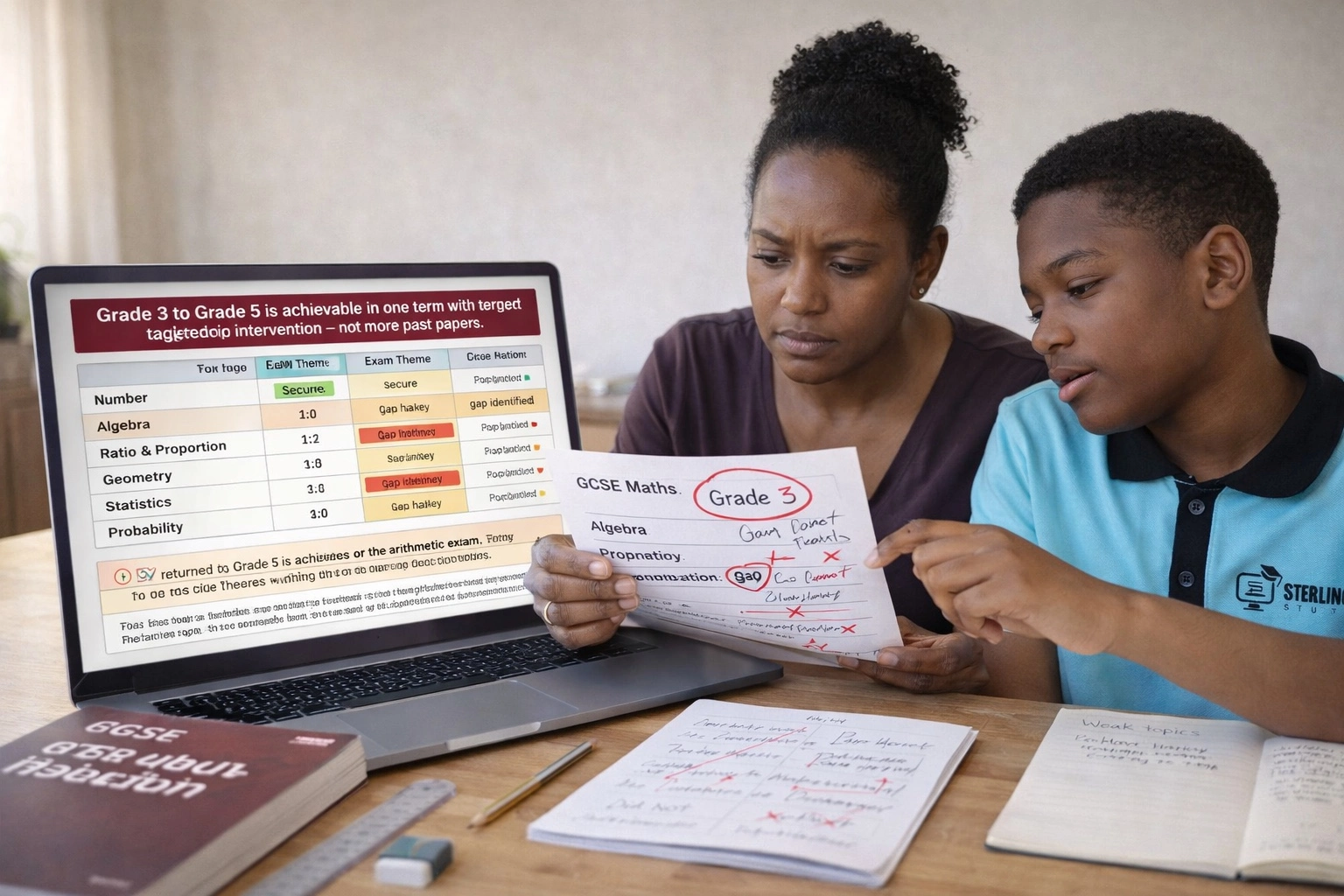
GCSE Results Day 2026 falls on Thursday 20 August, with most schools releasing results from around 8am. Your grades decide whether you have met the conditions of your sixth form, college or apprenticeship offer, and Maths and English are the two qualifications almost everyone needs at Grade 4 or above. If you are short of a grade, you have options: resits, reviews, and alternative pathways are all normal and nothing to panic about.
There is no getting around it: GCSE Results Day is one of the most anxiety-inducing mornings of a teenager's life, and most parents feel just as nervous waiting on the other side of the breakfast table. The good news is that almost everything about GCSE results 2026 is predictable. The date is set, the process is well established, and most of the questions families ask every year have straightforward answers. This guide walks through exactly what happens, why these particular grades carry so much weight, and what your next move should be whatever the envelope says. Sterling Study's PhD-led tutors, including founder Dr Parth Patel, have helped hundreds of students turn a difficult results day into a clear plan forward.
Fix them.
For free.
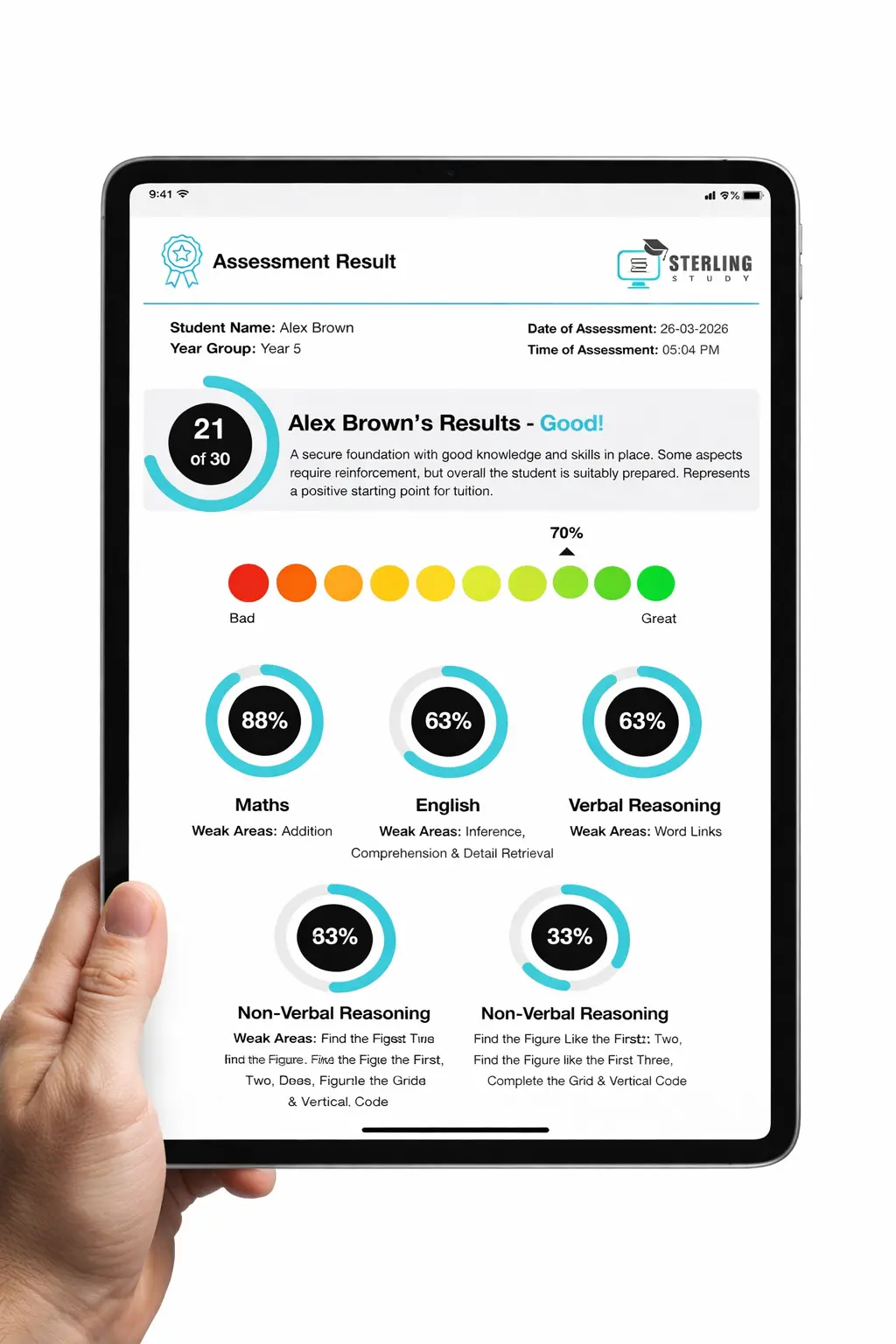
- ✓ Subject-by-subject breakdown across Maths, English and Science
- ✓ Time-per-question analysis
- ✓ Where you stand vs grade boundaries
- ✓ Detailed PDF results sent immediately
- ✓ No strings attached
1. When Is GCSE Results Day 2026 and What Time Do Results Come Out?
GCSE Results Day 2026 is confirmed for Thursday 20 August 2026 across England, Wales and Northern Ireland. Schools and exam centres receive results electronically the day before, on Wednesday 19 August, but students themselves cannot access their grades until results day itself.
Most schools open their doors from around 8am for in-person collection, though exact timings vary by school, so it is worth checking with yours in advance if you are unsure. A small but growing number of schools are also part of a pilot for the Department for Education's new Education Record app, which was trialled with around 95,000 students across the West Midlands and Greater Manchester and allowed them to view their grades digitally from 11am on results day. Whether this rolls out nationally for future years will depend on how that pilot is evaluated, so most students this year should still expect to collect their results through their school in the usual way.
Results are not emailed as standard, and there is no official route for a student to have their grades sent to a personal inbox ahead of collection. If you come across a GCSE results app beyond the Education Record pilot, treat it with caution: no other app has official standing for releasing your grades, and your school remains the only reliable source. If you cannot get to school in person, most schools will let a parent, guardian or named representative collect on your behalf with a signed authorisation letter and photo ID, or will arrange to post your results slip. It is worth confirming this directly with your school well before the summer holidays begin, since arrangements differ from one school to the next.
2. How to Check Your GCSE Results Online
Your results slip will show your grade for each subject on the 9 to 1 scale, alongside the exam board and specification code. It is a simple document, but it is the one piece of paper that determines your next two years, so it is worth knowing exactly how and where you can access it if you are not collecting in person.
The safest and most reliable way to check your results online is through your own school's official channels, whether that is a results portal, an email from your exam officer, or (for those in the pilot areas) the government's Education Record app. If your school has not mentioned a digital option, assume you will need to collect in person or arrange for someone to do so on your behalf.
Plenty of websites claim to offer GCSE result lookups, predictions or early access. None of these have any official connection to exam boards, and you should never enter personal exam details into a site that is not your school's own system. If in doubt, go directly to your school or exam centre.
If you are an international student, a private candidate, or someone who has missed the in-person window, your exam centre or the awarding body you sat exams through will be able to tell you the correct way to access your results remotely. It is worth contacting them directly rather than searching for a shortcut, since processes vary depending on how and where you sat your exams.
3. Why Your GCSE Results Matter More Than You Think
For most students, GCSE results are not just a reflection of the last two years, they are the entry ticket to the next two. Sixth forms, colleges and apprenticeship providers offer places conditionally, meaning your place is only confirmed once your actual grades match or exceed what was asked of you. If you have fallen short on a key subject, results day is when you find out, and when the conversation about alternatives begins.
Of all the grades on that slip, two matter more than the rest. GCSE Maths and GCSE English are treated as the baseline qualifications for almost everything that follows. A Grade 4 or above in both is the minimum most sixth forms, colleges, universities and employers will ask for, regardless of what you go on to study. Students who fall below this will typically be expected to resit, usually in November of the same year.
According to the Department for Education's most recent figures, 73.2% of 19-year-olds achieved Grade 4 or above in both English and Maths in 2024/25, down from 76.1% in 2023/24 and 78.0% in 2022/23. Attainment has been gradually returning towards pre-pandemic levels, which means the margin for error on these two subjects is shrinking, not growing.
That downward trend is worth sitting with for a moment. It is not a story about students working less hard, it is a sign that the temporary grading leniency of the pandemic years has fully unwound, and outcomes are now reverting to a tougher, more typical baseline. For families, the practical takeaway is simple: do not assume last year's grade boundaries or last year's pass rates will repeat exactly. Treat GCSE Maths and GCSE English as non-negotiable priorities well before results day arrives, not subjects to firefight afterwards.
It is also worth remembering that GCSEs do not stop mattering once you have a sixth form place confirmed. Russell Group universities, including Oxbridge, routinely look at GCSE performance alongside A-level grades when assessing competitive applications, and GCSE Maths and English remain a baseline requirement for many degree courses and graduate-entry careers years down the line.
4. What Strong GCSE Science Grades Unlock
If your child has ambitions in medicine, dentistry, veterinary science, engineering or any STEM degree, GCSE Science is where that path either opens up or narrows considerably. Most sixth forms ask for at least a Grade 6 in the relevant Science subjects before allowing students onto A-level Biology, Chemistry or Physics, and the more competitive and academically selective schools often push that requirement up to a Grade 7.
This is one of the quieter pressures of results day. A student who is otherwise doing well can still find their preferred A-level pathway blocked by a Science grade that landed one mark below the boundary their sixth form needed. It is rarely framed as dramatically as that on the day itself, but it is exactly what is happening behind the scenes when a place is queried or a meeting with a head of year gets booked.
- ✓ Medicine, Dentistry and Veterinary Science courses almost always require strong GCSE Science alongside A-level Chemistry and Biology.
- ✓ Engineering degrees typically expect a strong Physics and Maths foundation from GCSE level upward.
- ✓ Competitive sixth forms commonly set Grade 7+ as their entry bar for A-level sciences, even where the official minimum is lower.
- ✓ A weak Science grade rarely closes every door, but it usually means a harder conversation about which A-level combination is realistic.
This is the area Sterling Study was built around. Our PhD-led teaching team is shaped by Dr Parth Patel, who holds a BSc, MSc and PhD in Neuroscience from UCL, and Dr Igors Pupko, who holds a PhD in Genetics from the University of Surrey. Both designed Sterling Study's GCSE Science curriculum from their own research and academic backgrounds, with a deliberate focus on exam technique and the specific marks that get dropped most often in Biology, Chemistry and Physics papers. Across our students, 90% achieve Grades 6 to 9 in Maths, English and Science, which is the kind of margin that keeps A-level options open rather than narrowing them.
If Science has been a source of stress this year, it is worth treating it as a priority subject rather than an afterthought behind Maths and English. The grade boundary for A-level entry is rarely generous, and the gap between a 5 and a 6 in Science can be the difference between a student's first-choice sixth form and a backup plan.
5. What If You Don't Get the Grades You Need?
If results day does not go the way you hoped, take a breath before you do anything else. This is genuinely one of the most common experiences of the day, not a rare misfortune, and there are clear, well-trodden paths forward from almost every outcome.
The first thing to establish is whether a review of marking is worth requesting. If a grade looks unusually low compared with your other results, or you narrowly missed a boundary you were expecting to clear, speak to your subject teacher or head of year as soon as possible, ideally on results day itself. They can request that the exam board reviews how your paper was marked. It is worth knowing that a review can move your grade up, leave it unchanged, or in rare cases move it down, so this is a decision to make with your teacher's honest input rather than as an automatic next step.
If Maths or English fall below a Grade 4, resits are the standard route back. These two subjects can be retaken in November, with results released the following January, which means a student can be back on track well before the next academic year is properly underway. Other GCSE subjects are generally retaken the following summer alongside the next cohort.
One set of grades, taken on a handful of mornings in May and June, does not define what a student is capable of. Many students who resit perform considerably better the second time, simply because they already understand the format and know exactly which topics need work. If results do not go to plan, talking it through with someone you trust before deciding on next steps tends to help. There is almost always more flexibility in the system than it can feel like in the moment.
Outside of resits and reviews, it is also worth knowing that a missed grade does not automatically close every door. Some sixth forms and colleges will still accept a student onto an A-level or vocational course with a bridging arrangement, particularly where the rest of the profile is strong. Apprenticeships, BTECs and other Level 3 vocational routes also remain open to students whose GCSE results do not match their original plan, and for many, these turn out to be the better fit anyway.
Many families start looking into tutoring in the days after results day, often for the first time. Whoever you choose, it is worth asking directly about safeguarding rather than assuming it is covered. Every tutor at Sterling Study is DBS-checked, and our safeguarding policy sits under the direct oversight of a named Safeguarding Officer, Company Director Ms Yesha Mukhtiar. It is a reasonable question to ask of any provider, and a reputable one should answer it without hesitation.
6. Do GCSEs Still Matter After Sixth Form?
It is tempting to think of GCSEs as a finish line, a set of exams you sit once and then leave behind. In practice, their influence runs further than most students expect.
A-level entry requirements are built directly on GCSE performance. A sixth form's published entry grades for A-Levels are not arbitrary, they are calibrated against what a student typically needs at GCSE to cope with the jump in difficulty and pace. This is particularly true for Maths-heavy subjects: a student moving into A-level Maths or Further Maths without a strong GCSE Maths foundation tends to find the first term considerably harder than expected, and the same pattern holds for the sciences.
GCSEs also follow students further than sixth form itself. Russell Group universities, Oxbridge included, will often look at GCSE results alongside A-level grades and personal statements when assessing applications for competitive courses, particularly where A-level performance alone does not fully distinguish between strong candidates. GCSE Maths and English, specifically, remain minimum entry requirements for a wide range of degree courses and graduate careers well beyond school.
Sterling Study supports students through exactly this transition, with dedicated A-level teaching in Maths, Further Maths, Biology, Chemistry and Physics, built by the same academic team behind our GCSE programme. The aim is continuity: a student should not feel like they are starting from scratch each September, but building on a foundation that was deliberately laid the year before.