Is Your Child's KS3 Progress Good Enough for GCSE Success? Here's How to Know
Without national KS3 exams, parents often have no idea if their Year 8 child is genuinely on track. This guide explains what good KS3 progress actually looks like — and the warning signs to watch for.
Not sure if your child is genuinely on track? Book a free diagnostic — our team will find exactly where the gaps are and how to close them →
Your child is in Year 8. Their school report says 'working at expected level.' You feel roughly reassured. But 'expected level' in a school's internal system may not map onto 'on track for GCSE Grade 6' in any standardised sense — and without national KS3 exams, there is no external calibration. Here is what on-track actually means, at a level you can check.
Fix them.
For free.
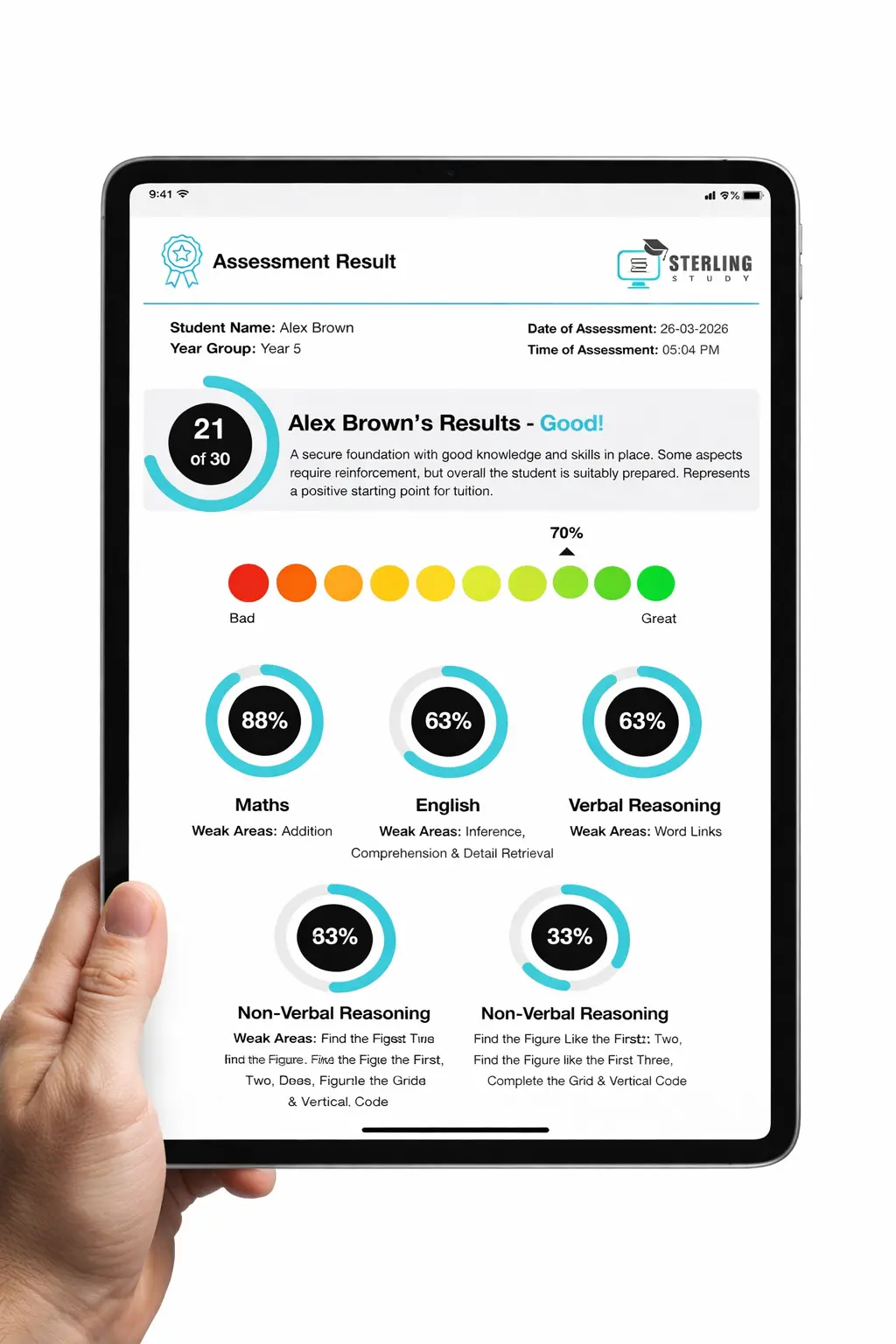
- ✓ Subject-by-subject breakdown across all Science topics
- ✓ Time-per-question analysis
- ✓ Where you stand vs grade boundaries
- ✓ Detailed PDF results sent immediately
- ✓ No strings attached
1. The Problem With 'Working at Expected Level'
Schools set their own internal KS3 benchmarks. One school's 'expected level' for Year 8 Maths may represent genuinely solid preparation for GCSE — another school's version of the same phrase may not. Because national KS3 tests were scrapped in 2009, there is no standardised external check. As a parent, you are largely relying on internal school judgements with no way of cross-referencing them.
This matters because Year 9 is when many schools begin formal GCSE content. A student who arrives in Year 9 with genuine gaps in core KS3 skills — algebraic manipulation, analytical writing, proportional reasoning — is immediately behind on GCSE material, often without realising it. KS3 gaps addressed in Year 8 are significantly easier to close than the same gaps addressed in Year 10 under exam pressure.
Rather than asking "is my child at expected level?", ask: "can my child do the specific things listed in the benchmark tables below?" One is a school's administrative label. The other is a skill check you can test yourself.
2. Year 8 Maths — What Your Child Should Be Able to Do by July
The table below outlines the skill areas a Year 8 student should be confident with by the end of the academic year to be on track for a Grade 5 or above at GCSE Maths.
| Skill area | Year 8 benchmark (on track for Grade 5+ GCSE) |
|---|---|
| Algebra | Expand and simplify expressions. Form and solve linear equations. Substitute into formulae. |
| Number | All four operations with fractions. Percentage increase/decrease. Confident with negatives. |
| Geometry | Angles in polygons. Pythagoras' theorem. Beginning trigonometry (SOHCAHTOA). |
| Ratio & proportion | Solve ratio problems in context. Apply direct proportion. Interpret proportional graphs. |
| Statistics | Calculate mean, median, mode, range. Interpret scatter graphs (correlation, outliers). |
| Algebra extension | Recognise and extend sequences. Plot and interpret linear graphs (y = mx + c). |
If your Year 8 child cannot reliably solve a linear equation (e.g. 3x + 7 = 22) in under 60 seconds, the GCSE algebraic topics that build on this are currently inaccessible to them. This is fixable in Year 8 — much harder to fix in Year 10.
3. Year 8 English — What Your Child Should Be Able to Do by July
English at GCSE is built almost entirely on skills developed during KS3 — close reading, analytical writing, and contextual understanding. The table below outlines the benchmarks for a student on track for Grade 5+ in GCSE English.
| Skill area | Year 8 benchmark (on track for Grade 5+ GCSE English) |
|---|---|
| Reading | Infer meaning from complex texts. Analyse how language creates specific effects. Compare two texts on similar themes. |
| Writing | Write structured analytical paragraphs with evidence and explanation (PEEL or equivalent). Produce persuasive non-fiction texts. |
| Grammar | Use grammatical terminology correctly: clauses, fronted adverbials, subjunctive, modal verbs. |
| Literature | Analyse character and theme in fiction. Beginning contextual awareness (historical context of set texts). |
Ask your child to write one analytical paragraph about a book or story they have read recently. A strong Year 8 response will include a quotation, explain what the word or phrase suggests, and link it to a theme or character idea — all within a single paragraph. If they cannot do this independently, it is worth addressing before Year 9.