How to Choose a Secondary School: The 2026 Parent Guide
How secondary admissions really work, how to read Ofsted's new report cards, what the results tables can and can't tell you, and how to judge which school will suit your child, ahead of the 31 October deadline.
Short on time? Compare your shortlist →
• Secondary school applications for September 2027 usually close on 31 October 2026, but some councils set a different date, so check yours.
• You apply through your home council and can name at least three schools, or more in some areas.
• List schools in the order you really want them. Schools never see your ranking, so there's nothing to gain from tactics.
• Since November 2025, Ofsted has published report cards with separate grades instead of one overall grade.
• Progress 8 isn't available for 2025 or 2026 GCSE results, so compare school league tables with care.
• The best school on paper isn't always the right one. Think about your child's needs, the journey, wellbeing and how the place feels.
A few years ago, choosing a secondary school felt almost mechanical. Find the nearest "Outstanding", glance at the league tables, fill in the form. That shortcut has gone. Ofsted has dropped its one-word grades, the government's favourite performance measure is missing for two years, and the comparison website most parents relied on is being replaced. The deadline, meanwhile, hasn't budged. So if you're wondering how to choose a secondary school this autumn, you're not imagining it: it really has got more complicated. This guide walks through how secondary school admissions work, how to read the new Ofsted report cards, what the results data can and can't tell you, and how to work out which school will genuinely suit your child.
When is the secondary school application deadline for 2027?
For children starting Year 7 in September 2027, the normal closing date across England is 31 October 2026. This year that's a Saturday, so look up your own council's admissions page for its exact closing date and time. A few areas do things differently; in Kent, for instance, applications close on Monday 2 November 2026. Offers then arrive on National Offer Day, Monday 1 March 2027.
If in doubt, your local authority's website is the final word on the process, any extra forms and the dates where you live.
How many schools can you list? Your council's form will tell you. Every local authority has to offer at least three, and some go further: many London boroughs give you six through eAdmissions, according to the Department for Education's guidance for parents. Our advice is simple. Use every slot you're given.
Two rules trip people up every year. You apply through the council where you live, even if the schools you want are in another borough. And you still have to apply if your child's primary is linked to a secondary. Nothing happens automatically.
What if you miss the deadline? You can still apply, but late applications are normally looked at only after all the on-time ones, and by then the popular schools have usually filled. Some councils will treat an application as on time if it was late for a specific, exceptional reason, so if you think you're going to miss it, ring your local authority straight away and follow what they tell you.
How do secondary school admissions actually work?
Every school has what's called an admission authority. For community schools that's the council; for academies, free schools and many faith schools it's the governors or the academy trust. Whoever it is publishes the rules for choosing between children when the school is full, known as the oversubscription criteria. And they differ from school to school, which is why two schools a mile apart can behave completely differently.
Who usually gets priority?
Under the national School Admissions Code, looked-after and previously looked-after children come first. After that, you'll usually see some mix of these:
- ✓Siblings already at the school. Watch the small print, though: some schools only count siblings who live in the catchment area.
- ✓Catchment or priority areas, drawn by the council or the school.
- ✓Distance, often as the final tie-break, measured however the policy says.
- ✓Faith, at many church and other faith schools, often with a supplementary form.
- ✓A selection test at grammar schools, usually ranked by score.
- ✓Feeder primaries, staff children or aptitude places at some schools.
Children with an Education, Health and Care (EHC) plan that names a particular school are admitted under the statutory SEND framework, separately from all of this. For children with special educational needs who don't have an EHC plan, the normal admissions rules generally apply, though individual circumstances and local policies can matter. If you're unsure what that means for your child, your local authority is the place to ask.
The order of these criteria, and how much weight each one carries, changes from school to school. Living in the catchment area doesn't always guarantee a place. Sibling priority can depend on exactly how the school defines a sibling. Grammar schools have their own selection and allocation rules on top. Past admission distances and qualifying scores are useful for judging your chances, but they don't promise anything about next year.
Honestly, there's only one reliable way to know how a school picks its pupils, and that's to read its admissions policy for September 2027, usually on the school's or council's website. It's dull. It's also the most useful twenty minutes you'll spend on the whole process.
Should you rank the "safe" school first?
No, and this is where plenty of families go wrong. Councils use an equal preference system. Each school assesses your application against its own rules, and none of them is told where you ranked it. Only at the very end, if more than one school could take your child, does your order come into play, and you're given the highest-ranked of those. So putting a school first doesn't boost your chances there, and putting it third doesn't hurt them.
Rank schools in the order you'd honestly choose them. Then make sure at least one of them is a realistic prospect, judged against its published admissions criteria and recent allocation data. Don't assume your nearest or catchment school is automatically safe, either. If none of your preferences can offer a place, the council may allocate a school you'd never have picked, and a realistic option on your list is the best protection against that.
Grammar, faith and other selective schools
Grammar schools need a qualifying score in their area's 11+, which children sit in the September of Year 6, and the rules vary enormously between areas. (We've written detailed guides to Redbridge, Kent and Buckinghamshire.) Faith schools may want evidence of religious practice on their own form, sometimes with a different deadline from the main application. Check every school on your list for an extra form. Missing one can quietly cost your child their priority.
Ofsted report cards explained: how to read the new grades
If "Outstanding", "Good", "Requires improvement" and "Inadequate" are what you grew up with, the new Ofsted reports will look a bit strange at first. Since November 2025, Ofsted no longer gives schools one overall grade. Each inspected school now gets a report card with separate, colour-coded grades for different parts of its work.
The five Ofsted grades
| Grade | What Ofsted says it means |
|---|---|
| Exceptional | Practice among the very best nationally, worth sharing with other schools |
| Strong standard | Excellent, consistent work making a real difference for pupils |
| Expected standard | The school is doing everything it should; Ofsted calls this a high standard |
| Needs attention | Work to do to reach the expected standard; Ofsted says it isn't a fail |
| Urgent improvement | Used in the most serious cases, where urgent action is needed |
Source: Ofsted's guide, Understanding Ofsted report cards and grades.
The areas Ofsted looks at include curriculum and teaching, achievement, attendance and behaviour, inclusion, personal development and wellbeing, and leadership and governance. Early years and sixth-form provision are graded too, where a school has them. Safeguarding sits on its own, as either "met" or "not met".
Don't stop at the colours. The written findings explain the school's strengths, what it needs to work on and how different groups of pupils experience it, and that's where the real picture is. Look across every area rather than fixing on one grade.
Three things to watch out for
Old and new grades don't line up. Ofsted is clear on this. A school that used to be "Good" and now shows "expected standard" hasn't necessarily slipped; it's simply a different system.
Plenty of schools still have old reports. A report card only appears after a school's next inspection, so for a while you'll be comparing old one-word Ofsted ratings with new report cards. Check the date on every report. A five-year-old "Outstanding" might describe a school with a different head and a different feel.
The words matter more than the colours. The sections describing what it's like to be a pupil there often tell you far more than the grades. You can look up any school on Ofsted's reports site, and Parent View shows what current parents think.
How much should Ofsted count?
It's useful, but it isn't a league table. An inspection captures what inspectors saw over a couple of days, and the school may have changed since. A grade can't tell you about your child's day-to-day experience, how they'll personally progress, or how much support they'll get when things go wrong.
So use Ofsted to spot strengths, weaknesses and anything that worries you, particularly on safeguarding. Then weigh it against the school's results, pastoral care, behaviour, curriculum and, above all, how well it fits your child. The report cards give more detail than the old grades ever did. They still only tell part of the story.
School league tables: Progress 8, Attainment 8 and GCSE results
The Department for Education still publishes GCSE results for every secondary school. The headline measures are Attainment 8 (average grades across eight subjects), the percentage of pupils getting grade 5 or above in English and maths, EBacc entry and results, and where pupils go after Year 11.
None of them tells the whole story on its own. Attainment 8 gives you average GCSE outcomes, the grade 5 figure in the two core subjects is a handy comparison point, and EBacc entry hints at how academic and broad the curriculum is. But results always need context. A selective school and a comprehensive can have completely different intakes, and raw results can't show how well a school looks after every pupil. Read them alongside the curriculum, pastoral care, admissions policy and Ofsted findings.
Why there's no Progress 8 this year
Progress 8 compares pupils' GCSE results with those of pupils nationally who had similar results at the end of primary school. Put simply, it tries to measure what the school added, rather than who it started with. The trouble is that its starting point is KS2 SATs, and there were none in 2020 or 2021 because of the pandemic.
The Department for Education has confirmed that Progress 8 won't be published for the 2024/25 and 2025/26 results, and plans to bring it back for 2026/27. It's worth checking the official guidance for any change.
You can still see GCSE performance data for these years. Attainment 8 and the English and maths grade 5+ figures show you outcomes, but not how far pupils travelled from where they started. When you're comparing schools with very different intakes, look at their admissions policies and pupil make-up too, and try not to treat raw GCSE results as proof of good or bad teaching.
Where to find the data
The DfE says its long-running Compare school and college performance website will close soon, with a new service due from autumn 2026. Until then, school-level GCSE data is on Explore education statistics, most schools publish their headline results on their own websites, and councils often summarise local results in their secondary admissions booklets.
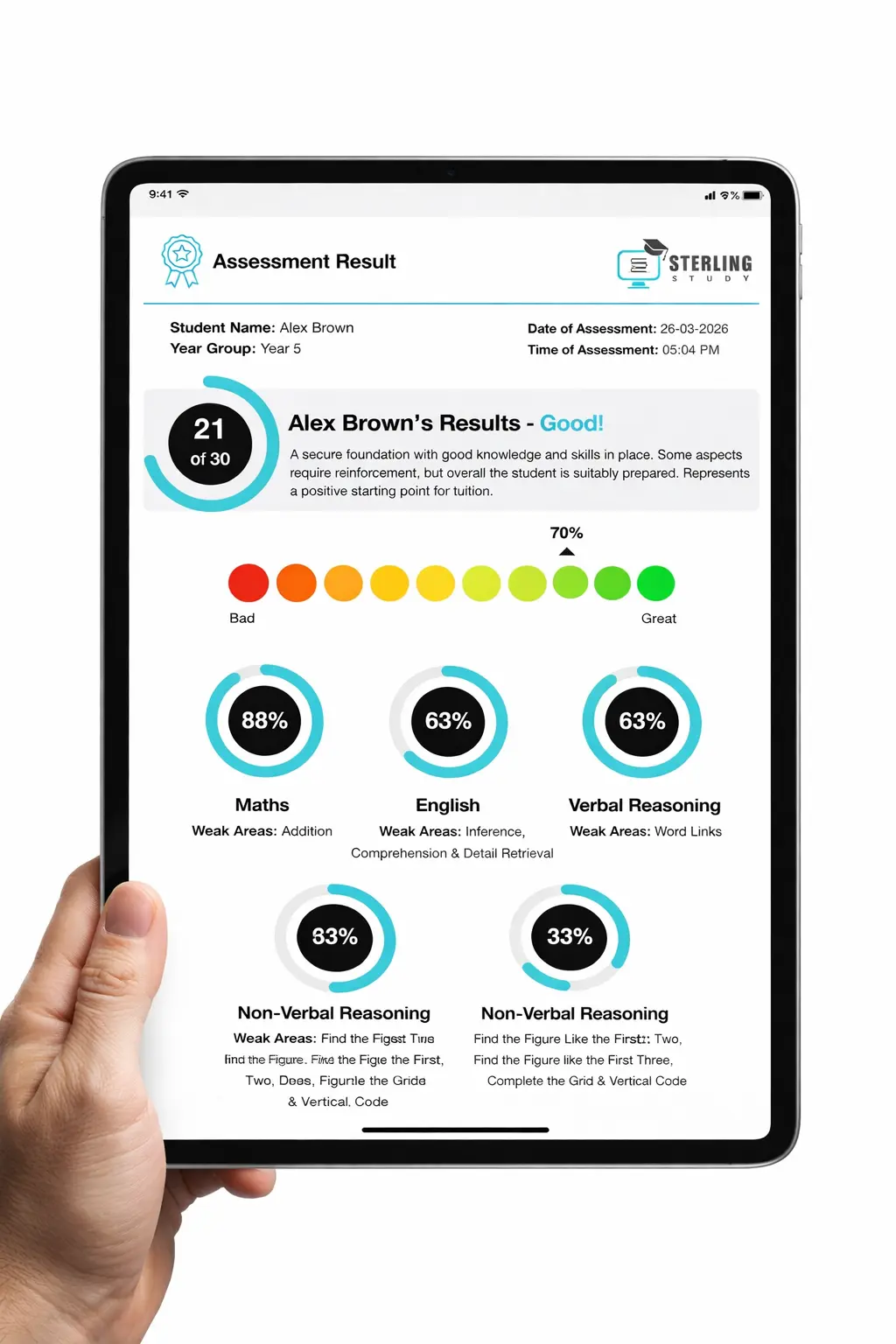
Find the gaps now.
For free.
- ✓ Topic-by-topic breakdown across English, maths, verbal and non-verbal reasoning
- ✓ Time-per-question analysis
- ✓ Where your child stands against the 11+ standard
- ✓ Detailed PDF results sent immediately
- ✓ No strings attached
How to choose the right secondary school for your child
If there's one part of how to choose a secondary school that no table can do for you, it's this. Two children from the same family can thrive in completely different schools. Day to day, these are the things that tend to matter most:
- ✓The journey. Do it at 8am on a school day. An hour each way is ten hours a week.
- ✓Behaviour and atmosphere. Watch the corridors and a real lesson, not just the showcase hall.
- ✓Pastoral care and SEND support. Who does your child go to when something goes wrong?
- ✓Size and set-up. Some children love a big, busy school; others do better somewhere smaller.
- ✓Curriculum and options. Which subjects are on offer at GCSE, and how much choice is there?
- ✓Sixth form. Is there one, and do most pupils stay on?
- ✓Life beyond lessons. Clubs, sport, music and trips, and whether they're open to everyone.
- ✓Friends. It shouldn't decide everything, but it matters more to an eleven-year-old than most adults admit.
Secondary school open days: questions worth asking
Open evenings are polished on purpose, so bring questions that get underneath the presentation. How are classes set, and from when? What happens when a child falls behind, or races ahead? How does the school deal with bullying, and how quickly do parents hear about problems? How much homework comes home in Year 7? What do pupils actually do at lunchtime? And if you can, ask to visit on an ordinary school day too. A normal Tuesday morning tells you more than any open evening.
Score up to three schools from 1 (poor) to 5 (excellent) on at least six factors, and say how much each factor matters to your family. Nothing is saved.
| Factor | How much it matters | |||
|---|---|---|---|---|
| The journey | ||||
| Behaviour and atmosphere | ||||
| Pastoral care and SEND support | ||||
| GCSE results (with the intake in mind) | ||||
| Latest Ofsted report | ||||
| Curriculum and GCSE options | ||||
| Clubs, sport and activities | ||||
| Chance of getting a place |
A way to organise your own impressions, not a ranking of schools. Admissions criteria still decide whether a place is likely.
How to put your secondary school preferences in order
Once you've visited and read the policies, sort your shortlist into three rough piles: the school you'd love, the schools you'd be genuinely happy with, and at least one where a place is close to certain, usually your catchment or nearest school. Then rank them purely by what you want. Equal preference means there's nothing to be gained by putting the "safe" one first, and doing it can actually cost your child a school they'd have preferred.
The two most common mistakes: filling the form with heavily oversubscribed schools, and leaving off the local school because it feels like "a given". It isn't. If it's not on the form, your child won't be considered for it in the main round.
National Offer Day, waiting lists and appeals
Monday 1 March 2027 brings one offer per child. If it's not the school you most wanted, accept it anyway. The DfE's guidance confirms you can still join waiting lists and appeal after accepting another place, and it means your child is never left without a school.
School waiting lists are ranked by each school's admissions criteria, not by how long you've been on them, so your child can move up or down as other children join or drop off. If you appeal, an independent panel hears the case, but success rates vary a lot and the deadlines are strict.
Whatever you decide, follow the instructions in your offer letter and accept by the deadline so the place is protected. Check the waiting-list and appeal procedures with your local authority or the school itself, because they're not the same everywhere.
Secondary school checklist
Tick things off as you go. Nothing's saved, so refreshing or leaving the page will clear it.
Getting ready for Year 7
Picking the school is only half the job. The move from Year 6 to Year 7 goes far more smoothly when the basics are secure, and reading, writing and maths are the foundations everything else at secondary school is built on.
If you'd like some help with that, Sterling Study offers KS2 SATs support for children preparing for their Year 6 tests, and KS3 tuition to help them settle into the faster pace of secondary school.